Repetitive head injuries in German American football players do not change blood-based biomarker candidates for CTE during a single season
Theres Bastgen, Janis Evers, Christiane Oedekoven, Caroline Weide, Lars Herzog, Nicholas Ashton, Henrik Zetterberg, Kaj Blennow, Alexandra Albus, Natasha Vidovic, Oliver Kraff, Cornelius Deuschl, Richard Dodel, J. Alexander Ross

TL;DR
This study finds that blood-based biomarkers for chronic traumatic encephalopathy (CTE) do not change significantly in American football players during a single season.
Contribution
The study provides new evidence that CTE biomarker changes may occur slowly over multiple seasons or be detectable only in cerebrospinal fluid.
Findings
Blood levels of CTE biomarkers like pTau, tTau, and GFAP did not change significantly in American football players during a single season.
Players showed generally elevated pTau levels compared to controls.
Correlations were found between biomarker levels and factors like depression, training participation, and concussion history.
Abstract
Repetitive traumatic brain injuries in American football players (AFPs) can lead to the neurodegenerative disease chronic traumatic encephalopathy (CTE). Clinical symptoms of CTE range from mood and behavioral changes to cognitive impairment, depression, and suicidality. So far, CTE cannot be diagnosed in vivo and thus specific diagnostic parameters for CTE need to be found, to observe and treat exposed athletes as early as possible. Promising blood-based biomarkers for CTE include total tau (tTau), hyperphosphorylated tau (pTau), neurofilament light protein (NF-L), glial fibrillary acidic protein (GFAP), amyloid-β40 (Aβ40), amyloid-β42 (Aβ42) and calcium-binding protein B (S100-B). Previous studies have found elevated levels of these biomarkers in subjects exposed to TBIs, whereas cerebrospinal fluid (CSF) levels of Aβ40 and Aβ42 were decreased in CTE subjects. Here, we investigated…
Genes, proteins, chemicals, diseases, species, mutations and cell lines named across the full text — each resolved to its canonical identifier and authoritative record.
Click any figure to enlarge with its caption.
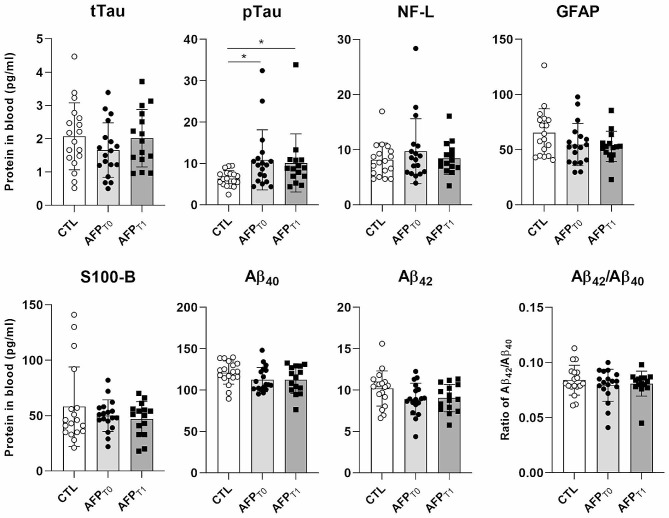 Figure 1
Peer Reviews
No public reviews on file for this paper yet. If you reviewed it on a platform where reviews are public (OpenReview, ICLR, NeurIPS, ICML), you can paste yours below so the community can read it here.
Videos
No videos yet. Explain this paper in a talk, walkthrough, or lecture? Add one.
Taxonomy
TopicsTraumatic Brain Injury Research · Traumatic Brain Injury and Neurovascular Disturbances · Cardiac Arrest and Resuscitation