Both coiling and clipping induce the time-dependent release of endogenous neuropeptide Y into serum
Elisabeth Bründl, Martin Proescholdt, Petra Schödel, Katharina Rosengarth, Eva-Maria Störr, Sylvia Bele, Martin Kieninger, Manuela Malsy, Nils Ole Schmidt, Karl-Michael Schebesch

TL;DR
This study shows that manipulating cerebral arteries during surgery causes a time-dependent release of Neuropeptide Y into the blood, which could affect patient outcomes.
Contribution
The study is the first to show how neurosurgical and endovascular procedures influence serum Neuropeptide Y levels over time.
Findings
Serum Neuropeptide Y levels were significantly higher in vascular procedures compared to non-vascular ones.
Endovascular procedures caused higher Neuropeptide Y levels than microsurgical clipping at specific time points.
Neuropeptide Y levels peaked at the 6-week follow-up after endovascular procedures.
Abstract
The vaso- and psychoactive endogenous Neuropeptide Y (NPY) has repeatedly been shown to be excessively released after subarachnoid hemorrhage and in numerous psychiatric disorders. NPY is stored in sympathetic perivascular nerve fibers around the major cerebral arteries. This prospective study was designed to analyze the impact of microsurgical and endovascular manipulation of the cerebral vasculature versus cranio- and durotomy alone on the serum levels of NPY. 58 patients (drop-out n = 3; m:f = 26:29; mean age 52.0 ± 14.1 years) were prospectively enrolled. The vascular group underwent repair for unruptured intracranial aneurysms (UIA) of the anterior circulation [endovascular aneurysm occlusion (EV) n = 13; microsurgical clipping (MS) n = 17]; in the non-vascular group, 14 patients received microsurgical resection of a small-sized convexity meningioma (CM), and 11 patients with…
Genes, proteins, chemicals, diseases, species, mutations and cell lines named across the full text — each resolved to its canonical identifier and authoritative record.
Click any figure to enlarge with its caption.
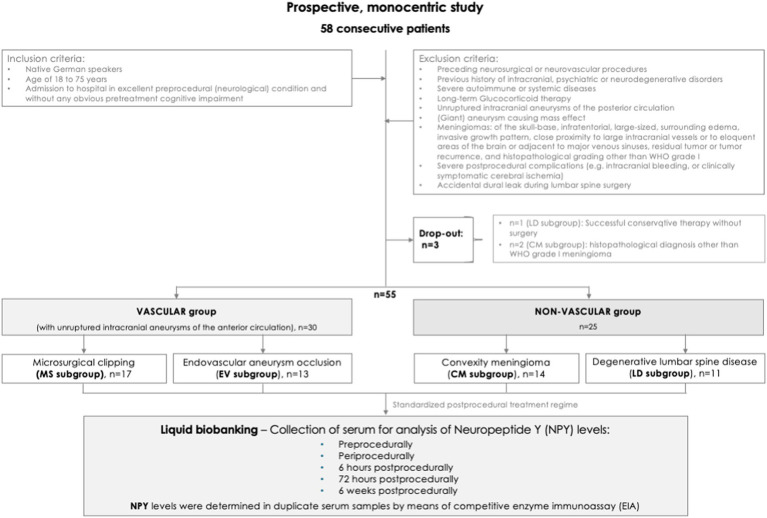 Figure 1
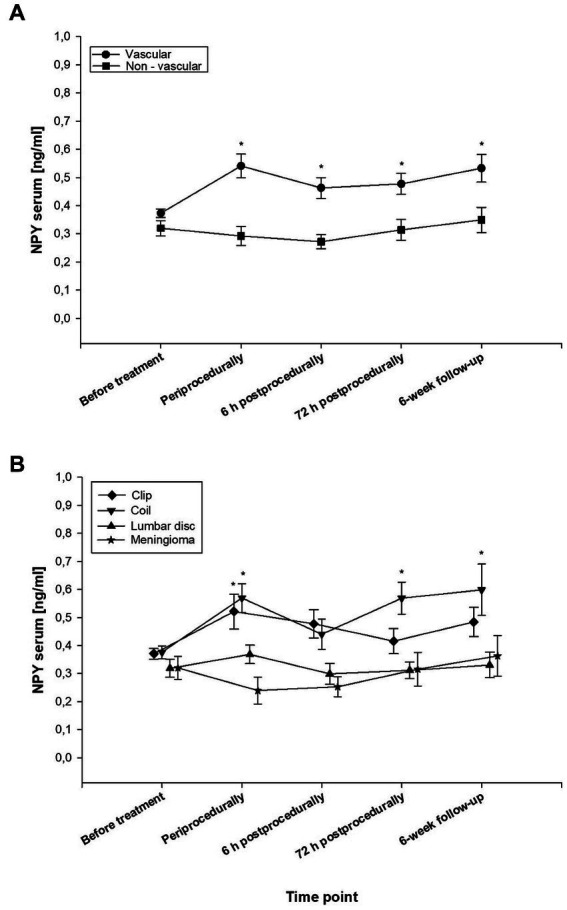 Figure 2
Peer Reviews
No public reviews on file for this paper yet. If you reviewed it on a platform where reviews are public (OpenReview, ICLR, NeurIPS, ICML), you can paste yours below so the community can read it here.
Videos
No videos yet. Explain this paper in a talk, walkthrough, or lecture? Add one.
Taxonomy
TopicsIntracranial Aneurysms: Treatment and Complications · Neuropeptides and Animal Physiology · Neurosurgical Procedures and Complications