High Prevalence of Echinostoma mekongi Infection in Schoolchildren and Adults, Kandal Province, Cambodia
Bong-Kwang Jung, Taehee Chang, Seungwan Ryoo, Sooji Hong, Jeonggyu Lee, Sung-Jong Hong, Woon-Mok Sohn, Virak Khieu, Rekol Huy, Jong-Yil Chai

TL;DR
A study in Cambodia found that many schoolchildren and adults are infected with Echinostoma mekongi, likely from eating snails.
Contribution
The study confirms snail consumption as the source of Echinostoma mekongi infection using both morphological and molecular methods.
Findings
Echinostoma mekongi infection was found in 13.9% of participants in Kandal Province.
Consumption of Pila sp. snails was identified as the source of infection.
Molecular analysis confirmed the infection source using cox1 and nd1 genes.
Abstract
A high prevalence of Echinostoma mekongi infection (13.9%; 260/1,876) was found among schoolchildren and adults in Kandal Province, Cambodia, by fecal examination, worm expulsion, and molecular analysis of cox1 and nd1 genes. The source of infection was consumption of Pila sp. snails, a finding confirmed morphologically and molecularly.
Genes, proteins, chemicals, diseases, species, mutations and cell lines named across the full text — each resolved to its canonical identifier and authoritative record.
Click any figure to enlarge with its caption.
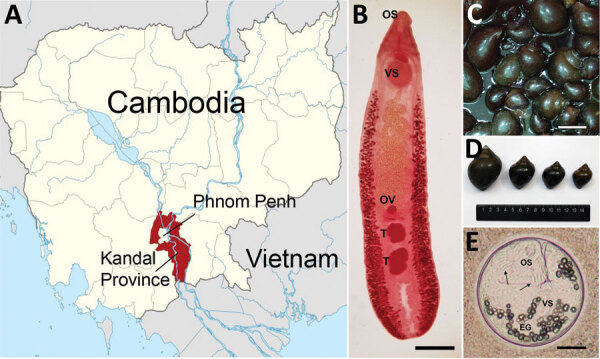 Figure 1
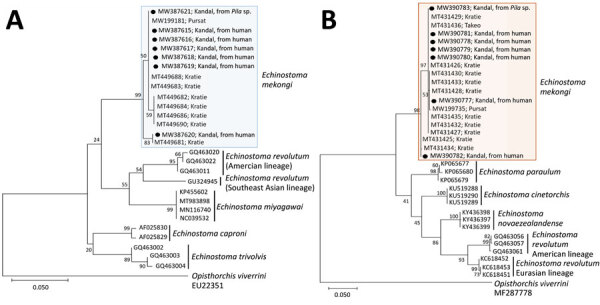 Figure 2
Peer Reviews
No public reviews on file for this paper yet. If you reviewed it on a platform where reviews are public (OpenReview, ICLR, NeurIPS, ICML), you can paste yours below so the community can read it here.
Videos
No videos yet. Explain this paper in a talk, walkthrough, or lecture? Add one.
Taxonomy
TopicsParasite Biology and Host Interactions · Parasites and Host Interactions · Parasitic Infections and Diagnostics