Embodied metacognition as strengthened functional connection between neural correlates of metacognition and dance in dancers: exploring creativity implications
Ching-Ju Yang, Hsin-Yen Yu, Tzu-Yi Hong, Li-Kai Cheng, Wei-Chi Li, Tzu-Chen Yeh, Li-Fen Chen, Jen-Chuen Hsieh

TL;DR
Dancers show stronger brain connections between metacognition and dance regions, which may enhance their creativity through embodied learning.
Contribution
This study identifies functional brain connectivity patterns linking metacognition and dance, and their implications for general creativity in dancers.
Findings
Dancers showed heightened functional connectivity between neural correlates of metacognition and dance compared to non-dancers.
Enhanced connectivity in dancers correlated with higher originality and flexibility in creativity measures.
Weaker connectivity in dancers was associated with better integration of creative cognitive processes.
Abstract
Dance education fosters embodied metacognition, enhancing student’s creativity. This study examines the crucial role of functional connectivity (FC) between the neural correlates of metacognition (NCM) and dance (NCD) as the neurological foundation for dancers’ embodied metacognition. The investigation also explores whether these consolidated FCs inform the general creativity in dancers. The research involved 29 dancers and 28 non-dancer controls. The study examined resting-state connections of the NCM through seed-based FC analysis. Correlation analyses were employed to investigate the connections between the targeted NCM-NCD FCs, initiated from the a priori NCM seed, and general creativity. Dancers demonstrated heightened FC between NCM and NCD compared to non-dancer controls. The targeted regions included the putamen, globus pallidus, posterior cerebellum, and anterior insula of…
Genes, proteins, chemicals, diseases, species, mutations and cell lines named across the full text — each resolved to its canonical identifier and authoritative record.
Click any figure to enlarge with its caption.
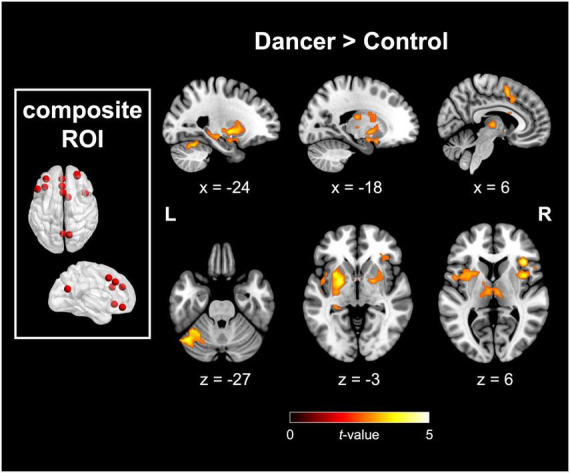 Figure 1
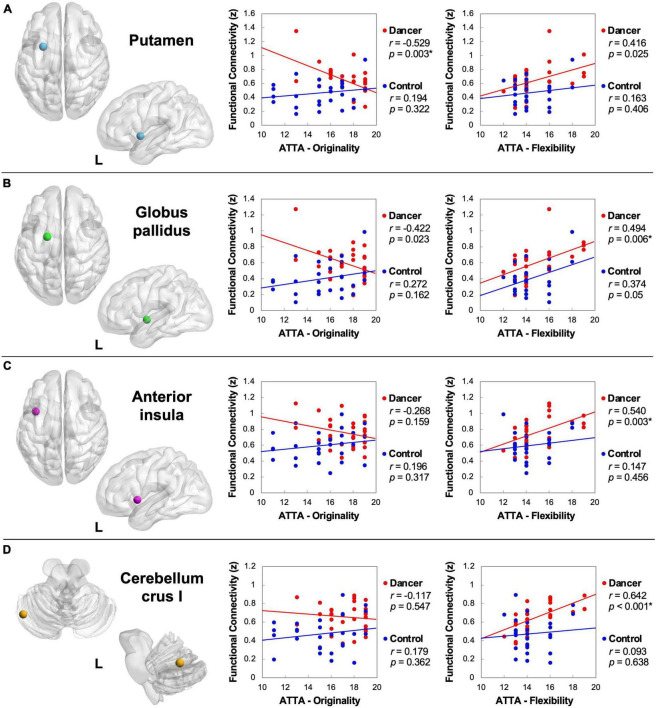 Figure 2
Peer Reviews
No public reviews on file for this paper yet. If you reviewed it on a platform where reviews are public (OpenReview, ICLR, NeurIPS, ICML), you can paste yours below so the community can read it here.
Videos
No videos yet. Explain this paper in a talk, walkthrough, or lecture? Add one.
Taxonomy
TopicsAction Observation and Synchronization · Diversity and Impact of Dance · Creativity in Education and Neuroscience