Correction: Endophenotype trait domains for advancing gene discovery in autism spectrum disorder
Matthew W. Mosconi, Cassandra J. Stevens, Kathryn E. Unruh, Robin Shafer, Jed T. Elison

Abstract
Genes, proteins, chemicals, diseases, species, mutations and cell lines named across the full text — each resolved to its canonical identifier and authoritative record.
Click any figure to enlarge with its caption.
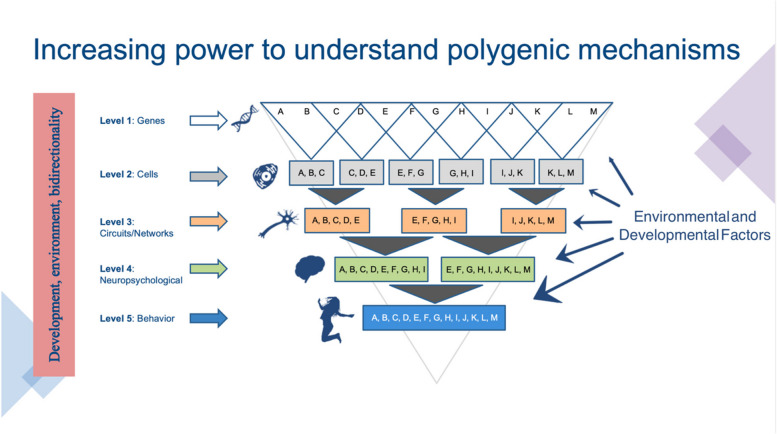 Figure 1
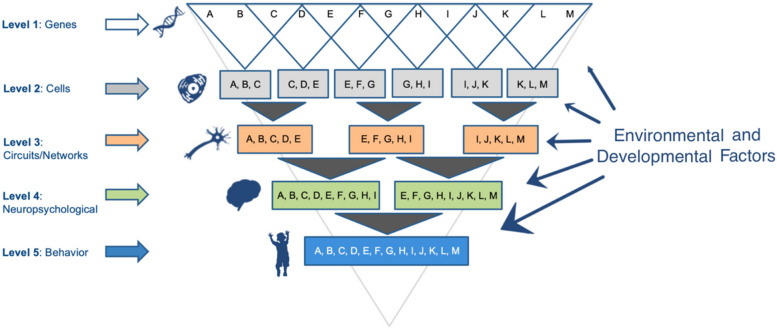 Figure 2
Peer Reviews
No public reviews on file for this paper yet. If you reviewed it on a platform where reviews are public (OpenReview, ICLR, NeurIPS, ICML), you can paste yours below so the community can read it here.
Videos
No videos yet. Explain this paper in a talk, walkthrough, or lecture? Add one.
Taxonomy
TopicsAutism Spectrum Disorder Research · Genetics and Neurodevelopmental Disorders · Child Development and Digital Technology
Correction: J Neurodevelop Disord 15, 41 (2023)
10.1186/s11689-023-09511-y
Following publication of the original article [1], the author reported that the wrong version of Fig. 1 which contains a PowerPoint background was uploaded.
Incorrect figure:
Fig. 1. Levels of analysis for mapping etiological pathways associated with behavioral and clinical traits. This schematic shows different layers or functional units of analysis that can be evaluated to clarify linkages between genotype and clinical phenotype. Endophenotypic traits closer to the level of genotype are expected to be more closely associated with inherited variation given their relatively simpler genetic architecture compared to behavioral traits, as evidenced above by the reduced complexity (i.e., number of genes or letters) at the higher levels (e.g., cells, circuits/networks). Multiple levels of analysis are depicted, though separate intermediate levels are not included for ease of presentation (e.g., proteomic). Based on this model, analysis of traits closer to genotypes will provide greater sensitivity to inherited variations than assessments of behavior or complex clusters of clinical symptoms. Analysis of traits across multiple levels, or establishment of endophenotypic trait domains (ETDs), also is proposed to offer unique opportunities for understanding etiological pathways contributing to discrete traits associated with ASD. Important environmental and developmental factors also are proposed to modify trait associations across levels and over time
Correct figure:
Fig. 1. Levels of analysis for mapping etiological pathways associated with behavioral and clinical traits. This schematic shows different layers or functional units of analysis that can be evaluated to clarify linkages between genotype and clinical phenotype. Endophenotypic traits closer to the level of genotype are expected to be more closely associated with inherited variation given their relatively simpler genetic architecture compared to behavioral traits, as evidenced above by the reduced complexity (i.e., number of genes or letters) at the higher levels (e.g., cells, circuits/networks). Multiple levels of analysis are depicted, though separate intermediate levels are not included for ease of presentation (e.g., proteomic). Based on this model, analysis of traits closer to genotypes will provide greater sensitivity to inherited variations than assessments of behavior or complex clusters of clinical symptoms. Analysis of traits across multiple levels, or establishment of endophenotypic trait domains (ETDs), also is proposed to offer unique opportunities for understanding etiological pathways contributing to discrete traits associated with ASD. Important environmental and developmental factors also are proposed to modify trait associations across levels and over time
The original article has been corrected.
The reference list from the paper itself. Each links out to its DOI / PubMed record.