Author Correction: C151 in KEAP1 is the main cysteine sensor for the cyanoenone class of NRF2 activators, irrespective of molecular size or shape
Sharadha Dayalan Naidu, Aki Muramatsu, Ryota Saito, Soichiro Asami, Tadashi Honda, Tomonori Hosoya, Ken Itoh, Masayuki Yamamoto, Takafumi Suzuki, Albena T. Dinkova-Kostova

Abstract
Genes, proteins, chemicals, diseases, species, mutations and cell lines named across the full text — each resolved to its canonical identifier and authoritative record.
Click any figure to enlarge with its caption.
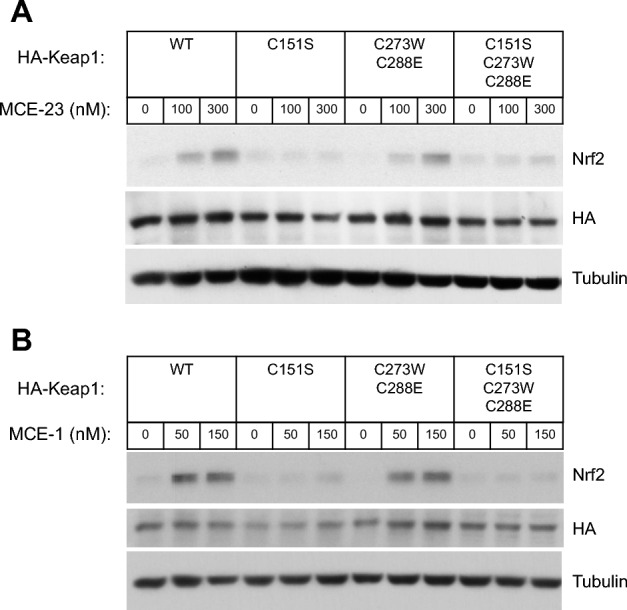 Figure 3
Peer Reviews
No public reviews on file for this paper yet. If you reviewed it on a platform where reviews are public (OpenReview, ICLR, NeurIPS, ICML), you can paste yours below so the community can read it here.
Videos
No videos yet. Explain this paper in a talk, walkthrough, or lecture? Add one.
Taxonomy
TopicsGenomics, phytochemicals, and oxidative stress · Ferrocene Chemistry and Applications · Estrogen and related hormone effects
Correction to: Scientific Reports 10.1038/s41598-018-26269-9, published online 23 May 2018
This Article contains an error in Figure 3.
As a result of an error during the preparation of the figures for this Article, the western blots shown in Figure 3A and 3B contained an additional lane for the protein Tubulin. This is because an additional sample was loaded in the last lane of the gel to prevent potential stretching of the gel in this lane during electrophoresis if left empty. It was subsequently left uncropped from the tubulin blot shown in the published figure.
The corrected Figure 3 and its accompanying legend appear below.Figure 3C151 in KEAP1 is the primary sensor for MCE-23 and MCE-1 in MEF cells. Western blot analyses of total cell lysates of KEAP1-knockout MEF cells rescued with either wild-type (WT), single cysteine mutant C151S, double cysteine mutant C273W/C288E or triple cysteine mutant C151S/C273W/C288E of mouse N-terminally tagged HA-KEAP1. Cells (3 × 10^5^ per well), growing in 6-well plates, were exposed to vehicle (0.1% DMSO) (A,B), MCE-23 (A) or MCE-1 (B) for 3 h, after which the cells were lysed. Immunoblotting was performed on cell lysates using antibodies raised against NRF2, HA and α-tubulin.