Publisher Correction: The complete plastome sequences of invasive weed Parthenium hysterophorus: genome organization, evolutionary significance, structural features, and comparative analysis
Lubna, Sajjad Asaf, Rahmatullah Jan, Saleem Asif, Saqib Bilal, Abdul Latif Khan, Ahmed N. Al-Rawahi, Kyung-Min Kim, Ahmed AL-Harrasi

Abstract
Genes, proteins, chemicals, diseases, species, mutations and cell lines named across the full text — each resolved to its canonical identifier and authoritative record.
Click any figure to enlarge with its caption.
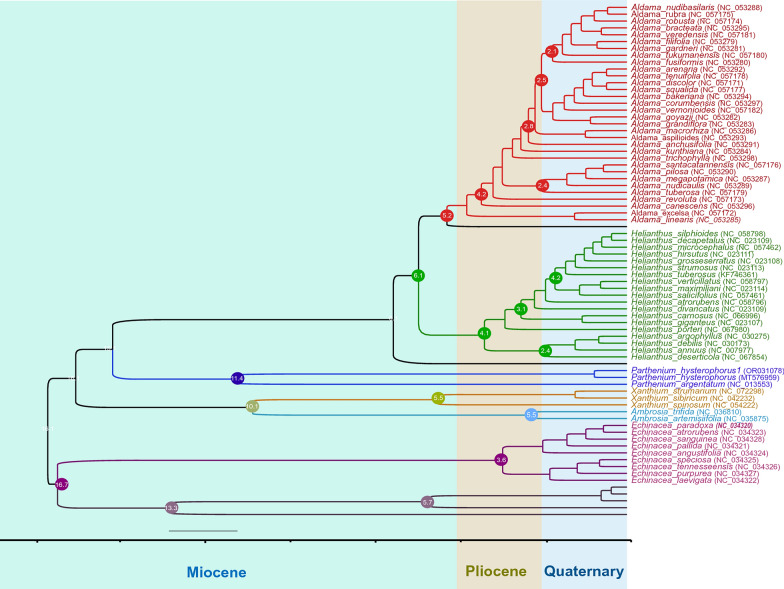 Figure 10
Peer Reviews
No public reviews on file for this paper yet. If you reviewed it on a platform where reviews are public (OpenReview, ICLR, NeurIPS, ICML), you can paste yours below so the community can read it here.
Videos
No videos yet. Explain this paper in a talk, walkthrough, or lecture? Add one.
Taxonomy
TopicsChemical synthesis and alkaloids · Plant and Biological Electrophysiology Studies · Allelopathy and phytotoxic interactions
Correction to: Scientific Reports 10.1038/s41598-024-54503-0, published online 18 February 2024
The original version of this Article contained an error in Figure 10, where the names in the lower part of the Phylogenetic tree did not display correctly.
The original Figure 10 and accompanying legend appear below.Figure 10. Divergence time estimates of P. hysterophorus based on 72 commonly shared genes among 75 members of the Heliantheae tribe, representing 11 different genera. The GTR + G substitution model was used with four rate categories and a Yule tree speciation model was applied with a lognormal relaxed clock model in BEAST. The 95% highest posterior density credibility intervals are shown for the node ages in circles (mya). Numbers indicate date estimates for different nodes. A geological time scale is shown at the bottom of the Fig.
The original Article has been corrected.