Competency Framework for Podiatric Medicine Training: A Validation Report Based on an Adapted E-Delphi Across Canada
Yassin Andoulsi, Olivier Hue, Martine Brousseau, James Hill, Joel Alleyne, Virginie Blanchette

TL;DR
This study validates a competency framework for podiatric medicine training in Canada using expert consensus.
Contribution
The study introduces a validated competency framework for podiatric education using an adapted e-Delphi method involving Canadian experts.
Findings
A consensus threshold of 80% agreement was achieved for the competency framework after two rounds of expert feedback.
95% of experts agreed the framework was relevant, though some indicators need provincial adaptation.
The validated framework supports standardized and high-quality podiatric education in Canada.
Abstract
Competency-based medical education has been introduced into many health professional curricula. Based on CanMEDs, a framework has recently been developed for podiatric medicine education in Canada. This study aimed to validate the framework through a consensus of various podiatric medicine experts across Canada. An adapted Delphi method was used for content validation. Two structured online questionnaires were used to gather expert opinions and agreement on the roles and core competencies described in the framework previously developed. The validation consensus threshold was set at a minimum of 80% agreement. The summary of comments and suggestions was used to reformulate certain items after the research team reached a consensus. Out of the 51 experts invited from the Canadian Podiatric Medicine Association, 19 completed the first-round questionnaire (mean podiatric experience = 24.5…
Genes, proteins, chemicals, diseases, species, mutations and cell lines named across the full text — each resolved to its canonical identifier and authoritative record.
Click any figure to enlarge with its caption.
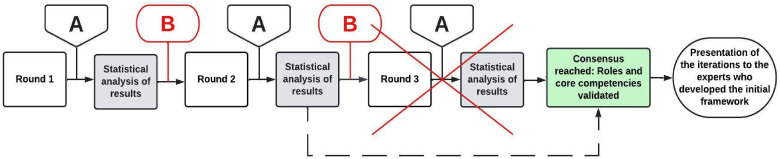 Figure 1
Peer Reviews
No public reviews on file for this paper yet. If you reviewed it on a platform where reviews are public (OpenReview, ICLR, NeurIPS, ICML), you can paste yours below so the community can read it here.
Videos
No videos yet. Explain this paper in a talk, walkthrough, or lecture? Add one.
Taxonomy
TopicsDelphi Technique in Research · Innovations in Medical Education · Healthcare Systems and Technology
Background
Competency-based medical education was developed several years ago.^ 1 ^ Its relevance has been demonstrated in many studies.^2?–4^ It is postulated that it increases the quality and safety of healthcare by developing an educational system centered on the learner, which would contribute to the development of a healthcare system centered on the patient.^ 1 ^ This model can also enhance the clinical performance of health care providers.^ 5 ^
This approach was recently explored for podiatric medicine education using a modified Delphi method at our university.^ 6 ^ This resulted in the development of competency-based podiatric medicine education using the CanMEDS, a competency framework based on the work initiated by The Royal College of Physicians and Surgeons of Canada,^ 7 ^ which included seven roles (ie, podiatric expert, collaborator, communicator, health advocate, leader and manager, professional and scholar), 24 core competencies and 288 observable-related indicators.^ 6 ^
Content validation by external experts is an important step before implementation following knowledge product developed by a Delphi technique,^ 8 ^ particularly for the dissemination of our work across Canada or worldwide to improve the quality of podiatric medical education.^ 6 ^ Various methods (eg, Delphi technique and nominal group technique) for the validation of frameworks in medical education research exist, but these are poorly standardized.^ 9 ^ Therefore, our objective was to seek out consensus among podiatric medicine stakeholders across Canada in order to obtain controlled feedback to validate and enhance our framework.
Methods
Design, reporting guidelines, ethical considerations
Our competency framework development has been described elsewhere.^ 6 ^ This content validation was based on an adapted online Delphi technique (e-Delphi)^ 10 ^ as this eliminated the constraints of geographic location, and facilitated the organization and analysis of the data collected.^9,11,12^ This study is reported using CREDES (Conducting and REporting DElphi Studies) criteria,^ 8 ^ which promotes consistency and design reproducibility. Participation was voluntary, ethics approval was waived by the Institutional Review Board (Comité éthique de recherche avec les êtres humains of Université du Québec à Trois-Rivières) and the project respected the Tri-Council Policy Statement of Canada (in accordance with the Declaration of Helsinki).^ 13 ^ Electronic informed consent was obtained from the experts at the beginning of the questionnaire and the entire process was anonymous.
Participants and recruitment
As it has been shown in previous studies that large panels generate low response rates and that more than 30 participants rarely improve results, the convenience sample size was estimated at between 12 and 24 experts; this was also to reduce the influence of rater aberration in the content validation task.^14,15^ Inclusion criteria were: 1) ability to read, understand and write in English; 2) obtained a diploma or degree related to podiatry/chiropody in Canada; 3) practice exclusively in Canada. The Canadian Podiatric Medical Association (CPMA) (JA) supported the experts’ identification, and the recruitment within their network by targeted podiatrists involved in continued education and profession development in Canada. For this validation study, an expert in podiatric medicine was someone who met our inclusion criteria. Potential participants were solicited by email from October to December 2022, with a detailed description of the study, the published framework, and the online questionnaire.
Data collection and e-Delphi rounds
The team (VB, JH, OH) constructed a questionnaire using Qualtrics software (Qualtrics software, Provo, UT), knowledge user's input (JH, YA) and methodology expert (MB). This is not a validated questionnaire (Supplementary Appendix A). The questionnaire consisted of three sections: 1) participants’ characteristics; 2) level of agreement regarding the roles and core competencies using a 7-point Likert scale (1 [strongly disagree] to 7 [strongly agree]); and 3) general comments about the indicators or suggestions including the feasibility of implementation.^ 14 ^ Three rounds were expected for the e-Delphi process (Figure 1), detailed in Appendix B. The agreement threshold was set at 80% by the team as there is no standard.^ 14 ^ For each round, two reminders were sent to the participants to obtain the highest possible response rate and a two-week deadline was given to complete the questionnaire.
Summary of the adapted e-Delphi process. A: Two-week deadline for completion of the round; B: Team consensus related to relevancy, comprehensiveness, and clarity. Iteration of items; X: As consensus was reached at the end of Round 2, Round 3 was not necessary.
Data analysis
Data analysis was performed using Qualtrics software (Qualtrics, Provo, UT) with descriptive statistics. A narrative synthesis was produced for the written content, which was evaluated by two researchers (VB, OH) and discussed with the entire team as necessary to move along the process.
Results
The characteristics of the experts involved in this validation study are presented in Table 1. Most of the panel of experts were men practicing in the central region (ie, Québec or Ontario) who had a doctorate in podiatric medicine, which is the same degree as those who developed the initial framework. However, the majority had a surgical residency, which was not the case in the development phase.^ 6 ^ The mean experience in podiatric medicine of the panel was approximately 25 years.
Table 1.: Participants’ characteristics.
The response rate was 37% (19/51 invited participants) for the first round and 68% (13/19) for the second round (Table 1). As consensus was reached at the end of Round 2, the third round was unnecessary. As a result of this content validation (Table 2), the description of “Podiatric Expert” was slightly modified, along with a competency for this role. No changes were made to the “Collaborator”, “Health Advocate”, “Leader and Manager”, and “Professional” roles. Two competencies have been modified for the “Communicator” role, and a new indicator has been added to a competency under the “Scholar” role. The experts agreed (95%) that this framework could be relevant to continuing medical education even if some indicators may need adaptation across the provinces and territories.
Table 2.: Adapted e-Delphi results.
Discussion
This short report adds to the growing literature about education related to podiatric medicine.^6,16?–18^ This validation has contributed to modifying the initial competency framework, taking into account expertise across Canada.^ 6 ^ This framework was presented to the experts who developed the initial framework, and this version will be implemented. The iterations supported medical reasoning to the “Podiatric Expert” and the “Scholar”, care trajectory to the “Podiatric Expert” and ethical consideration to the “Communicator” roles which are all in alignment with care quality and the Quintuple Aims.^ 19 ^
The expert panel was balanced geographically. However, as there were few podiatrists in the northern regions, we were unable to represent these areas. The experts solicited had more experience (25 years vs 18 years) and were more surgically trained (47% vs 37%) than at our institution.^ 6 ^ This is consistent with the fact that podiatrists outside Québec are often trained in English-speaking countries, mostly in the United States requiring residency, and Québec does not offer a residency program.^ 20 ^ Some provinces, particularly in the Western regions, require a surgical residency to practice or to perform certain procedures.^ 21 ^ There is also a gender disparity in the expert panel (16% women vs 37% men), but this is aligned with what it is observed in this profession in North America.^ 22 ^
This validation may support a common vision and language regarding the education of podiatrists in Canada, notwithstanding the differences in legislation and professional titles across Canada.^ 21 ^ This may encourage change and professional development to promote excellence and quality especially when no program accreditation is available.^23,24^ The experts agreed that this framework may support continuing education programs. This is seen in other professions.^25,26^ The CanMEDS framework can support potential learning needs associated with specific competencies and/or indicators. Perceived learning needs and challenges encountered in practice can provide insight into the selection and design of continuing education activities and empower the learner.^ 25 ^
Limitations to this study must be emphasized, as the type of sampling and the population does not necessarily represent all Canadian podiatrists, notably due to the wide variety of degrees and the fact that the experts were chosen by a specific network (CPMA). Our questionnaire was not validated. The first questionnaire was long (Supplementary Appendix A), which may have led to fatigue and less accurate responses. However, the results add value to our previous work, and the validated version represents a broader perspective to enhance the quality of our program and hopefully, the quality of podiatric care. This study may also serve as preliminary work for another similar study, but on an international scale.
Conclusion
This validation process led to the enhancement of a framework that now takes into account the expertise of many professionals across Canada focused on foot care. This framework promotes the excellence and quality of our podiatry training program and, ultimately, foot care and prevention. By implementing it locally in Canada and, hopefully, internationally, it could foster a common vision and language for consistent training among podiatrists.
Supplemental Material
sj-docx-1-mde-10.1177_23821205241234974 - Supplemental material for Competency Framework for Podiatric Medicine Training: A Validation Report Based on an Adapted E-Delphi Across CanadaSupplemental material, sj-docx-1-mde-10.1177_23821205241234974 for Competency Framework for Podiatric Medicine Training: A Validation Report Based on an Adapted E-Delphi Across Canada by Yassin Andoulsi, Olivier Hue, Martine Brousseau, James Hill, Joel Alleyne and Virginie Blanchette in Journal of Medical Education and Curricular Development
sj-docx-2-mde-10.1177_23821205241234974 - Supplemental material for Competency Framework for Podiatric Medicine Training: A Validation Report Based on an Adapted E-Delphi Across CanadaSupplemental material, sj-docx-2-mde-10.1177_23821205241234974 for Competency Framework for Podiatric Medicine Training: A Validation Report Based on an Adapted E-Delphi Across Canada by Yassin Andoulsi, Olivier Hue, Martine Brousseau, James Hill, Joel Alleyne and Virginie Blanchette in Journal of Medical Education and Curricular Development
The reference list from the paper itself. Each links out to its DOI / PubMed record.
- 1Powell DE Carraccio C . Toward competency-based medical education. N Engl J Med. 2018;378(1):3-5. doi:10.1056/nejmp 171290029298154 · doi ↗ · pubmed ↗
- 2Hawkins RE Welcher CM Holmboe ES , et al. Implementation of competency-based medical education: are we addressing the concerns and challenges? Med Educ. 2015;49(11):1086-1102. doi:10.1111/medu.1283126494062 · doi ↗ · pubmed ↗
- 3Frank JR Snell LS Cate OT , et al. Competency-based medical education: theory to practice. Med Teach. 2010;32(8):638-645. doi:10.3109/0142159 x.2010.50119020662574 · doi ↗ · pubmed ↗
- 4Brydges R Boyd VA Tavares W , et al. Assumptions about competency-based medical education and the state of the underlying evidence: a critical narrative review. Acad Med. 2021;96(2):296-306. doi:10.1097/acm.000000000000378133031117 · doi ↗ · pubmed ↗
- 5Imanipour M Ebadi A Monadi Ziarat H Mohammadi MM . The effect of competency-based education on clinical performance of health care providers: a systematic review and meta-analysis. Int J Nurs Pract. 2022;28(1):e 13003.10.1111/ijn.1300334374171 · doi ↗ · pubmed ↗
- 6Blanchette V Andoulsi Y Brousseau M Leblanc C Guillemette F Hue O . Competency framework for podiatric medicine training in Canada: an adapted Delphi study. Adv Med Educ Pract. 2022;13:1207-1241. doi:10.2147/amep.S 37232436212705 PMC 9533777 · doi ↗ · pubmed ↗
- 7Frank JR Danoff D . The Can MEDS initiative: implementing an outcomes-based framework of physician competencies. Med Teach. 2007;29(7):642-647.18236250 10.1080/01421590701746983 · doi ↗ · pubmed ↗
- 8Jünger S Payne SA Brine J Radbruch L Brearley SG . Guidance on conducting and R Eporting D Elphi studies (CREDES) in palliative care: recommendations based on a methodological systematic review. Palliat Med. 2017;31(8):684-706. doi:10.1177/026921631769068528190381 · doi ↗ · pubmed ↗