Utility of routine post-admission testing for SARS-CoV-2 in a rehabilitation facility
Victoria R. Williams, Larry Robinson, Morty Eisenberg, Kuldeep Virdi, Robert Kozak, Jerome A. Leis

TL;DR
Routine weekly testing for SARS-CoV-2 in a rehab facility provided little benefit beyond existing testing methods and did not reduce healthcare-associated COVID-19 risk.
Contribution
This study evaluates the effectiveness of routine post-admission testing for SARS-CoV-2 in a rehabilitation setting.
Findings
Routine weekly post-admission testing offered marginal gain beyond syndromic and targeted unit testing.
Routine testing was not associated with a reduced risk of healthcare-associated COVID-19.
Abstract
Asymptomatic screening for SARS-CoV-2 is recommended in healthcare settings during periods of increased incidence, yet studies in rehabilitation settings are lacking. Routine weekly post-admission asymptomatic testing in a rehabilitation facility offered marginal gain beyond syndromic and targeted unit testing and was not associated with a reduced risk of healthcare-associated COVID-19.
Genes, proteins, chemicals, diseases, species, mutations and cell lines named across the full text — each resolved to its canonical identifier and authoritative record.
Click any figure to enlarge with its caption.
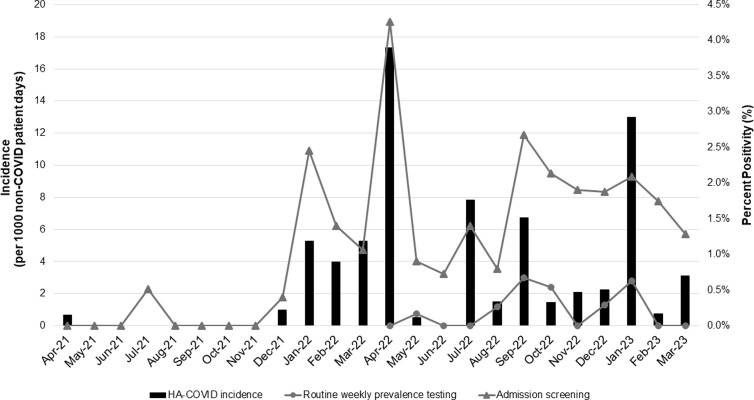 Figure 1
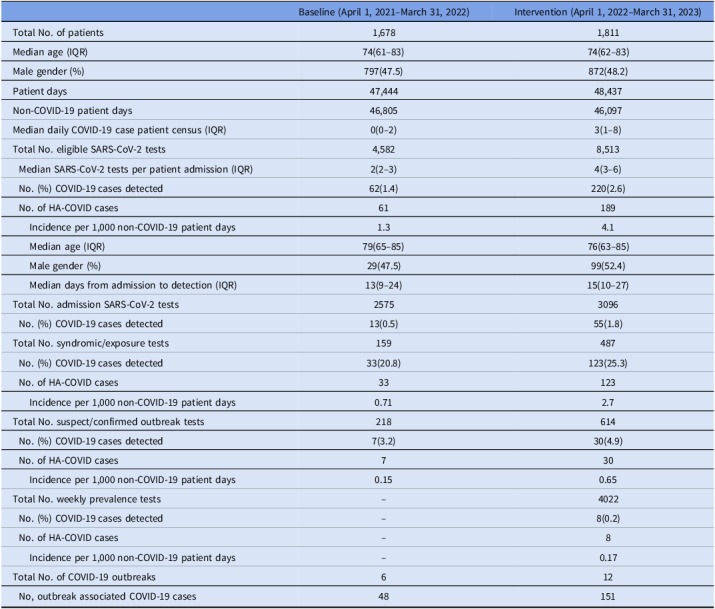 Figure 2
Peer Reviews
No public reviews on file for this paper yet. If you reviewed it on a platform where reviews are public (OpenReview, ICLR, NeurIPS, ICML), you can paste yours below so the community can read it here.
Videos
No videos yet. Explain this paper in a talk, walkthrough, or lecture? Add one.
Taxonomy
TopicsSARS-CoV-2 detection and testing · Long-Term Effects of COVID-19 · COVID-19 Clinical Research Studies