Effects of Neural Adaptation to Habitual Spherical Aberration on Depth of Focus
Seung Pil Bang, Ramkumar Sabesan, Geunyoung Yoon

TL;DR
This study shows that people's depth of focus is influenced by their long-term exposure to spherical aberration, suggesting that optical corrections should consider individual visual habits.
Contribution
The study reveals a quadratic relationship between habitual spherical aberration and subjective depth of focus when induced with different aberrations.
Findings
Positive habitual SA groups had larger depth of focus with positive induced SA.
Negative habitual SA groups had smaller depth of focus with positive induced SA.
Depth of focus was maximized when induced SA matched the participant's habitual SA.
Abstract
We investigated how long-term visual experience with habitual spherical aberration (SA) influences subjective depth of focus (DoF). Nine healthy cycloplegic eyes with habitual SAs of different signs and magnitudes were enrolled. An adaptive optics (AO) visual simulator was used to measure through-focus high-contrast visual acuity after correcting all monochromatic aberrations and imposing +0.5 μm and −0.5 μm SAs for a 6-mm pupil. The positive (n=6) and negative (n=3) SA groups ranged from 0.17 to 0.8 μm and from −1.2 to −0.12 μm for a 6-mm pupil, respectively. For the positive habitual SA group, the median DoF with positive AO-induced SA (2.18D) was larger than that with negative AO-induced SA (1.91D); for the negative habitual SA group, a smaller DoF was measured with positive AO-induced SA (1.81D) than that with negative AO-induced SA (2.09D). The difference in the DoF of individual…
Genes, proteins, chemicals, diseases, species, mutations and cell lines named across the full text — each resolved to its canonical identifier and authoritative record.
Click any figure to enlarge with its caption.
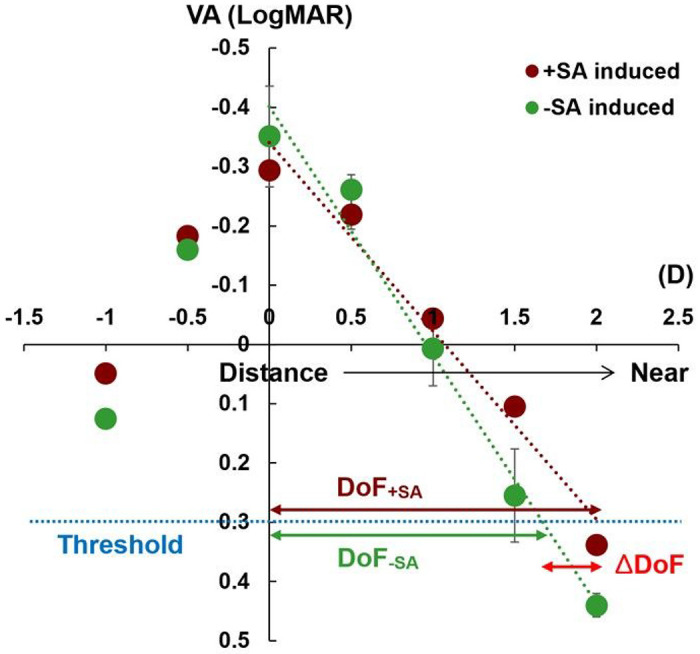 Figure 1
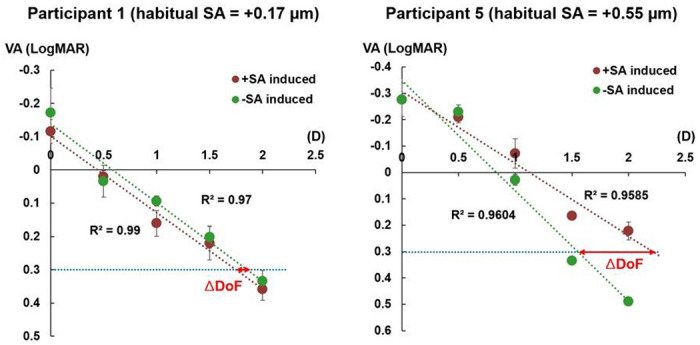 Figure 2
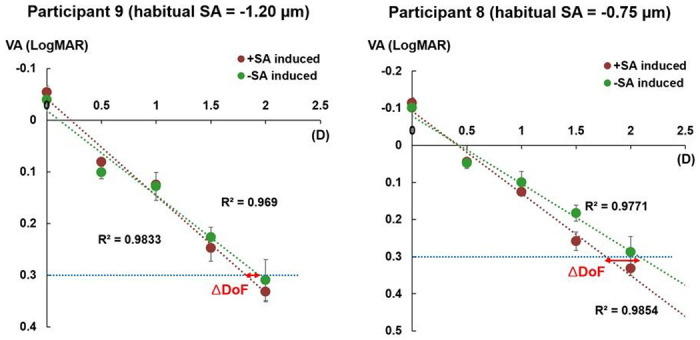 Figure 3
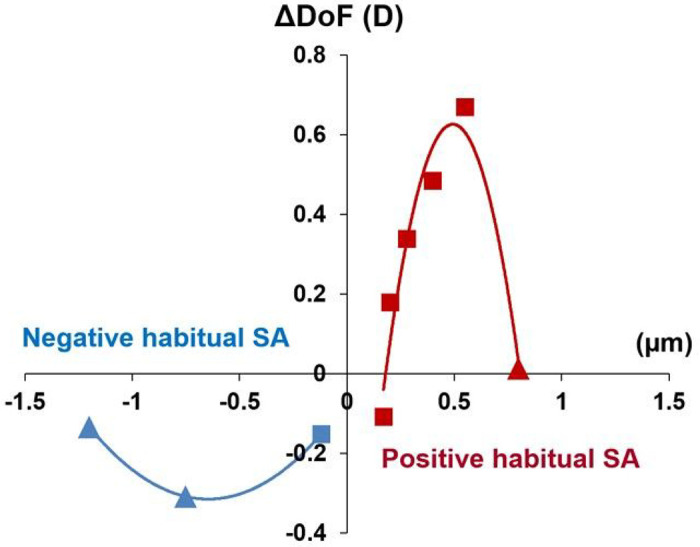 Figure 4
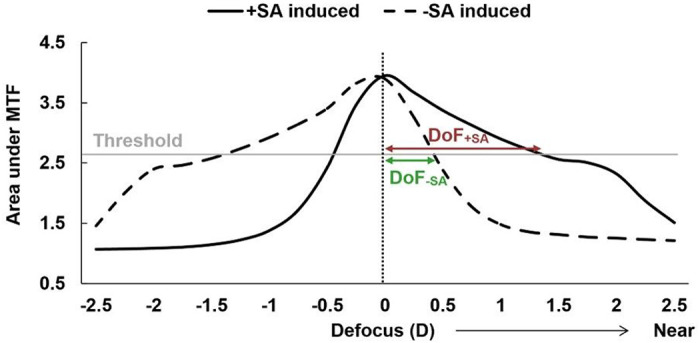 Figure 5
Peer Reviews
No public reviews on file for this paper yet. If you reviewed it on a platform where reviews are public (OpenReview, ICLR, NeurIPS, ICML), you can paste yours below so the community can read it here.
Videos
No videos yet. Explain this paper in a talk, walkthrough, or lecture? Add one.
Taxonomy
TopicsOphthalmology and Visual Impairment Studies · Visual perception and processing mechanisms · Retinal Diseases and Treatments