Serum levels of glucose, thyroid stimulating hormone, and free thyroxine in boys diagnosed with attention deficit hyperactivity disorder: a cross-sectional pilot study
Tanja Lukovac, Olivera Aleksić Hil, Milka Popović, Tatjana Savić, Aleksandra M. Pavlović, Dragan Pavlović

TL;DR
This study found that boys with ADHD have different levels of glucose, thyroid hormones, and TSH compared to healthy boys, suggesting a possible link between ADHD symptoms and hormonal patterns.
Contribution
The study is novel in exploring the association between ADHD in boys and specific serum biochemical markers like glucose, TSH, and FT4.
Findings
ADHD participants had lower glucose and FT4 levels and higher TSH levels compared to controls.
TSH levels were significantly correlated with hyperactivity and impulsivity symptoms in ADHD boys.
Elevated FT4 levels were associated with a lower likelihood of ADHD diagnosis.
Abstract
Although attention deficit hyperactivity disorder (ADHD) is a common neurodevelopmental disorder, its aetiology remains unclear. We aimed to establish a relationship between ADHD diagnosis and serum levels of glucose, free thyroxine (FT4), and thyroid stimulating hormone (TSH) in primary school aged boys. In a cross-sectional study, we enrolled 133 participants aged 6.5–12.5 years, 67 of whom met DSM-5 criteria for ADHD and 66 healthy age-matched boys. The ADHDT test (ADHDT) was used to assess ADHD symptoms and the Wechsler Intelligence Scale for Children – Revised was used to exclude participants with cognitive deficits. The ADHD participants were tested using the Iowa Conners’ Teacher Rating Scale. The ADHD participants had lower glucose levels, higher TSH values, and significantly lower FT4 values than the control group. The multiple logistic regression analysis showed that TSH is…
Genes, proteins, chemicals, diseases, species, mutations and cell lines named across the full text — each resolved to its canonical identifier and authoritative record.
Click any figure to enlarge with its caption.
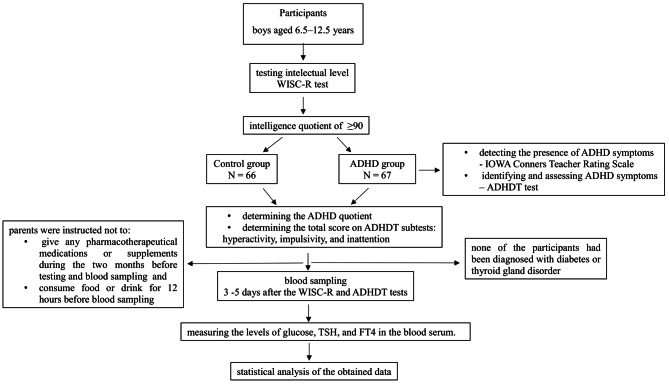 Figure 1
Peer Reviews
No public reviews on file for this paper yet. If you reviewed it on a platform where reviews are public (OpenReview, ICLR, NeurIPS, ICML), you can paste yours below so the community can read it here.
Videos
No videos yet. Explain this paper in a talk, walkthrough, or lecture? Add one.
Taxonomy
TopicsEducation and Character Development · Qur’anic Interpretation Studies · Islamic Studies and Radicalism