Construction of a Prognostic Prediction Model of Patients with Pathologic N0 in Resected Invasive Mucinous Adenocarcinoma of the Lung
Zheng WANG, Jinxian HE, Haibo SHEN, Xiaohan CHEN, Chengbin LIN, Hongyan YU, Jiajun GAO, Xianneng HE, Weiyu SHEN

TL;DR
This paper develops a predictive model to assess the prognosis of lung invasive mucinous adenocarcinoma patients with no lymph node involvement after surgery.
Contribution
The novel contribution is the construction and validation of a prognostic nomogram for lymph node-negative IMA patients.
Findings
Imaging type, tumor size, and mucin content are independent prognostic factors for survival in IMA patients.
The nomogram achieved good predictive performance with C-indexes of 0.815 for PFS and 0.767 for OS.
Pneumonic and mixed-type IMA patients had significantly worse 5-year survival rates than isolated or pure mucinous types.
Abstract
背景与目的 肺浸润性黏液腺癌(invasive mucinous adenocarcinoma of the lung, IMA)是肺腺癌中一种少见且特殊的类型,该类肿瘤的特点往往是少有淋巴结转移,因此对于该类肿瘤的预后评估依靠现有的肿瘤原发灶-淋巴结-转移(tumor-node-metastasis, TNM)分期存在困难。本研究的目的是构建列线图来预测术后淋巴结阴性的IMA患者的预后。 方法 根据纳入标准和排除标准,回顾性分析2012年7月至2017年5月宁波大学附属李惠利医院(训练队列,n=78)和宁波市第二医院(验证队列,n=66)胸外科收治的术后病理为淋巴结阴性的IMA患者的资料,分析训练队列的临床病理特征的预后价值并建立预后预测模型,并对模型性能进行评价,最后将验证队列的数据代入进行外部验证。 结果 单因素分析显示肺炎型、较大的肿块、包含黏液和非黏液成分的混合型、较高的总分期是5年无进展生存期(progression-free survival, PFS)及总生存期(overall survival, OS)的影响因素。多因素分析进一步表明,影像学分型、肿块大小、黏液成分是5年PFS及OS的独立预后因素。5年PFS率和OS率分别为62.82%和75.64%,亚组的生存分析显示,肺炎型和包含黏液和非黏液成分的混合型IMA患者的5年PFS及OS分别明显低于孤立型和纯黏液型IMA患者。5年PFS和OS的Harrell’s C指数分别为0.815(95%CI: 0.741-0.889)和0.767(95%CI: 0.669-0.865),这两个模型的校准曲线及决策曲线分析(decision curve analysis, DCA)在两个队列中显示出良好的预测性能。 结论 本次基于临床病理特征构建的列线图在一定程度上可以作为IMA切除术后淋巴结阴性患者的一种有效预后预测工具。 Univariate analysis of clinicopathologic features of 78 patients with IMA A: 5-year PFS; B:…
Genes, proteins, chemicals, diseases, species, mutations and cell lines named across the full text — each resolved to its canonical identifier and authoritative record.
Click any figure to enlarge with its caption.
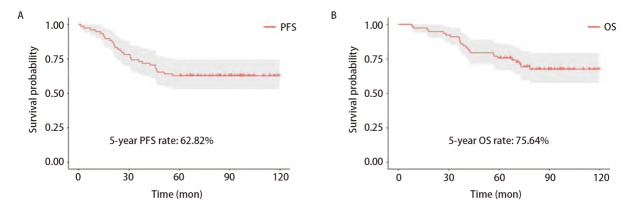 Figure 1
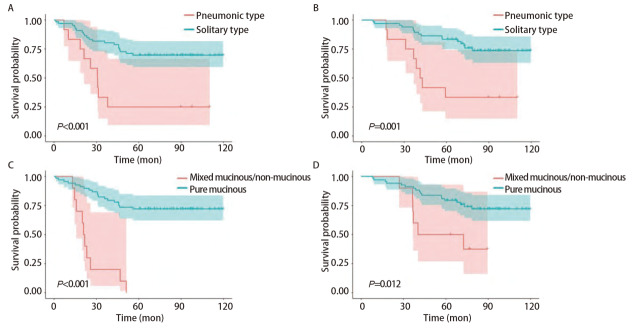 Figure 2
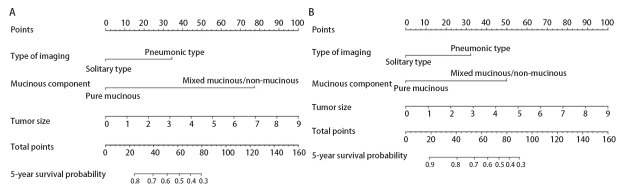 Figure 3
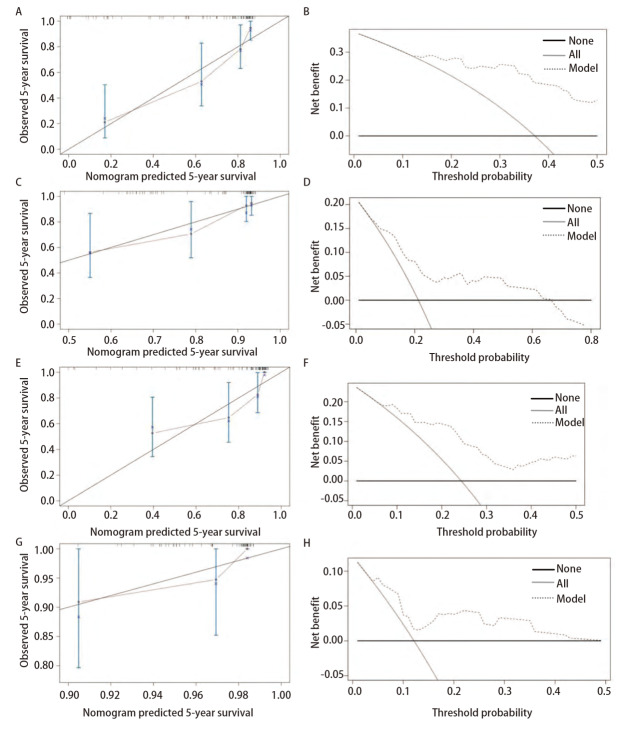 Figure 4
Peer Reviews
No public reviews on file for this paper yet. If you reviewed it on a platform where reviews are public (OpenReview, ICLR, NeurIPS, ICML), you can paste yours below so the community can read it here.
Videos
No videos yet. Explain this paper in a talk, walkthrough, or lecture? Add one.
Taxonomy
TopicsLung Cancer Diagnosis and Treatment · Radiomics and Machine Learning in Medical Imaging · Lung Cancer Treatments and Mutations