Determination of sweetener specificity of horse gut-expressed sweet taste receptor T1R2-T1R3 and its significance for energy provision and hydration
Liberty Smith, Andrew W. Moran, Miran Al-Rammahi, Kristian Daly, Soraya P. Shirazi-Beechey

TL;DR
This study identifies which sweeteners activate the sweet taste receptor in horses, which could help improve their glucose absorption and hydration.
Contribution
The paper reveals the sweetener specificity of the horse sweet taste receptor T1R2-T1R3 for the first time.
Findings
Sucralose, stevia, and neohesperidin dihydrochalcone activate the horse T1R2-T1R3 receptor.
Cyclamate does not activate the horse T1R2-T1R3 receptor.
Understanding this specificity can help design dietary additives to enhance glucose absorption and hydration in horses.
Abstract
Studies carried out in several species have demonstrated that detection of low-calorie sweeteners in the lumen of the intestine, by the sweet receptor, T1R2-T1R3, initiates a signaling pathway leading to enhanced expression and activity of intestinal Na+/glucose cotransporter 1, SGLT1. This results in an increased gut capacity to absorb glucose, sodium chloride and water, the basis for oral rehydration therapy. Horses express T1R2, T1R3 and downstream signaling elements in the intestinal tissue. As such, the potential of sweetener-stimulation of T1R2-T1R3 leading to upregulation of SGLT1 allows the provision of more glucose (energy) and hydration for horses. This is especially important when the need for glucose increases during strenuous exercise, pregnancy, and lactation. There are significant differences among species in the ability to detect sweeteners. Amino acid substitutions and…
Genes, proteins, chemicals, diseases, species, mutations and cell lines named across the full text — each resolved to its canonical identifier and authoritative record.
Click any figure to enlarge with its caption.
 Figure 1
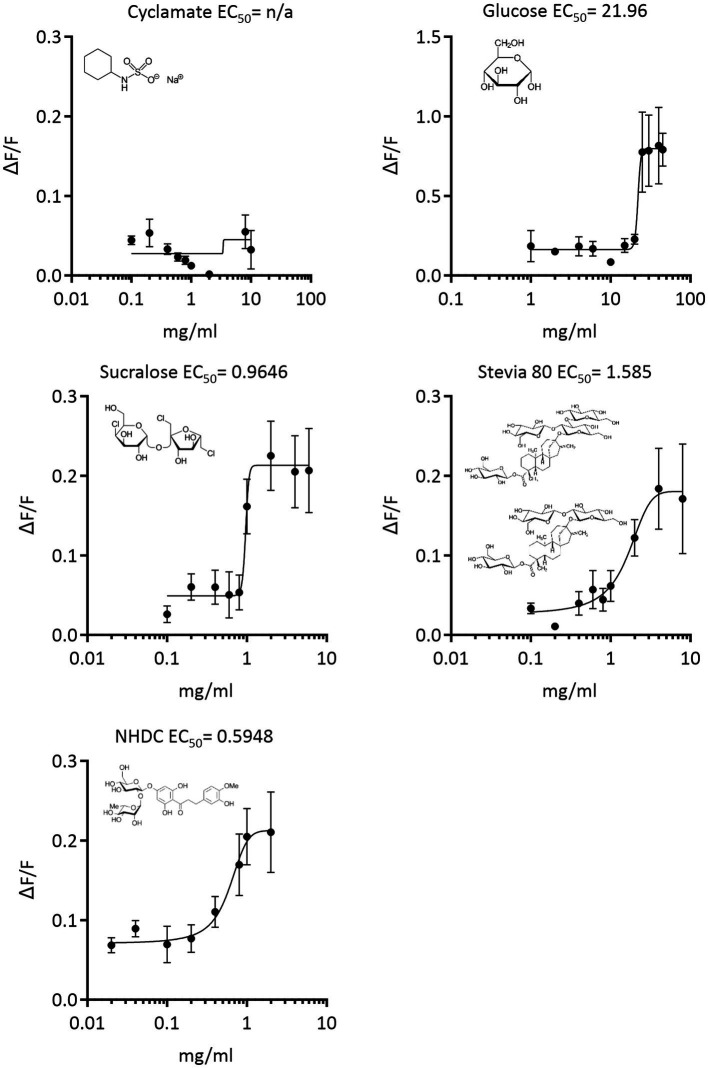 Figure 2
 Figure 3
Peer Reviews
No public reviews on file for this paper yet. If you reviewed it on a platform where reviews are public (OpenReview, ICLR, NeurIPS, ICML), you can paste yours below so the community can read it here.
Videos
No videos yet. Explain this paper in a talk, walkthrough, or lecture? Add one.
Taxonomy
TopicsBiochemical Analysis and Sensing Techniques · Regulation of Appetite and Obesity · Meat and Animal Product Quality