Identifying the Heterogeneity in the Association between Workforce Diversity and Retention in Opioid Treatment among Black clients
Yinfei Kong, Erick Guerrero, Jemima Frimpong, Tenie Khachikian, Suojin Wang, Thomas D’Aunno, Daniel Howard

TL;DR
This study explores how having a diverse workforce affects retention in opioid treatment for Black clients, finding that diversity alone isn't enough to improve outcomes.
Contribution
The study introduces a novel causal forest machine learning approach to examine heterogeneous treatment effects of workforce diversity on client retention in opioid treatment.
Findings
Workforce diversity was positively associated with retention in only 61 out of 627 treatment programs.
Programs with positive diversity effects were more likely to be private-for-profit, newer, and have specific demographic and staffing characteristics.
Workforce diversity alone is insufficient to improve retention in opioid treatment for Black clients.
Abstract
This study investigates the impact of workforce diversity, specifically staff identified as Black/African American, on retention in opioid use disorder (OUD) treatment, aiming to enhance patient outcomes. Employing a novel machine learning technique known as ‘causal forest,’ we explore heterogeneous treatment effects on retention. We relied on four waves of the National Drug Abuse Treatment System Survey (NDATSS), a nationally representative longitudinal dataset of treatment programs. We analyzed OUD program data from the years 2000, 2005, 2014 and 2017 (n = 627). Employing the ‘causal forest’ method, we analyzed the heterogeneity in the relationship between workforce diversity and retention in OUD treatment. Interviews with program directors and clinical supervisors provided the data for this study. The results reveal diversity-related variations in the association with retention…
Genes, proteins, chemicals, diseases, species, mutations and cell lines named across the full text — each resolved to its canonical identifier and authoritative record.
Click any figure to enlarge with its caption.
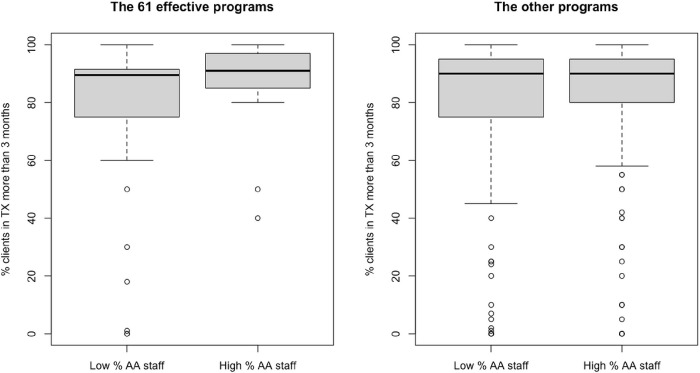 Figure 1
Peer Reviews
No public reviews on file for this paper yet. If you reviewed it on a platform where reviews are public (OpenReview, ICLR, NeurIPS, ICML), you can paste yours below so the community can read it here.
Videos
No videos yet. Explain this paper in a talk, walkthrough, or lecture? Add one.
Taxonomy
TopicsHealthcare Policy and Management · Opioid Use Disorder Treatment · Primary Care and Health Outcomes