The Influence of Hyponatremia and Hypokalemia on the Risk of Fractures in Various Anatomical Regions among Adult Trauma Patients: A Propensity Score-Matched Analysis
Shiun-Yuan Hsu, Cheng-Shyuan Rau, Ching-Hua Tsai, Sheng-En Chou, Wei-Ti Su, Ching-Hua Hsieh

TL;DR
This study finds that low sodium levels in trauma patients increase the risk of certain fractures, while low potassium levels have a smaller impact.
Contribution
The study is the first to use propensity score-matching to compare fracture risks in trauma patients with hyponatremia and hypokalemia.
Findings
Hyponatremia increases the odds of thoracic vertebral, pelvic, and femoral fractures.
Hypokalemia is not significantly associated with most fractures but decreases radial fracture risk.
Patients with both hyponatremia and hypokalemia show reduced risk of radial and patella fractures.
Abstract
Background: Hyponatremia and hypokalemia are common electrolyte imbalances in trauma patients and have been identified to be risk factors for a fall. In addition, hyponatremia was reported to be related to osteoporosis and fragility fractures, while the association between hypokalemia and osteoporosis has only been reported in rare case reports. This study investigated the impact of hyponatremia and hypokalemia on the incidence of fractures in various body regions of adult trauma patients, using the propensity score-matched patient cohort to reduce the influence of patients’ baseline characteristics. Methods: The study analyzed data from 11,173 hospitalized adult trauma patients treated from 1 January 1998, to 31 December 2022. The study included 1968 patients with hyponatremia and 9205 without, and 1986 with hypokalemia and 9187 without. Different 1:1 propensity score-matched cohorts…
Genes, proteins, chemicals, diseases, species, mutations and cell lines named across the full text — each resolved to its canonical identifier and authoritative record.
Click any figure to enlarge with its caption.
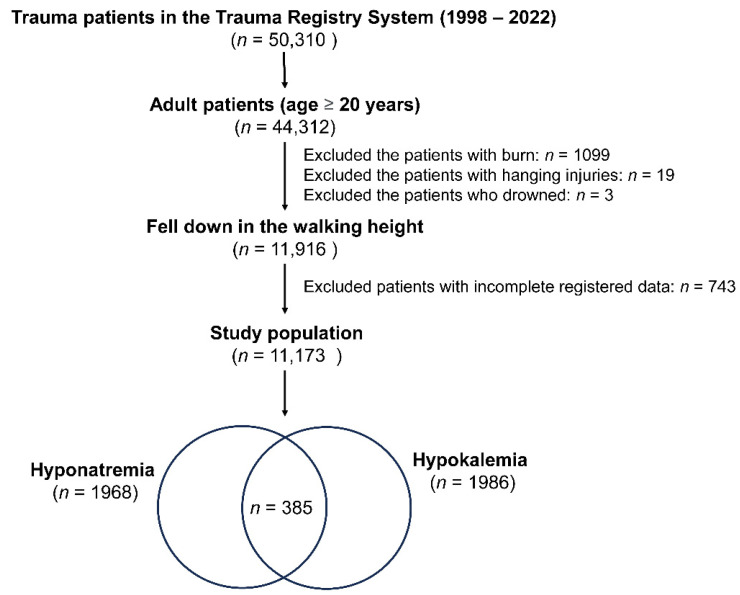 Figure 1
Peer Reviews
No public reviews on file for this paper yet. If you reviewed it on a platform where reviews are public (OpenReview, ICLR, NeurIPS, ICML), you can paste yours below so the community can read it here.
Videos
No videos yet. Explain this paper in a talk, walkthrough, or lecture? Add one.
Taxonomy
TopicsElectrolyte and hormonal disorders · Hip and Femur Fractures · Cardiac, Anesthesia and Surgical Outcomes