Deep Individual Active Learning: Safeguarding against Out-of-Distribution Challenges in Neural Networks
Shachar Shayovitz, Koby Bibas, Meir Feder

TL;DR
This paper introduces a new active learning method that improves model training efficiency, especially when test data differs from training data.
Contribution
The novel contribution is an efficient algorithm for minimizing min-max regret in active learning, reducing training data needs.
Findings
The proposed algorithm reduces required training set size by up to 15.4% for CIFAR10.
It achieves 35.1% reduction in training data for MNIST with out-of-distribution challenges.
The method is computationally efficient for neural networks in individual active learning settings.
Abstract
Active learning (AL) is a paradigm focused on purposefully selecting training data to enhance a model’s performance by minimizing the need for annotated samples. Typically, strategies assume that the training pool shares the same distribution as the test set, which is not always valid in privacy-sensitive applications where annotating user data is challenging. In this study, we operate within an individual setting and leverage an active learning criterion which selects data points for labeling based on minimizing the min-max regret on a small unlabeled test set sample. Our key contribution lies in the development of an efficient algorithm, addressing the challenging computational complexity associated with approximating this criterion for neural networks. Notably, our results show that, especially in the presence of out-of-distribution data, the proposed algorithm substantially reduces…
Genes, proteins, chemicals, diseases, species, mutations and cell lines named across the full text — each resolved to its canonical identifier and authoritative record.
Click any figure to enlarge with its caption.
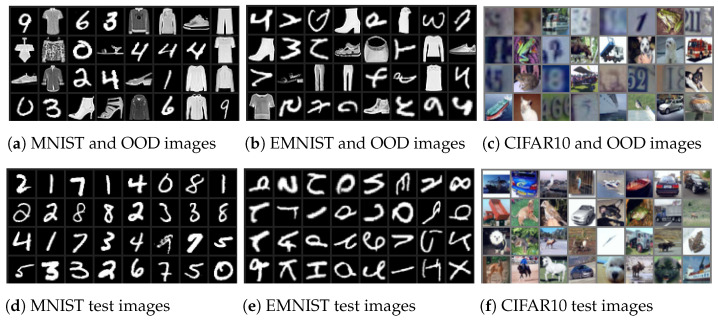 Figure 1
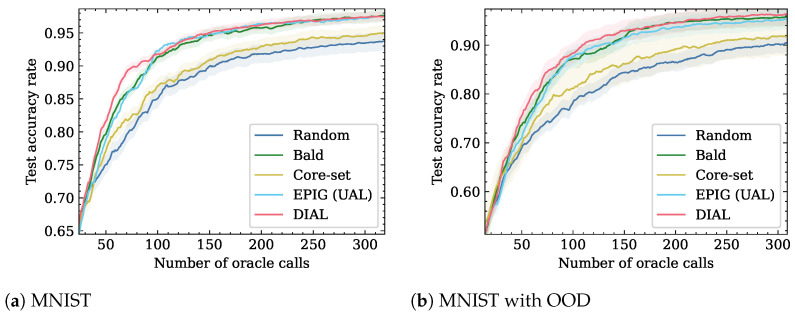 Figure 2
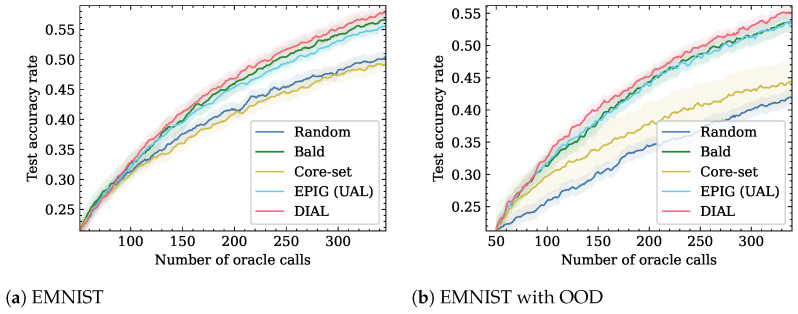 Figure 3
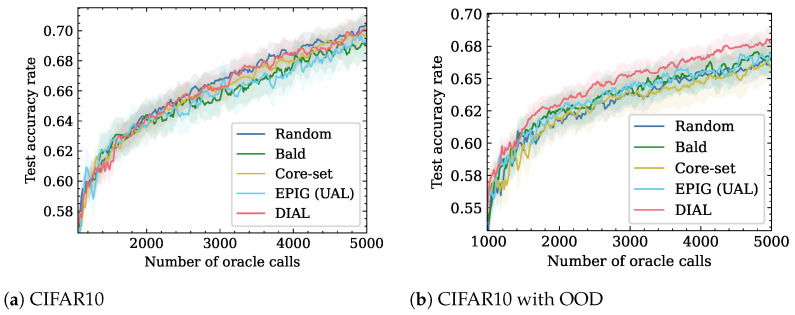 Figure 4
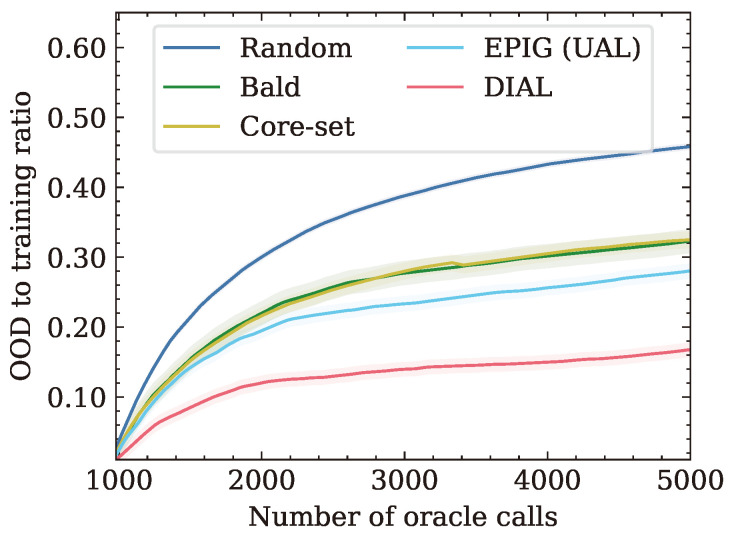 Figure 5
Peer Reviews
No public reviews on file for this paper yet. If you reviewed it on a platform where reviews are public (OpenReview, ICLR, NeurIPS, ICML), you can paste yours below so the community can read it here.
Videos
No videos yet. Explain this paper in a talk, walkthrough, or lecture? Add one.
Taxonomy
TopicsMachine Learning and Algorithms · Machine Learning and Data Classification · Adversarial Robustness in Machine Learning