Situational judgement tests: important clarifications regarding the methodology
Rebecca Beesley, Angelica Sharma, Jason Leo Walsh, Benjamin Howell Lole Harris, David John Wilson, Ken Masters, Trevor Gibbs

Abstract
This article was migrated. The article was marked as recommended.
Genes, proteins, chemicals, diseases, species, mutations and cell lines named across the full text — each resolved to its canonical identifier and authoritative record.
Click any figure to enlarge with its caption.
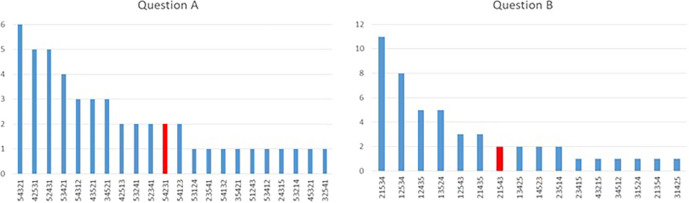 Figure 1
| “Correct” (pre-determined) answer | Frequency count (n=49) | Most frequent answer rank sequence | Frequency count (n=49) | Popularity of “correct” answer order in our sample |
|---|---|---|---|---|
|
|
|
|
|
|
|
|
|
|
|
|
|
|
|
|
|
|
|
|
|
|
|
|
|
|
|
|
|
|
|
|
|
|
|
|
|
|
|
|
|
|
|
|
|
|
|
|
|
|
|
|
|
|
|
|
|
|
|
|
Peer Reviews
No public reviews on file for this paper yet. If you reviewed it on a platform where reviews are public (OpenReview, ICLR, NeurIPS, ICML), you can paste yours below so the community can read it here.
Videos
No videos yet. Explain this paper in a talk, walkthrough, or lecture? Add one.
Taxonomy
TopicsMedical Education and Admissions · Cardiac, Anesthesia and Surgical Outcomes · Innovations in Medical Education
Letter
Editor,
We thank the Editor of Medical Teacher for suggesting that we continue the discussion through MedEdPublish.
In our previous account, we asked the question: who knows the right answer when dealing with the ranking format questions in a situational judgement test (SJT)?. ^ 1 ^ The results suggested that the discriminatory ability of ranking questions may be driven by ranking options of medium/lower appropriateness, and the clinical relevance of this was questioned. To improve clinical pertinence, a single-best answer format was suggested.
We appreciate the clarification provided Patterson et al ^ 2 ^ in their response to our suggestions, particularly on the matter of which subject matter experts (SMEs) are utilised at the concordance stage. In view of their comments, reanalysis of our data, retaining only ‘senior doctors who work closely with FY1 doctors’ (n = 49, approximately 5-7 times larger than the standard sample of SMEs), the results continue to show concerning trends.
In only 4 out of 10 (40%) of the questions in our mock SJT, our larger sample of SMEs identified the original answer key as being “correct”. Here, we show a summary of all ten tested questions to clarify the extent of disagreement between our SMEs and the “correct (pre-determined) answers”.
There appears to be a marked disagreement over the “correct answer” and what SMEs perceive as the correct answer ( Table 1 and Figure 1). The heterogeneity of SME responses underlines the subjectivity of SJT ranking questions. Even if SME unanimous agreement is not sought, one would hope it was common.
Notably, when looking at the most frequent answers in our sample, in one question, the most inappropriate option was chosen as the most appropriate option and vice versa. In another, the most inappropriate option was chosen as the second most appropriate option. These two questions are denoted with obelisks in Table 1. Furthermore, over half the SMEs arrived at the “correct” sequence in only one of the 10 questions.
Near-miss scoring is all well and good, but it is unlikely to correct for the subjectivity of the questions and is likely to contribute to the volatility of the Foundation Programme SJT, where student scores tend to cluster close to the mean. ^ 3 ^
Bar charts highlighting the heterogeneity of answers between SMEs in two SJT ranking questions from the online practise SJT available on the UK Foundation Programme Office website (2016). “Correct” (pre-determined) answers are marked in red.
Our study highlights that there is uncertainty surrounding the “correct answer” in ranking questions within the Foundation Programme Situational Judgement Test. We feel this uncertainty needs further investigation. We would encourage independent scrutiny of the concordance data between SMEs and the itemised pilot data to ensure the determined “correct answer” is free from uncertainty. Independent post-hoc analysis of the candidate ranking sequences would be very interesting to examine candidate answer heterogeneity.
The SJT ranking format is claimed to be less susceptible to coaching effects than single-best answer questions. Is this simply because it is hard to find consensus over what is truly the correct answer?
Notes On Contributors
Rebecca Beesley and Angelica Sharma are senior medical school students and were joint authors on this article.
Benjamin Harris and Jason Walsh are practising doctors currently in higher training.
David Wilson is a professor of medical education and the Director of Admissions for the medical school.
The reference list from the paper itself. Each links out to its DOI / PubMed record.
- 1Beesley R Sharma A Walsh JL Wilson DJ & Harris BHL . Situational judgment tests: Who knows the right answers? Medical Teacher. 2017.39(12),1293–1294 10.1080/0142159 X.2017.1367766 28835158 · doi ↗ · pubmed ↗
- 2Patterson F Aitkenhead A & Ashworth V . Response to: Situational judgment tests: Who knows the right answers? Medical Teacher. 2017.39(12),1294 10.1080/0142159 X.2017.1369714 29020852 · doi ↗ · pubmed ↗
- 3Harris BH Walsh JL & Lammy S . UK medical selection: lottery or meritocracy? Clinical Medicine (Lond). 2015.15,40–6. 10.7861/clinmedicine.15-1-40 PMC 495452225650197 · doi ↗ · pubmed ↗