A rare electrocardiographic sign of acute inferior myocardial infarction
Mirte Hoevenaars, Robert J. van Geuns, Niels van Royen, Peter Damman

Abstract
Genes, proteins, chemicals, diseases, species, mutations and cell lines named across the full text — each resolved to its canonical identifier and authoritative record.
Click any figure to enlarge with its caption.
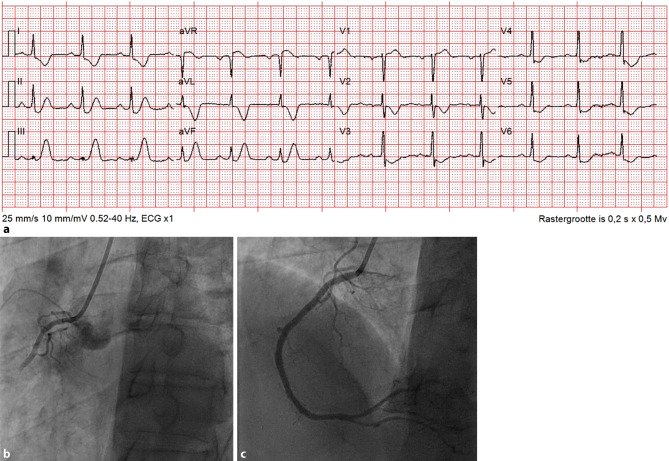 Figure 1
Peer Reviews
No public reviews on file for this paper yet. If you reviewed it on a platform where reviews are public (OpenReview, ICLR, NeurIPS, ICML), you can paste yours below so the community can read it here.
Videos
No videos yet. Explain this paper in a talk, walkthrough, or lecture? Add one.
Taxonomy
TopicsCardiac Structural Anomalies and Repair
A 62-year-old man attended our emergency department with acute chest pain. The electrocardiogram (ECG) showed 2 mm ST-segment depression at the J point with tall, peaked T‑waves in inferior leads, 2 mm ST elevation in aVR and reciprocal depressions in leads I and aVL (Fig. 1a). These features resemble ‘de Winter pattern’ ECG abnormalities: upsloping ST-segment depression at the J point in leads V1–V6 with tall, positive and symmetrical T waves. This is recognised as a sign of proximal left anterior descending coronary artery occlusion, observed in a minority of patients with acute anterior myocardial infarction [1]. This ECG pattern has rarely been described in inferior ST-segment elevation myocardial infarction [2].Fig. 1a Electrocardiogram at first medical contact. b Angiography showing proximal occlusion of the right coronary artery. c Angiography after primary percutaneous intervention
We performed urgent coronary angiography, showing a proximal occlusion of the right coronary artery (Fig. 1b). After primary percutaneous coronary intervention (Fig. 1c), complaints disappeared and the ECG normalised.
We emphasise the importance of early recognition in order to prevent a delay in treatment.
The reference list from the paper itself. Each links out to its DOI / PubMed record.
- 1de Winter RJ Verouden NJ Wellens HJA new ECG sign of proximal LAD occlusion N Engl J Med 2008359192071207310.1056/NEJ Mc 080473718987380 · doi ↗ · pubmed ↗
- 2Tsutsumi K Tsukahara K Is the diagnosis ST-segment elevation or non-ST-segment elevation myocardial infarction?Circulation 20181382715271710.1161/CIRCULATIONAHA.118.03781830571261 · doi ↗ · pubmed ↗