Unraveling the conumdrum: innovative technique to remove the stent from the displaced pancreatic duct in stenosis
Junqian Chen, Shuting Wen, Xiaofeng Lin, Zhuodan Zhong, Yan Guo, Dongjing Zhou, Tianwen Liu

Abstract
Genes, proteins, chemicals, diseases, species, mutations and cell lines named across the full text — each resolved to its canonical identifier and authoritative record.
Click any figure to enlarge with its caption.
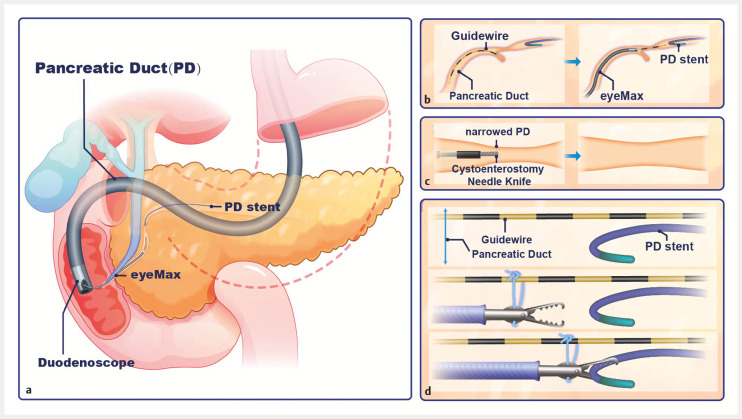 Fig. 1
- —Science Project Foundation of Guangdong Province Hospital of Chinese Medicine
- —Guangdong Traditional Chinese Medicine bureau project
- —the Science and Technology Project of Guangzhou City
- —the 17th Top-notch Talents of Guangdong Provincial Hospital of Traditional Chinese Medicine
Peer Reviews
No public reviews on file for this paper yet. If you reviewed it on a platform where reviews are public (OpenReview, ICLR, NeurIPS, ICML), you can paste yours below so the community can read it here.
Videos
No videos yet. Explain this paper in a talk, walkthrough, or lecture? Add one.
Taxonomy
TopicsPancreatitis Pathology and Treatment · Pancreatic and Hepatic Oncology Research · Gallbladder and Bile Duct Disorders
Stent migration from the pancreatic duct (PD) is a relatively rare but serious complication 1 . If not treated in a timely way, it can lead to serious illnesses, such as recurrent pancreatitis, jaundice, pancreatic cysts, infection, etc. 2 . It is challenging to remove the displaced PD stent, especially in the presence of a PD stenosis, stent distortion, and adhesion to surrounding tissues 3 .
A 64-year-old woman underwent routine endoscopic retrograde cholangiopancreatography (ERCP) due to choledocholithiasis and biliary pancreatitis 3 years ago. The stone was successfully removed and a 5-Fr 5-cm PD stent was placed. Unfortunately, after 2 months, the stent had completely migrated into the PD. Removal using stone extraction balloons, baskets, snares, and foreign body forceps was unsuccessful. After suffering from recurrent pancreatitis for the past 3 years, another attempt was made to remove the PD stent.
During the operation, the guidewire was inserted into the proximal main PD but failed to advance to the cervical and caudal PD. Under the guidance of the pancreaticobiliary digital controller (eyeMAX; Micro-Tech Co Ltd, Nanjing, China), the stenosis and scar formation in the distal segment of the PD could be observed and the guidewire was placed through the stenotic segment in distal main PD. Dilation catheters and a balloon were used unsuccessfully in an attempt to dilate the narrowed PD. Finally, it was widened using the Cystotome cystoenterostomy needle knife (Cook Medical, Bloomington, IN, USA).
Using eyeMAX, the distal end of the PD stent was visualized. Removal of the PD stent with biopsy forceps and a basket was again unsuccessful. We then investigated a new method, and the PD stent was successfully removed using the guidewire orientation of dental floss and the foreign body forceps ( Fig. 1 , Video 1 ). The method that we report can safely remove the displaced PD stent in a stenosis without any complications.
a Schematic diagram of the surgical procedure to remove an ectopic pancreatic duct (PD) stent in a narrowed PD. b Under the guidance of eyeMAX, the guidewire was threaded through the stenotic segment to the distal main PD. c Using the Cystotome cystoenterostomy needle knife, the narrowed PD was enlarged. d With the help of the dental floss traction guide and foreign body forceps, the PD stent can be successfully removed without significant trauma to the pancreas. Source: Shuting Wen and Mingyue Jin.
New method for recovering a displaced pancreatic duct stent in stenosis. Source for graphical illustration: Shuting Wen.Video 1
Endoscopy_UCTN_Code_CPL_1AK_2AD
The reference list from the paper itself. Each links out to its DOI / PubMed record.
- 1Price LH Brandabur JJ Kozarek RA Good stents gone bad: endoscopic treatment of proximally migrated pancreatic duct stents Gastrointest Endosc 20097017417910.1016/j.gie.2008.12.05119559842 · doi ↗ · pubmed ↗
- 2Zapatier JA Jani P Pimentel R Pancreatic stent migration into the bile duct causing cholangitis Endoscopy 201345 E 324E 32524022514 10.1055/s-0033-1344773 · doi ↗ · pubmed ↗
- 3Ng WK Tan QR Punamiya SJ Novel method to remove deeply migrated pancreatic duct stent Endoscopy 202254 E 748E 74910.1055/a-1792-246935359016 · doi ↗ · pubmed ↗