Endoscopic removal of a whole ascaris from the colonic lumen
Cheng Guo, Wei Liu, Yijun Wang, Tao Chen, Meidong Xu

Abstract
Genes, proteins, chemicals, diseases, species, mutations and cell lines named across the full text — each resolved to its canonical identifier and authoritative record.
Click any figure to enlarge with its caption.
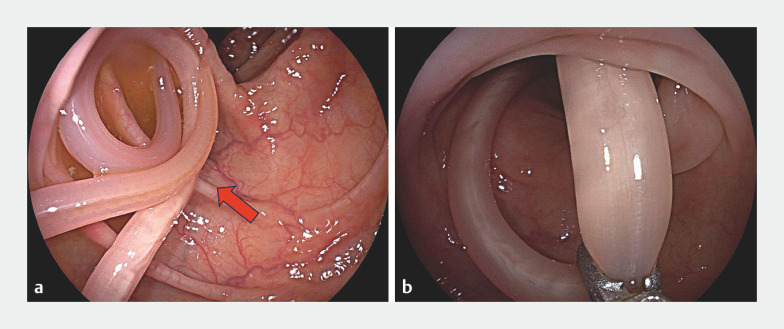 Fig. 1
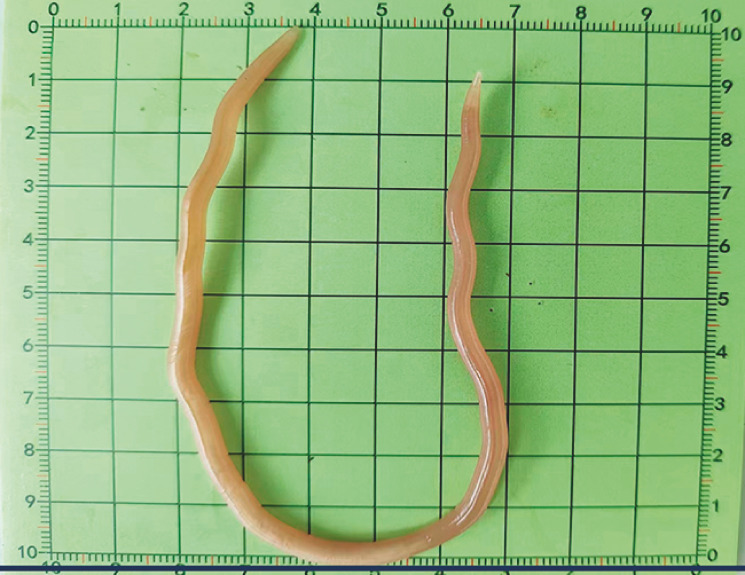 Fig. 2
- —National Natural Science Foundation of China10.13039/501100001809
Peer Reviews
No public reviews on file for this paper yet. If you reviewed it on a platform where reviews are public (OpenReview, ICLR, NeurIPS, ICML), you can paste yours below so the community can read it here.
Videos
No videos yet. Explain this paper in a talk, walkthrough, or lecture? Add one.
Taxonomy
TopicsAmoebic Infections and Treatments · Diverticular Disease and Complications · Foreign Body Medical Cases
A 67-year-old previous healthy woman was admitted to our hospital with paroxysmal abdominal colic. She reported that she loved eating raw food. She underwent colonoscopy, which revealed a reddish white, cylindrical ascaris with horizontal stripes wriggling vigorously in the lumen of the ascending colon ( Fig. 1 a ). We used forceps to grab the middle of the live ascaris and pull it out of the patient’s body under direct visualization ( Fig. 1 b ; Video 1 ). The ascaris was found to be more than 20 cm long ( Fig. 2 ).
Endoscopic images showing: a a live ascaris (red arrow) vigorously wriggling in the lumen of the ascending colon; b capture of the ascaris using forceps.
Colonoscopy revealing a live ascaris within the ascending colon, and its endoscopic removal.Video 1
Photograph of the 20-cm ascaris that was pulled alive from the colonic lumen.
Immediately following the procedure, the patient's abdominal pain was significantly reduced. Antiparasitic treatment, in conjunction with education of the patient and family about hygiene and sanitation, were subsequently introduced.
Ascaris is one of the nematodes with the highest incidence in developing areas. It can parasitize any part of the digestive tract, especially the jejunum and proximal ileum, but is rarely found in the colon. Ascaris can lead to abdominal pain, cholangitis, obstructive jaundice, pancreatitis, and gallstones 1 . Antiparasitic treatment, and improved hygiene and sanitation are important in preventing the spread of disease. In this case, the live ascaris was the cause of the patient’s abdominal pain and was removed under direct visualization.
Endoscopy_UCTN_Code_CCL_1AD_2AJ
The reference list from the paper itself. Each links out to its DOI / PubMed record.