Historical dataset of osteological and archaeological records for equines on Crete
Vera Klontza-Jaklova, Michal Smíšek, Romilda Nevěčná, Nikos Panagiotakis, Manolis Klontzas, Ricardo Fernandes

TL;DR
This paper presents a historical dataset of equine records in Crete from the Neolithic to 1895, combining archaeological, osteological, and written evidence.
Contribution
The paper introduces a comprehensive dataset for studying the historical presence and development of equines in Crete.
Findings
The dataset includes archaeological and osteological evidence of equines in Crete from the Neolithic to 1895.
It provides information on the type, location, and chronology of equine remains and records.
The dataset supports research on the socioeconomic role and evolution of the Cretan horse breed.
Abstract
We gathered evidence on the occurrence of equines in the island of Crete from the Neolithic until 1895. We relied on published archaeological and osteological records plus on historical written documents. Our dataset includes a description of the type of evidence, where this was located, and the associated absolute and relative chronologies. The collected data can be used to investigate the past spread of equids in Crete (Equus asinus and Equus caballus), their socioeconomic status, and the development of the local Cretan breed. The dataset is made available via the Abraxas data community within the Pandora data platform. This community is devoted to the historical study of horses. The dataset presented here is a component of a project tracing the history of the Cretan horse until present day.
Genes, proteins, chemicals, diseases, species, mutations and cell lines named across the full text — each resolved to its canonical identifier and authoritative record.
Click any figure to enlarge with its caption.
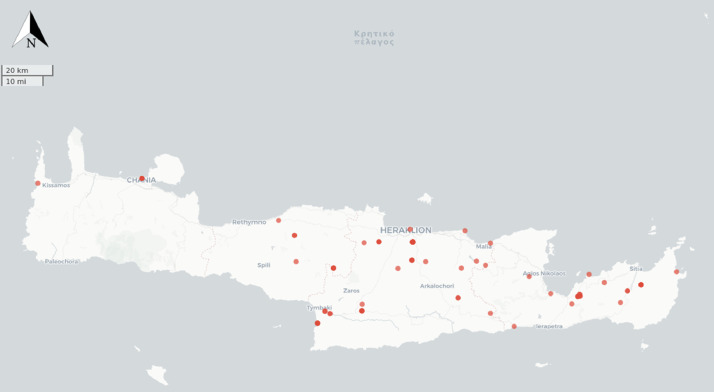 Figure 1
Peer Reviews
No public reviews on file for this paper yet. If you reviewed it on a platform where reviews are public (OpenReview, ICLR, NeurIPS, ICML), you can paste yours below so the community can read it here.
Videos
No videos yet. Explain this paper in a talk, walkthrough, or lecture? Add one.
Taxonomy
TopicsAnimal Diversity and Health Studies
Specifications TableSubjectHistoryArchaeologyZoology**Veterinary Science and MedicineSpecific subject areaZooarcheologyEquine history and archaeology.History of horse breeds.Data formatSecondary (retrieved from bibliography)Type of dataTableData collectionData was compiled from archaeological and osteological articles and monographs, and from the study of historical written documents.Data source locationCrete: Lattitude 35,50 – 34,75; Longitude 23,50 – 26,50Santorini: Lattitude 36,50 – 36,30; Longitude 25,30 – 25,50Repository: PandoraData accessibilityRepository name: PandoraData identification number: https://www.doi.org/10.48493/tm6j-fq61Direct URL to data: https://pandoradata.earth/dataset/vera-klontza-jaklovaInstructions for accessing these data: free accessRelated research articleKlontza-Jaklova, V. Panagiotakis, N. Nevěčná, R. Smíšek, M. Fernandes, R. Klontzas, M. (2023): The Cretan Horse: Still a Unique Breed? Part I: Equines on Crete from the Neolithic to the Ottoman Period, Cheiron: The International Journal of Equine and Equestrian History, Volume 3, Issue 2, pp.114-169. ; https://trivent-publishing.eu/img/cms/7-%20Cheiron_2-2023_V%C4%9Bra%20Klontza-Jaklov%C3%A1.pdf
Value of the Data
1
- •The Cretan horse breed is facing extinction. Our dataset can be used to investigate the physical development of the breed, what was its socioeconomic status through time, and the uses that the breed was given by humans.
- •The dataset can be used in interdisciplinary research projects combining osteology, archeology, history, military history, art history, and veterinary medicine.
- •The dataset can be combined with other historical and archaeological records to offer a broad view of diachronic animal management practices in the island of Crete.
Background
2
The dataset is part of a comprehensive study on the specific horses bred on Crete. The primary objective is to define the Cretan horse as a specific breed. It was, therefore, necessary to collect archaeological and historical evidence of the presence and breeding of the horse on the island and, based on these sources, including osteological remains, iconography, and written sources, to assess the likelihood of continuity of breeding and, if necessary, the genetic resources of the individuals cited today. The first equids were on the island at the beginning of the Bronze Age (ca. early 3rd millennium BC). They were donkeys rather than horses [1,2]. The first specimens of Equus caballus were present in the Late Minoan Period (before 1500 BC) until the modern period [3], [4], [5], [6], [7], [8].
Data Description
3
Each data entry is uniquely identified via an identification field (ID_Nr). For this field integers are entered in sequence.
Each site from which equine evidence originates is uniquely identified by an integer (Site_Nr) and by a site name (Site). Site names are written in English and the most common name is given. The list of sites included in our dataset (ordered alphabetically): Afrati, Agia Triada, Akrotiri, Archaes – Fournoi, Astrakous, Avdou. Azoria, Eleutherna, Gortyn, Chalasmenos, Chamalevri, Chania, Chersonissos, Idaion Andron, Karphi, Kavousi Kastro, Kavousi Vronda, Knossos, Kommos, Lato, Lyttos, Malia, Mochlos, Monastiraki, Mouliana, Myrtos Pyrgos, Orthi Petra, Palaikastro, Phaistos, Phalasarna, Poros, Praisos, Prinias, Profitis Ilias, Sklavokambos, Syme, Tylissos, Vrokastro.
The coordinates of each site location are given in latitude (Latitude) and longitude (Longitude) fields. These are reported in decimal degrees relative to the WGS84 system. A field (Exact_loc) is used to flag if the coordinates of a location are reported by excavators (value Y) or not (value N). When not available, approximate coordinates are entered into previously mentioned fields.
The type of evidence for equines is given in a categorical field (Finds). When multiple categories refer to the same location and chronology these are entered in the same data cell and separated using semicolons. The list of evidence categories included in our dataset (ordered alphabetically): Attic pixis lid, bones, bronze bit, bronze figurine, bronze helmet, bronze mitra, bronze shield, bronze tripod, cheek piece, clay figurine, coin, faience (scarab), Fe bit, fresco, glass, horn bridle ornament, ivory seals, lamps, painted pottery, relief pithos, sarcophagus, script, seal, temple frieze, terracotta figurines, terracotta plate, weight, zoomorphic vessel.
We used binomial nomenclature to identify equine species (Species) present for a certain location and chronology. When more than one species is present for a certain location and chronology these are entered in the same data cell and separated using semicolons. An unknown category is included. The list of species included in our dataset: Equus caballus, Equus asinus, and Unknown.
The chronology for each equine find is given in two numeric fields expressing the minimum (Min_date) and maximum (Max_date) values for a date range. These are reported as positive CE and negative BCE values. In additional, chronological tags are used to assign each find to chronological periods/phases. Employed categories are listed in Table 1 and if a chronological assignment includes more than one period we give the earliest and latest period for the evidence separated by a dash.Table 1. List of chronological periods/phases [9], [10], [11] employed to tag the chronology of each equine find. The smaller than symbol given in the field “Absolute chronology” sets the maximum value for a chronological period/phase with the minimum value given in the following row. All values are BCE up to the Roman period after which dates are CE.Table 1. PeriodPhaseAbbreviationAlternative termAbsolute ChronologyPaleolithic PeriodPaleo<10.300 BCEMesolithic PeriodMeso<7000Neolithic PeriodNP<3300Early Bronze AgeEarly Minoan IEM IPrepalatial Period<2700Early Minoan IIEM II<2450Early Minoan IIIEMI III<2200Middle Bronze AgeMiddle Minoan IMM IProtopalatial Period<2050Middle Minoan IIMM II<1950Middle Minoan IIIMM IIINeopalatial Period<1750Late Bronze AgeLate Minoan ILM I<1470Late Minoan IILM IIFinal- and Postpalatial Period<1430Late Minoan IIILM III<1150Early Iron AgeSubminoanSMSubminoan<1000Protogeomentric PeriodPG<900Geometric PeriodGP<650Orientalizing PeriodOP<600Archaic PeriodAP<479Classical PeriodCP<323Hellenistic PeriodHP<66 BCERoman PeriodRP<324 CEEarly Byzantine PeriodEByzFirst Byzantine Period<824Arabic PeriodArabP<961Late Byzantine PeriodLByzSecond Byzantine Period<1204Venetian PeriodVP<1669Ottoman PeriodOttoman<1895Modern timesModern< present-day
The citation for each bibliographic source (Reference) is given in APA style and the associated digital object identification (DOI) is given whenever available. A notes fields (Notes) is used to provide additional information not included in aforementioned fields.
To the best of our knowledge, we have compiled all bibliographic evidence on the historical presence of equines in the island of Crete. However, our dataset does not include unpublished materials which can present a large volume of information. We do not have access to these, but we would like to encourage our colleagues to publish the material and make it available for research. We will continue to update our dataset as new data becomes available.
Experimental Design, Materials and Methods
4
We collected historical evidence for equines in Crete by undertaking a bibliographic research to locate and read all published archaeological and osteological articles and monographs pertaining to the topic. We also consulted historical written documents concerning the study of equines. We used the bibliography from these sources to locate additional primary sources and successively applied this approach. We also relied on contributions from expert colleagues and on online data search using the scientific search engine Google Scholar to locate primary sources. We consulted primary sources in different languages (Greek, English, Italian, German, and French) and compiled our dataset between 7000 BCE and 1895. Full references for these sources are included in our dataset together with, whenever available, a DOI.
In addition to the English version of the site name associated to equine evidence, we recorded the latitude and longitude coordinates for each site if this was given in original publications. Otherwise, we used the Google Maps web mapping platform to obtain an approximate location from site name. We used a field in our dataset to tag whenever an approximate location was employed. Fig. 1 shows the spatial distribution of sites listed in our dataset. Our dataset relies on some sources that include deprecated terminology to describe the typology of material finds. Whenever necessary, we report the typology of material finds using up to date archaeological terminology. We also revised original chronological assignments of finds using chronological classifications based on current consensus among the archaeological community (Table 1).Fig. 1. Spatial distribution of sites listed in the dataset.Fig 1
Limitations
The completeness of the dataset in archaeological databases is affected by various factors, and this is also true for datasets containing information on horses and other equines in archaeological contexts across the island. The identification of donkeys and horses from fragmentary skeletal remains is a significant challenge. Additionally, there has been a lack of interest in certain periods of Cretan prehistory and history, resulting in incomplete information for those periods. The Bronze Age and Classical Antiquity periods have been the focus of research for a long time [9,12]. There is also a dearth of information about the Venetian and Ottoman periods, as well as much of the 20th century. Moreover, there is no stud book available that traces at least the last few generations of the island's horse population.
Ethics Statement
All authors have read and follow the ethical requirements for publication in Data in Brief and confirm that this paper does not involve human subjects, animal experiments, or any data collected from social media platforms.
CRediT authorship contribution statement
Vera Klontza-Jaklova: Conceptualization, Methodology, Validation, Data curation, Writing – original draft, Writing – review & editing. Michal Smíšek: Methodology, Validation, Formal analysis, Visualization, Data curation, Investigation. Romilda Nevěčná: Investigation. Nikos Panagiotakis: Investigation. Manolis Klontzas: Investigation. Ricardo Fernandes: Writing – review & editing, Formal analysis, Data curation.
The reference list from the paper itself. Each links out to its DOI / PubMed record.
- 1Jarman M.R.Human influence in the developments of the Cretan mammalian fauna Reese S.Madison D.Pleistocene and Holocene Fauna of Crete and Its First Settlers 1996 Prehistory Press 211230
- 2Moody J.Hinterlands and hinterseas: resources and production zones in bronze age and iron age crete Br. School Athens Stud.2012233271
- 3Reese, D.S. et al. The Minoan Fauna, in Kommos I. The Kommos Region and Houses of the Minoan Town I. The Kommos Region, Ecology, and Minoan Industries, (ed.) J. W. Shaw and M. C. Shaw, Princeton, 1995, pp. 163–291.
- 4Snyder L.The vertebrate faunal material Aegean Archaeology I 1994 Polish Academy of science Warsaw 9293
- 5Bintliff J.The Complete Archaeology of Greece. From Hunter-Gatherers to the 20th Century AD 2012 Willey-Blackwell Chichester, West Sussex 10.1002/9781118255179 · doi ↗
- 6Web page: J.B. Rutter, “Aegean Prehistoric Archaeology,” n.d., https://sites.dartmouth.edu/aegean-prehistory/chronology/.
- 7Shelmerdine C.The Cambridge Companion to the Aegean Bronze Age 2008 Cambridge University Press Cambridge 10.1017/CCOL 9780521814447 · doi ↗
- 8Klontza-Jaklova Byzantská archeologie - její vývoj, současný stav bádání a perspektivy (Byzantine archaeology – its development, current state, and its perspectives)Archaeol. Hist. 14/2201654256310.5817/AH 2016-2-28 · doi ↗