Two cities, two stages in transforming society—a mixed methods study comparing doctors’ adoption of mobile apps for communication with patients in Hangzhou and Yancheng, China
Dongjin Chen, Zhenhua Su, Zheng Gu

TL;DR
This study compares how doctors in two Chinese cities use mobile apps to communicate with patients, finding that social context influences their app choices.
Contribution
The study introduces a mixed methods approach to show how societal transformation affects doctors' adoption of mobile communication tools.
Findings
Doctors in Yancheng prefer social networking apps to maintain social connections, while Hangzhou doctors favor medical platform apps.
Adoption rates of Haodf app are higher in Hangzhou compared to Yancheng, with significant differences in service counts per doctor.
Social context shapes app usage: traditional societies favor social apps, modern societies favor medical platform apps for reputation marketing.
Abstract
Mobile apps have become commonplace in doctor-patient communication over the last 20 years. Doctors mainly use two kinds of app, social networking apps (i.e., WeChat) and medical platform apps (i.e., Haodf). The purpose of this study was to investigate whether the attributes of social interaction in local society impact doctors’ choice of mobile apps to communicate with patients. This article addresses two research questions: (a) To what degree do doctors’ adoption patterns in different societies differ? (b) Why do doctors choose certain mobile apps to communicate with patients? This study employed a mixed methods research design to analyze doctor’s adoption behavior patterns in two cities, Hangzhou (HZ) and Yancheng (YC), which represent two stages in transforming society. Various patterns, measured as the percentage of doctors who utilize the medical platform app of Haodf among all…
Genes, proteins, chemicals, diseases, species, mutations and cell lines named across the full text — each resolved to its canonical identifier and authoritative record.
Click any figure to enlarge with its caption.
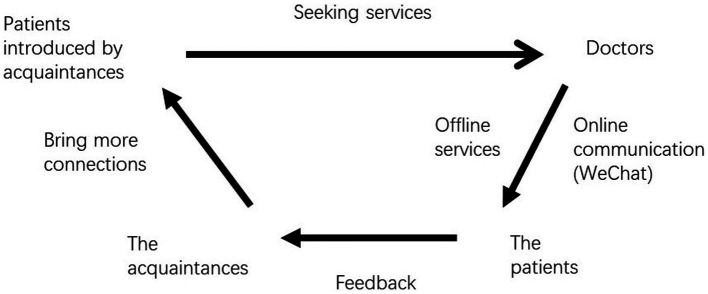 Figure 1
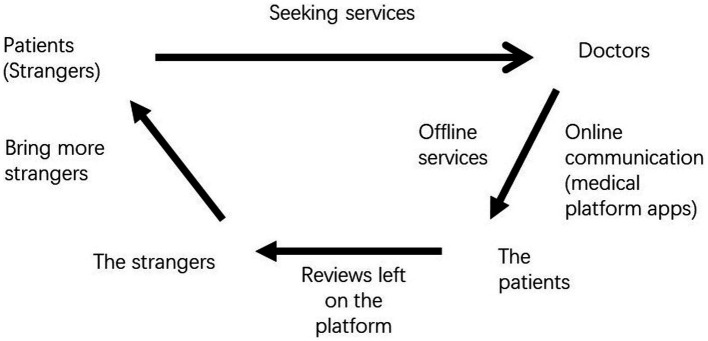 Figure 2
Peer Reviews
No public reviews on file for this paper yet. If you reviewed it on a platform where reviews are public (OpenReview, ICLR, NeurIPS, ICML), you can paste yours below so the community can read it here.
Videos
No videos yet. Explain this paper in a talk, walkthrough, or lecture? Add one.
Taxonomy
TopicsMobile Health and mHealth Applications · Social Media in Health Education · Health Literacy and Information Accessibility