Sequence-specific delayed gains in motor fluency evolve after movement observation training in the absence of early sleep
Rinatia Maaravi-Hesseg, Sigal Cohen, Avi Karni

TL;DR
Observing a motor sequence repeatedly leads to improved performance after a delay, even without sleep, similar to perceptual learning.
Contribution
Demonstrates that delayed motor fluency gains after observation training occur without sleep, unlike physical practice.
Findings
Immediate observation of a motor sequence does not improve performance compared to unobserved sequences.
Delayed gains in performance for the observed sequence emerge 12 hours post-training, regardless of sleep.
The largest performance improvements occur 24 hours after observation training.
Abstract
Following physical practice, delayed, consolidation-phase, gains in the performance of the trained finger-to-thumb opposition sequence (FOS) can be expressed, in young adults, only after a sleep interval is afforded. These delayed gains are order-of-movements specific. However, in several perceptual learning tasks, time post-learning, rather than an interval of sleep, may suffice for the expression of delayed performance gains. Here we tested whether the affordance of a sleep interval is necessary for the expression of delayed performance gains after FOS training by repeated observation. Participants were trained by observing videos displaying a left hand repeatedly performing a 5-element FOS. To assess post-session observation-related learning and delayed gains participants were tested in performing the observed (trained) and an unobserved (new, the 5-elements mirror-reversed) FOS…
Genes, proteins, chemicals, diseases, species, mutations and cell lines named across the full text — each resolved to its canonical identifier and authoritative record.
Click any figure to enlarge with its caption.
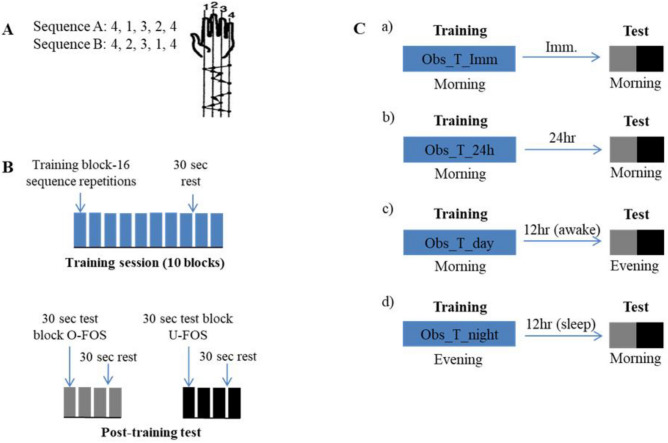 Figure 1
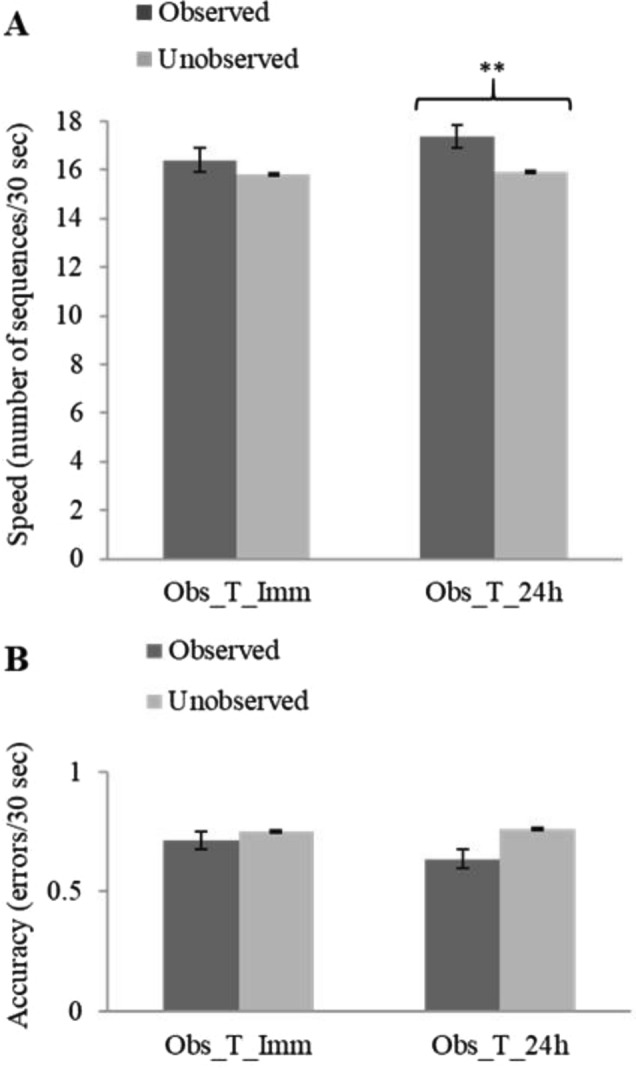 Figure 2
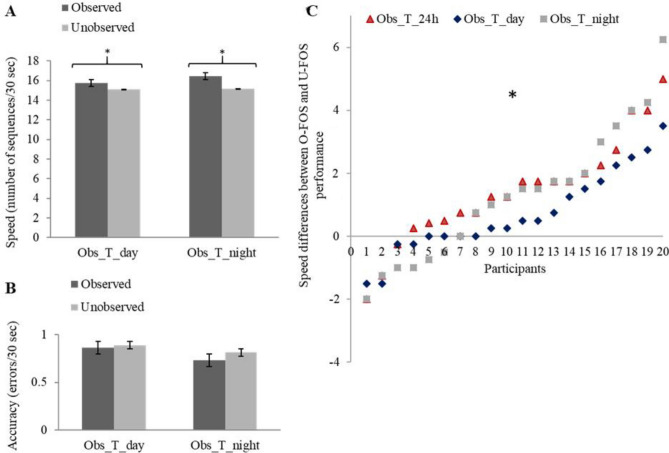 Figure 3
Peer Reviews
No public reviews on file for this paper yet. If you reviewed it on a platform where reviews are public (OpenReview, ICLR, NeurIPS, ICML), you can paste yours below so the community can read it here.
Videos
No videos yet. Explain this paper in a talk, walkthrough, or lecture? Add one.
Taxonomy
TopicsSleep and Wakefulness Research · EEG and Brain-Computer Interfaces · Neuroscience and Music Perception