Nicotinic acetylcholine receptor CHRNA5 is overexpressed in head and neck squamous cell carcinoma patients with a recent tobacco smoking history
Charlotte B McGuinness, Sara R White, Emma V Gray, Margaret V Leonard, Yong Teng, Austin Y Shull

TL;DR
This study finds that the CHRNA5 gene is overexpressed in head and neck cancers linked to recent smoking, which may worsen patient outcomes.
Contribution
The study identifies CHRNA5 overexpression as a novel marker in smoking-related HNSCC with implications for prognosis and immune response.
Findings
CHRNA5 is overexpressed in HNSCC cases with recent tobacco smoking history.
CHRNA5 overexpression correlates with worse prognosis in these patients.
CHRNA5 overexpression is inversely linked to immune-related gene expression signatures.
Abstract
Tobacco smoking is a major driver of head and neck squamous cell carcinoma (HNSCC) occurrence, and previous studies have shed light on the precise molecular alterations in tobacco-related HNSCCs when compared to HNSCCs associated with other risk factors (ex: human papillomavirus/HPV status). In this study, we analyzed the gene expression differences in HNSCC cases with a recent smoking history and revealed that the nicotinic acetylcholine receptor CHRNA5 is differentially overexpressed in smoking-related HNSCCs. CHRNA5 overexpression in these HNSCCs corresponds with a worse prognosis and is inversely correlated with an immune expression signature commonly associated with better prognosis. From these results, our study highlights the potential role of the nicotine-activated CHRNA5 receptor in HNSCC progression and corresponds with other recent reports highlighting the potential role of…
Genes, proteins, chemicals, diseases, species, mutations and cell lines named across the full text — each resolved to its canonical identifier and authoritative record.
Click any figure to enlarge with its caption.
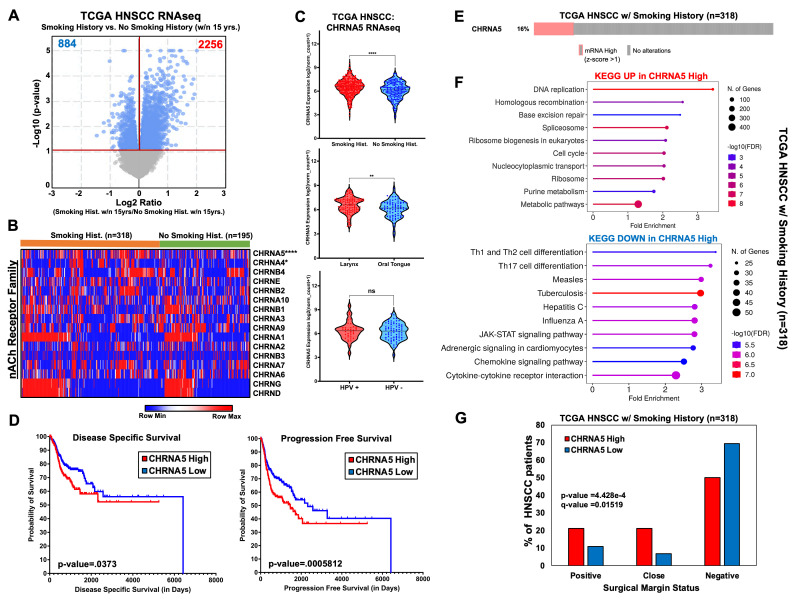 Figure 1
Peer Reviews
No public reviews on file for this paper yet. If you reviewed it on a platform where reviews are public (OpenReview, ICLR, NeurIPS, ICML), you can paste yours below so the community can read it here.
Videos
No videos yet. Explain this paper in a talk, walkthrough, or lecture? Add one.
Taxonomy
TopicsNicotinic Acetylcholine Receptors Study · Antimicrobial Peptides and Activities · Chemical Synthesis and Analysis
Description
Tobacco smoking is the leading risk factor in head and neck squamous cell carcinoma (HNSCC) development, with the second leading risk factor being human papilloma virus (HPV) infection. These risk factor subtypes differ greatly from both a clinical and molecular standpoint for this heterogenous cancer group that affects the oral cavity, pharynx, or larynx, with HPV-positivity generally exhibiting a better response to treatment and having a more favorable overall prognosis when compared to their tobacco smoking-related HNSCC counterparts. This dichotomy in outcomes underscores the need for defining the precise molecular mechanisms that differentially drive these different HNSCC subtypes, especially with the specific context that smokers with HNSCC often experience more aggressive disease progression, higher rates of recurrence, and diminished response to treatment regimens (Johnson et al. 2020) .
Because of these clinical hurdles related to tobacco-smoking associated HNSCC cases, we sought to better characterize the transcriptional landscape of HNSCC patients who have a recent history with tobacco smoking compared to those who have no smoking history within a 15-year time frame of diagnosis (fifteen years of tobacco cessation is often used as a time frame for typical risk factors to become normalized with individuals who have no smoking history) (U.S. Department of Health and Human Services 2020) . For this approach, we performed differential gene expression analysis using The Cancer Genome Atlas (TCGA) HNSCC dataset of 513 HNSCC patient samples with an identified smoking history (Leemans et al. 2018) and determined that 2256 transcripts were differentially upregulated and 884 transcripts downregulated in HNSCC patient samples with a recent smoking history. Such transcripts upregulated included oxidative stress response genes like *UGT1A1 * [Fold Change: 1.72, FDR p-value = 5.095e-5] (Yueh and Tukey 2007) , *CYP1A1 * [Fold Change: 2.30, FDR p-value = 5.39e-8] (Coelho et al. 2022) *, FGF19 * [Fold Change: 2.19, FDR p-value = 2.135e-5] (Teng et al. 2017; Gao et al. 2019) , and *AKR1C1 * [Fold Change: 2.14, FDR p-value = 7.265e-5] (Chang et al. 2019) , whereas transcripts downregulated included inflammatory genes like *IL4R * [Fold Change: 0.78, FDR p-value = 8.902e-5] (Bankaitis and Fingleton 2015) , *MYD88 * [Fold Change: 0.83, FDR p-value = 3.258e-4] (Geng et al. 2010) , *CASP1 * [Fold Change: 0.74, FDR p-value = 2.868e-4] (Song et al. 2022) , and *STAT2 * [Fold Change: 0.82, FDR p-value = 9.424e-4] (Yang et al. 2022) ( Figure 1A ). These differently expressed transcripts logically correspond with the dichotomy of molecular characteristics between stress-resistant tobacco-related cancers and immunologically hot HPV+ cancers (Johnson et al. 2020) .
Interestingly, two of the differentially upregulated transcripts in HNSCC patients with a smoking history are the nicotinic acetylcholine receptor subunits CHRNA5 [Fold Change: 1.31, FDR p-value = 1.905e-3] and CHRNA4 [Fold Change: 1.38, FDR p-value = .0112], with CHRNA5 being more significantly upregulated of the two transcripts based on a Benjamini-Hochberg corrected FDR p-value. These two subunits are two of the sixteen subunits that comprise the overall nicotinic receptor family in humans, where different heteropentameric structures make up the varying nicotinic receptor complexes throughout the body ( Figure 1B ) (Millar and Harkness 2008; Dang et al. 2016) . Interestingly, several studies have highlighted CHRNA5’s dynamic role in nicotine sensitivity as well as its potential oncogenic role in different cancer types (Improgo et al. 2010; Lin et al. 2019; Fu et al. 2022) . To further validate CHRNA5’s role with tobacco related HNSCC, we observed the CHRNA5 expression was significantly overexpressed in HNSCC tumors from the larynx when compared to the oral tongue, as most tobacco-related HNSCCs occur in the laryngeal region whereas oral tongue HNSCCs are more associated with HPV positivity (Johnson et al. 2020) . Furthermore, as expected, we observed no statistically significant difference in CHRNA5 expression between HPV+ and HPV- HNSCC tumors ( Figure 1C ). To further investigate CHRNA5’s connection with tobacco-related HNSCC, we analyzed the survival status of patients based on CHRNA5 expression and discovered that high CHRNA5 corresponded to a significantly lower disease-specific survival and significantly lower progression-free survival, both of which correspond with typical observation that tobacco-related HNSCCs have worse prognoses ( Figure 1D ).
From these initial results, we then isolated TCGA HNSCC samples that had a tobacco smoking history (n=318) to further focus on the differential CHRNA5 expression status within this subset of HNSCC patients and postulate on its specific contribution in smoking-related HNSCC cancers. From these 318 patients, sixteen percent of patients had a CHRNA5 expression z-score >1, which we then used as our cutoff in determining which tobacco associated HNSCC patients are considered “CHRNA5 High” ( Figure 1E ). We then compared the differentially expression of transcripts in “CHRNA5 High” HNSCC patients with a smoking history versus “CHRNA5 Low” HNSCC patients with a smoking history and observed that transcripts upregulated in CHRNA5 High HNSCC tumors were involved in DNA repair processes (ex: Base Excision Repair, Homologous Recombination, etc.) whereas transcripts downregulated in CHRNA5 High tumors were involved immune regulation pathways (Th1 and Th2 cell differentiation, JAK-STAT signaling pathway, etc.) ( Figure 1F ). This result provided evidence that CHRNA5 expression negatively corresponds to immune activation pathways, which is a negative correlation also generally observed in tobacco related HNSCC tumors. Furthermore, these gene ontology patterns observed in these HNSCC tumor subsets relate with the clinical observation that CHRNA5 High status in HNSCC patients with a Smoking History have a higher percentage of patients with “Positive” or “Close” surgical margins, which is an indicator of disease progression and worse prognosis ( Figure 1G ).
With the combined clinical and transcriptional data from TCGA concerning tobacco-related HNSCC patients, we observe that the nicotinic acetylcholine receptor subunit CHRNA5 corresponds with smoking history and may play both a prognostic and mechanistic role in HNSCC disease progression. These results concerning CHRNA5 are highly important as they correspond with other studies highlighting CHRNA5’s role in cancer progression in cancer types like lung and breast (Sun et al. 2017; Zhang et al. 2017; Koker et al. 2018) . Specifically, one study showing increased lung cancer cell aggressiveness due to nicotine treatment could be mitigated when knocking down CHRNA5 expression with siRNA. This result of a nicotine-induced CHRNA5 axis is especially interesting considering nicotine use in electronic cigarettes. Therefore, our analysis in HNSCC along with previous reports in other cancers associated with tobacco use highlight the potential importance of nicotinic receptor CHRNA5 in cancer progression and the potentially overlooked role nicotine induction via CHRNA5 may play in cancer severity.
Methods
Data Acquisition and RNAseq Differential Expression Analysis
Clinical information and RSEM-normalized RNAseq expression counts from TCGA Head and Neck Squamous Cell Carcinoma (HNSCC) cohort were securely obtained using cBioPortal for Cancer Genomics platform (Gao et al. 2013; Gao et al. 2022) . TCGA HNSCC datasets used for this analysis were from the Firehose Legacy datasets maintained through the Broad Institute. Differential gene expression analysis and volcano plot construction was performed using the cBioPortal platform. A Benjamini-Hochberg FDR corrected p-value (i.e. q value) < 0.05 was set as the threshold for statistical significance for differential expression. Survival data for TCGA HNSSC samples were obtained using the UCSC Xena Browser platform (Goldman et al. 2019) . The OncoPrint in Figure 1E was generated in cBioPortal .
Heatmap construction
Heatmap of the normalized RNAseq expression counts for the nAChR gene family was constructed using the Morpheus matrix visualization and analysis software maintained by the Broad Institute (https://software.broadinstitute.org/morpheus). TCGA HNSCC samples were grouped based on tobacco smoking history status and were then clustered based on Euclidean distance to create the heatmap shown.
Violin and bar plots
Violin plots of the HNSCC subgroups for CHRNA5 expression were created using GraphPad Prism version 10. A Student’s t-test was used to determine statistical significance between the group comparisons (p-value < 0.05). Bar plot showing surgical margin status was constructed in Microsoft Excel 2021. A Chi-squared test was used to determine statistical significance of surgical margin status between the two CHRNA5 status groups.
Survival analysis
A Kaplan-Meir plot for disease-specific survival and progression-free survival was constructed using GraphPad Prism version 10. Grouping of CHRNA5 High and CHRNA5 Low for the KM survival analysis was determined using the median expression count value for all TCGA HNSCC patients with RNAseq information as the threshold separating the two groups. A log-rank test was used to determine statistical significance (p-value < 0.05).
Gene Ontology (GO) analysis
GO analysis of the Kyoto Encyclopedia of Gene and Genomes (KEGG) pathways was performed using the ShinyGO 0.77 platform (Ge et al. 2020) . Transcripts that were significantly upregulated and significantly downregulated in CHRNA5 high HNSCC tumors (cutoff FDR p-value<0.05) with a smoking history were used as inputs to perform the GO analysis. An FDR q-value of 0.05 was used as cutoff for significant pathways in the analysis, and the lollipop charts show the top 10 pathways ranked based on fold enrichment with size of the circle representing overall number of genes overlapping with KEGG pathway, and the color of each lollipop line representing the -log10 transformed FDR q-value.
The reference list from the paper itself. Each links out to its DOI / PubMed record.
- 1Bankaitis KV Fingleton B 2015918 Targeting IL 4/IL 4R for the treatment of epithelial cancer metastasis.Clin Exp Metastasis 3280262-089884785610.1007/s 10585-015-9747-926385103 PMC 4651701 · doi ↗ · pubmed ↗
- 2Chang WM Chang YC Yang YC Lin SK Chang PM Hsiao M 2019610 AKR 1C 1 controls cisplatin-resistance in head and neck squamous cell carcinoma through cross-talk with the STAT 1/3 signaling pathway.J Exp Clin Cancer Res 3810392-907824524510.1186/s 13046-019-1256-231182137 PMC 6558898 · doi ↗ · pubmed ↗
- 3Coelho NR Pimpão AB Correia MJ Rodrigues TC Monteiro EC Morello J Pereira SA 20211120 Pharmacological blockage of the AHR-CYP 1A 1 axis: a call for in vivo evidence.J Mol Med (Berl)10020946-271621524310.1007/s 00109-021-02163-234800164 PMC 8605459 · doi ↗ · pubmed ↗
- 4Dang N Meng X Song H 201637 Nicotinic acetylcholine receptors and cancer.Biomed Rep 452049-943451551810.3892/br.2016.62527123240 PMC 4840641 · doi ↗ · pubmed ↗
- 5Fu Y Ci H Du W Dong Q Jia H 2022125 CHRNA 5 Contributes to Hepatocellular Carcinoma Progression by Regulating YAP Activity.Pharmaceutics 1421999-492310.3390/pharmaceutics 1402027535214008 PMC 8877699 · doi ↗ · pubmed ↗
- 6Gao J Aksoy BA Dogrusoz U Dresdner G Gross B Sumer SO Sun Y Jacobsen A Sinha R Larsson E Cerami E Sander C Schultz N 201342 Integrative analysis of complex cancer genomics and clinical profiles using the c Bio Portal.Sci Signal 62691945-0877 pl 1pl 110.1126/scisignal.200408823550210 PMC 4160307 · doi ↗ · pubmed ↗
- 7Gao L Lang L Zhao X Shay C Shull AY Teng Y 2018125 FGF 19 amplification reveals an oncogenic dependency upon autocrine FGF 19/FGFR 4 signaling in head and neck squamous cell carcinoma.Oncogene 38130950-92322394240410.1038/s 41388-018-0591-730518874 · doi ↗ · pubmed ↗
- 8Ge SX Jung D Yao R 2020415 Shiny GO: a graphical gene-set enrichment tool for animals and plants.Bioinformatics 3681367-48032628262910.1093/bioinformatics/btz 93131882993 PMC 7178415 · doi ↗ · pubmed ↗