A78 VALIDITY EVIDENCE FOR OBSERVATIONAL EUS COMPETENCY ASSESSMENT: A SYSTEMATIC REVIEW
A Ceccacci, H Hothi, R Khan, N Gimpaya, B Chan, N Forbes, P D James, J Mosko, E Yeung, C M Walsh, S C Grover

TL;DR
This paper reviews observational tools for assessing endoscopic ultrasound skills and evaluates their validity and educational usefulness.
Contribution
The study systematically evaluates the validity and educational utility of observational EUS competency assessment tools using established frameworks.
Findings
Five observational EUS assessment tools were identified, with EUSAT, GAPS-EUS, and TEESAT showing the strongest validity evidence.
All tools are formative, with high educational utility and ease of use in clinical or simulated settings.
TEESAT had the strongest educational impact due to its influence on credentialing and competence thresholds.
Abstract
Endoscopic ultrasound (EUS) encompasses a range of diagnostic and therapeutic procedures that require technical, cognitive, and non-technical skills. The implementation of competency-based frameworks in endoscopic education has emphasized trainee assessment based on predefined milestones, rather than procedure volume. Observational assessment tools with strong validity evidence are needed to achieve this goal. To systematically identify and evaluate observational competency assessment tools employed in EUS using an established validity framework. The secondary aim is to evaluate the educational utility of assessment tools. We searched three databases (MEDLINE, EMBASE, and Evidence-Based Medicine Reviews) and the grey literature from inception to May 2023. Messick’s unified framework was used to evaluate validity evidence based on content, response process, internal structure,…
Click any figure to enlarge with its caption.
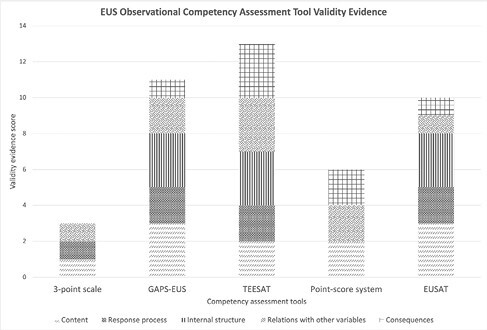 Figure 1
Peer Reviews
No public reviews on file for this paper yet. If you reviewed it on a platform where reviews are public (OpenReview, ICLR, NeurIPS, ICML), you can paste yours below so the community can read it here.
Videos
No videos yet. Explain this paper in a talk, walkthrough, or lecture? Add one.
Taxonomy
TopicsDelphi Technique in Research · Interprofessional Education and Collaboration