A106 COLONOSCOPY TEACHING: A SURVEY OF CANADIAN GASTROENTEROLOGY RESIDENTS
G Park, H Komeylian, A Kohansal, M Stewart

TL;DR
This study surveys Canadian gastroenterology residents to assess the consistency and use of specific colonoscopy teaching techniques.
Contribution
The study identifies variability in colonoscopy teaching methods among Canadian gastroenterology residents.
Findings
Only 24% of residents reported uniform colonoscopy teaching methods among faculty members.
Most residents (90%) reported that water immersion was recommended by most preceptors during colonoscopy insertion.
There is considerable variability in how techniques like loop reduction and position changes are taught.
Abstract
With the advancement in equipment and techniques, colonoscopy training continues to evolve. Programs such as the Skills Enhancement for Endoscopy (SEE) curriculum developed by the Canadian Association of Gastroenterology teach techniques such as loop reduction, patient turning, and water immersion aimed at improving adenoma detection, cecal intubation, and patient comfort. While there is vast literature focused on assessing learners’ endoscopic competencies, there is limited data pertaining to the training of specific colonoscopy techniques. To assess various colonoscopy techniques used to train gastroenterology residents in Canada. A survey of gastroenterology trainees was developed to assess specific aspects of their experience with colonoscopy education. This included questions on the frequency of position changes, use of pediatrics colonoscopes, water immersion, loops reduction,…
Click any figure to enlarge with its caption.
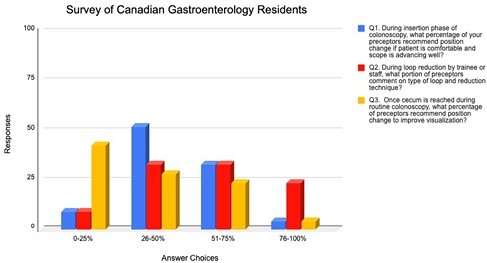 Figure 1
Peer Reviews
No public reviews on file for this paper yet. If you reviewed it on a platform where reviews are public (OpenReview, ICLR, NeurIPS, ICML), you can paste yours below so the community can read it here.
Videos
No videos yet. Explain this paper in a talk, walkthrough, or lecture? Add one.
Taxonomy
TopicsColorectal Cancer Screening and Detection