A20 FECAL MICROBIOTA TRANSPLANTATION FORMULATIONS DO NOT AFFECT BACTERIAL VIABILITY OR TREATMENT OUTCOMES IN RECURRENT C. DIFFICILE INFECTION
L Chan, R Franz, C McDougall, K Wong, D Kao

TL;DR
Lyophilized fecal microbiota transplantation is as effective as frozen FMT for treating recurrent C. difficile infections, with no loss of bacterial viability over time.
Contribution
Demonstrates that lyophilized FMT maintains bacterial viability and treatment success rates comparable to frozen FMT, even when stored at 4°C.
Findings
Lyophilized FMT stored at -80°C or 4°C for up to 12 months showed no decline in bacterial viability compared to frozen FMT.
Treatment success rates for lyophilized FMT were 14% higher than frozen FMT in rCDI patients.
Abstract
Fecal microbiota transplantation (FMT) is the most effective therapy for recurrent Clostridioides difficile infections (rCDI) with multiple RCTs showing efficacy of 80-90%. Frozen FMT is a commonly used formulation but requires storage at -80°C, creating barriers to storage and transportation. More recently, lyophilized FMT (LFMT) has shown promise as an alternative formulation, but little data exists as to how bacterial viability may be affected compared to fresh or frozen FMT by different storage temperatures and duration, and real-world outcome data is sparse. As such, this study aims to evaluate the viability and efficacy of LFMT compared to fresh and frozen FMT. To 1) compare bacterial viability in 3 FMT formulations: fresh, frozen and lyophilization, at varying storage temperatures and duration, and 2) correlate different formulations with treatment outcomes. We compared…
Click any figure to enlarge with its caption.
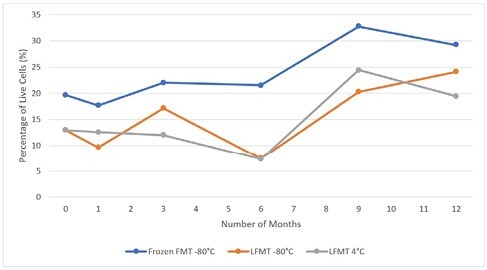 Figure 1
Peer Reviews
No public reviews on file for this paper yet. If you reviewed it on a platform where reviews are public (OpenReview, ICLR, NeurIPS, ICML), you can paste yours below so the community can read it here.
Videos
No videos yet. Explain this paper in a talk, walkthrough, or lecture? Add one.
Taxonomy
TopicsClostridium difficile and Clostridium perfringens research · Gut microbiota and health