Genetic diversity of Gallus sp. in Southeast Asia based on d-lopp: In silico study
Zultinur Muttaqin, Tike Sartika, Ferdy Saputra

TL;DR
This study explores the genetic diversity of Gallus sp. in Southeast Asia using the D-loop region, finding high haplotype diversity and three haplogroups.
Contribution
The study identifies high genetic diversity and three haplogroups in Gallus sp. based on D-loop analysis in Southeast Asia.
Findings
Analysis of 563 sequences revealed 89 haplotypes in Gallus sp. from Southeast Asia.
Neighbor-joining analysis identified three haplogroups among Gallus sp. in the region.
D-loop region shows high haplotype diversity (0.524 to 1) but is not specific to breeds or countries.
Abstract
This study was conducted to analyze the matrilineal structure of Gallus sp. in Southeast Asia, especially in the D-loop region. A total of 563 sequences from eight countries (Laos, Myanmar, Vietnam, Malaysia, Indonesia, Cambodia, the Philippines, and Thailand) in Southeast Asia are used in this study. Data collected from National Center for Biotechnology Information (NCBI) regarding the genus Gallus sp. in a Southeast Asian country. Data analysis was performed using MEGA 7.2 and DnaSP v6. In the haplotype found in Gallus sp. in Southeast Asia, there are 89 haplotypes. Using a neighbor-joining (Nj) analysis, 89 haplotypes found three haplogroups for Gallus sp. in Southeast Asia. In Southeast Asia, the genetic diversity of the d-loop is exceptionally high, with a haplotype diversity value of 0.524 to 1. D-loop cannot be used as a specific marker for breeds or country-specifics.
Genes, proteins, chemicals, diseases, species, mutations and cell lines named across the full text — each resolved to its canonical identifier and authoritative record.
Click any figure to enlarge with its caption.
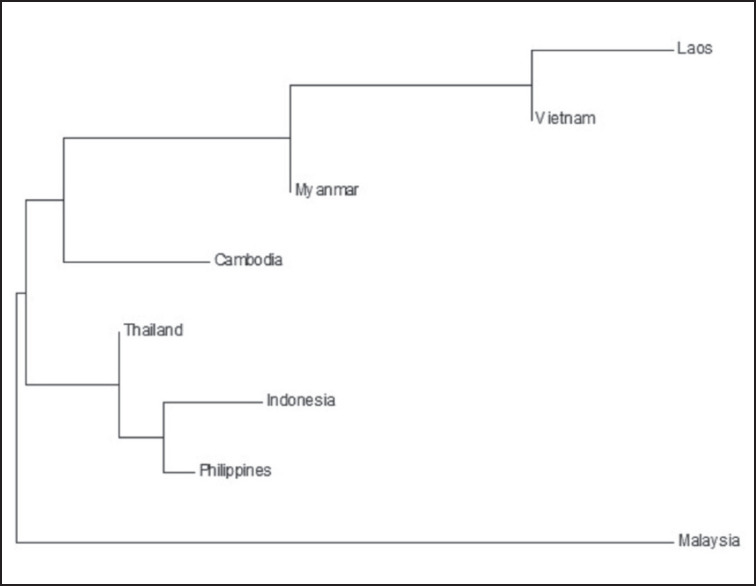 Figure 1
| Population | n | h | Hd |
|---|---|---|---|
| Laos | 40 | 11 | 0.822 |
| Myanmar | 13 | 10 | 0.949 |
| Vietnam | 63 | 21 | 0.876 |
| Malaysia | 7 | 3 | 0.524 |
| Indonesia | 206 | 44 | 0.902 |
| Cambodia | 13 | 8 | 0.859 |
| Philippines | 22 | 14 | 0.948 |
| Thailand | 3 | 3 | 1 |
Peer Reviews
No public reviews on file for this paper yet. If you reviewed it on a platform where reviews are public (OpenReview, ICLR, NeurIPS, ICML), you can paste yours below so the community can read it here.
Videos
No videos yet. Explain this paper in a talk, walkthrough, or lecture? Add one.
Taxonomy
TopicsRNA and protein synthesis mechanisms · Livestock and Poultry Management · Genomics and Phylogenetic Studies
Introduction
Domestic chicken is widely used as a source of both meat and eggs all over the world. Asia has 53.3% of the world’s chicken population. From 1994 to 2021, FAO provides information that Indonesia ranks seventh as the meat-producing country under China and the US [1]. The population of chickens in Southeast Asia is 3,611,972,000 [2]. This indicates that the role of chickens is very important in people’s lives, especially in Southeast Asia.
In recent years, Indonesia has imported many breeds from other countries, especially from countries in Southeast Asia. Most of the chicken breeds in Indonesia come from Thailand, Vietnam, and Myanmar, with fighting advantages, e.g., Bangkok, Birma, Mangon, Saigon, Pakhoy, and Pama. Cockfighting is a hobby of Indonesian gamblers, and it is illegal in Indonesia. These fighting chickens are competed by some communities, and winning increases their price. Cockfighting in Bali is more than just gambling; it has an important role in culture [3]. However, at the community level, Indonesia cannot regulate cross-breeding between fighting chickens from other countries and Indonesian local chickens. Indonesia must adopt a closed breeding policy to maintain the purity of local chickens. Indonesia has implemented a closed breeding policy for Bali cattle and Madura cattle.
To maintain the genetic purity of local chickens, researchers need to conduct a study on the genetic diversity of chickens in Southeast Asia. D-loop is a mitochondrial DNA region that is the most commonly used for matrilineal studies. D-loop has high sequence variation and a moderate mutation rate [4]. Domestic chickens are the domestication of junglefowl in Southeast Asia [5]. Therefore, it is very important to analyze the matrilineal structure of Gallus sp. in Southeast Asia, especially in the D-loop region.
Materials and Methods
The data used in this study were from the National Center for Biotechnology Information (NCBI). A total of 563 sequences from eight countries (Laos, Myanmar, Vietnam, Malaysia, Indonesia, Cambodia, the Philippines, and Thailand) in Southeast Asia are used in this study. All analyses in this study used a sequence length of 320 bp. The data were aligned by MUSCLE in MEGA 7.2 [6]. Haplotype diversity, number of haplotypes, and Fst distance were performed using DnaSP v6 [7]. Furthermore, using MEGA 7.2, the Fst distance was calculated using neighbor-joining (Nj) with 1,000 bootstrap replications.
Results
Analysis of data from NCBI resulted in 89 haplotypes. Indonesia had 44 haplotypes and high haplotype diversity (Hd = 0.902) in this study (Table 1). This happens because of the large amount of data and the various breeds of data used. The highest haplotype diversity (Hd = 1) was found in Thailand because three sequences of Gallus sp. in Thailand made three haplotypes. On the other hand, the least haplotype diversity (Hd = 0.524) was found in Malaysia. Nj-based Fst distance found a relationship Gallus sp in Laos, Vietnam, and Myanmar (Fig. 1). The Philippines and Indonesia had a strong relationship, and Thailand was in the same cluster as the Philippines and Indonesia. NJ showed Cambodia, Myanmar, Vietnam, and Laos in the same cluster. On the other hand, Malaysia was in an outgroup cluster.
Neighbor-joining tree of Gallus sp. in Southeast Asia tree based on Fst genetic distance.
Discussion
The sequence analyzed in this study contained information on chicken breeds in Indonesia, conducted by [8]. Bekisar is crossbred between the rooster of Gallus varius and the hen of Gallus gallus domesticus [9]. Based on the D-loop, Bekisar showed a similar haplotype to chickens from Laos and Myanmar. We found that pelung chicken in Indonesia had a specific haplotype. On the other hand, the Pelung haplotype has similar haplotypes to other Indonesian, Vietnamese, Myanmar, and Philippine chickens. This is possible because Southeast Asia is a center of chicken domestication. The haplotype diversity in Vietnamese chickens in Ha Giang Province ranged from 0.75 to 1, with a total haplotype of 25 [10]. This study suggested two centers of Gallus sp. in Southeast Asia, e.g., the north center (Laos and Myanmar) and the south center (Indonesia and Malaysia). Vietnam, the Philippines, Thailand, and Cambodia are the meeting centers of these two centers. The red junglefowl in the Philippines was closely related to Myanmar [11]. Herrera et al. [12] stated that South American chickens are more closely related to European chickens, while European chickens are more closely related to Southeast Asian chickens, which also have a high level of diversity. Wang et al. [13] supported the center of domestication occurring in Southeast Asia. Adaptation to high temperatures in domestic chickens is obtained from tropical red junglefowl [14]. The aggressiveness of roosters and the ability to exhibit cockfighting behavior in domestic chickens may be obtained from red junglefowl [15]. On the other hand, other studies have found that white feathers are more aggressive than red feathers [16]. Sartika et al. [17] stated that microsatellites cannot be used to distinguish eight native breeds of Indonesian chickens and argued that a microarray with many single nucleotide polymorphisms (SNPs) will be able to distinguish breed-specific. Zimmerman et al. [18] stated that significant SNPs are better than microsatellites at identifying groups in clustering methods and providing more accurate estimates of diversity. As a result, we propose additional research on finding and clustering genetic structures utilizing large SNPs.
Conclusion
This research found 89 haplotypes with high haplotype diversity values in Southeast Asia. Furthermore, the D-loop cannot be used as a specific marker for breeds or country-specifics. A microarray analysis should be conducted to determine specific markers for breeds.
The reference list from the paper itself. Each links out to its DOI / PubMed record.
- 1FAO Production of Chickens: Top 10 producers 2021 http://www.fao.org/faostat/en/#data/QA/visualize
- 2FAO Population of Chickens 2021 http://www.fao.org/faostat/en/#data/QA
- 3Geertz C. Deep play: notes on the balinese cockfight. Culture and Politics Palgrave Macmillan Daedalus New York 56862005
- 4Hudson W. Whole-loop mitochondrial DNA D-loop sequence variability in Egyptian Arabian equine matrilines P Lo S One 2017128 e 0184309 https://doi.org/10.1371/journal.pone.01843092885917410.1371/journal.pone.0184309 PMC 5578668 · doi ↗ · pubmed ↗
- 5Sawai H Kim HL Kuno K Suzuki S Gotoh H Takada M The origin and genetic variation of domestic chickens with special reference to junglefowls Gallus g. gallus and G. varius P Lo S One 201055 e 10639 https://doi.org/10.1371/journal.pone.00106392050270310.1371/journal.pone.0010639 PMC 2873279 · doi ↗ · pubmed ↗
- 6Kumar S Stecher G Tamura K. MEGA 7: molecular evolutionary genetics analysis Version 7.0 for bigger datasets Mol Biol Evol 2016337187074 https://doi.org/10.1093/molbev/msw 0542700490410.1093/molbev/msw 054PMC 8210823 · doi ↗ · pubmed ↗
- 7Rozas J Ferrer-Mata A Sanchez-Del Barrio JC Guirao-Rico S Librado P Ramos-Onsins SE Dna SP 6: DNA sequence polymorphism analysis of large data sets Mol Biol Evol 201734123299302 https://doi.org/10.1093/molbev/msx 2482902917210.1093/molbev/msx 248 · doi ↗ · pubmed ↗
- 8Ulfah M Perwitasari D Jakaria J Muladno M Farajallah A. Multiple maternal origins of Indonesian crowing chickens revealed by mitochondrial DNA analysis Mitochondrial DNA A: DNA Mapp Seq 2017282025462 https://doi.org/10.3109/19401736.2015.111806910.3109/19401736.2015.111806926714142 · doi ↗ · pubmed ↗