Comparative label-free proteomics of the neonatal meningitis-causing Escherichia coli K1 IHE3034 and RS218 morphotypes
Nikola Zlatkov, Wilma Gunnari, Ulrike Resch

TL;DR
This study compares the protein profiles of two Escherichia coli strains that cause neonatal meningitis, revealing differences in their survival strategies.
Contribution
The novel contribution is the use of label-free proteomics to uncover distinct evolutionary strategies in two neonatal meningitis-causing E. coli morphotypes.
Findings
Strain IHE3034 continuously performs anaerobic respiration.
Strain RS218 maintains a filamentous shape due to an active SOS response.
Abstract
The proteome of two newborn meningitis Escherichia coli K1 (NMEC) morphotypes was examined via a label-free proteomics approach. Besides shared NMEC virulence factors, the two strains have different evolutionary strategies—strain IHE3034 tends to perform anaerobic respiration continuously, while strain RS218 maintains its filamentous morphotype due to active SOS response.
Genes, proteins, chemicals, diseases, species, mutations and cell lines named across the full text — each resolved to its canonical identifier and authoritative record.
Click any figure to enlarge with its caption.
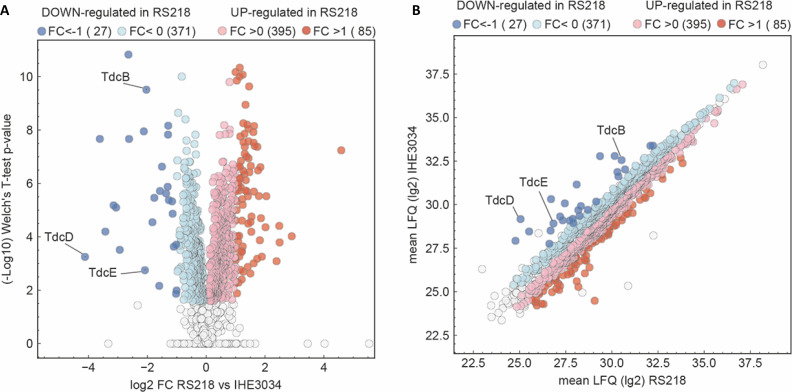 Figure 1
Peer Reviews
No public reviews on file for this paper yet. If you reviewed it on a platform where reviews are public (OpenReview, ICLR, NeurIPS, ICML), you can paste yours below so the community can read it here.
Videos
No videos yet. Explain this paper in a talk, walkthrough, or lecture? Add one.
Taxonomy
TopicsRNA and protein synthesis mechanisms · Genomics and Phylogenetic Studies · Glycosylation and Glycoproteins Research