Auxin-induced degradation of the aurora A kinase, AIR-1, in C. elegans does not prevent assembly of bipolar meiotic spindles
Karen McNally, Francis McNally

TL;DR
This study shows that removing the AIR-1 kinase in C. elegans embryos does not stop the formation of bipolar meiotic spindles, but causes chromosome issues during cell division.
Contribution
The study reveals that AIR-1 is not essential for bipolar spindle assembly in acentrosomal meiosis in C. elegans.
Findings
AIR-1 depletion in C. elegans embryos does not prevent bipolar meiotic spindle formation.
An increase in lagging chromosomes was observed during anaphase in AIR-1-depleted embryos.
Abstract
Chromosome segregation during mitosis and male meiosis is mediated by centrosomal spindles that require the activity of the aurora A kinase, whereas female meiotic spindles of many species are acentrosomal. We addressed the role of the C. elegans aurora A kinase, AIR-1 , in acentrosomal spindle assembly by generating a strain in which AIR-1 is tagged with both an auxin-induced degron and HALO tag. The meiotic spindle pole marker, MEI-1 , and chromosomes were labeled with GFP and mCH::histone respectively. All meiotic spindles were bipolar in AIR-1 depleted embryos, however an increase in lagging chromosomes was observed during anaphase.
Genes, proteins, chemicals, diseases, species, mutations and cell lines named across the full text — each resolved to its canonical identifier and authoritative record.
Click any figure to enlarge with its caption.
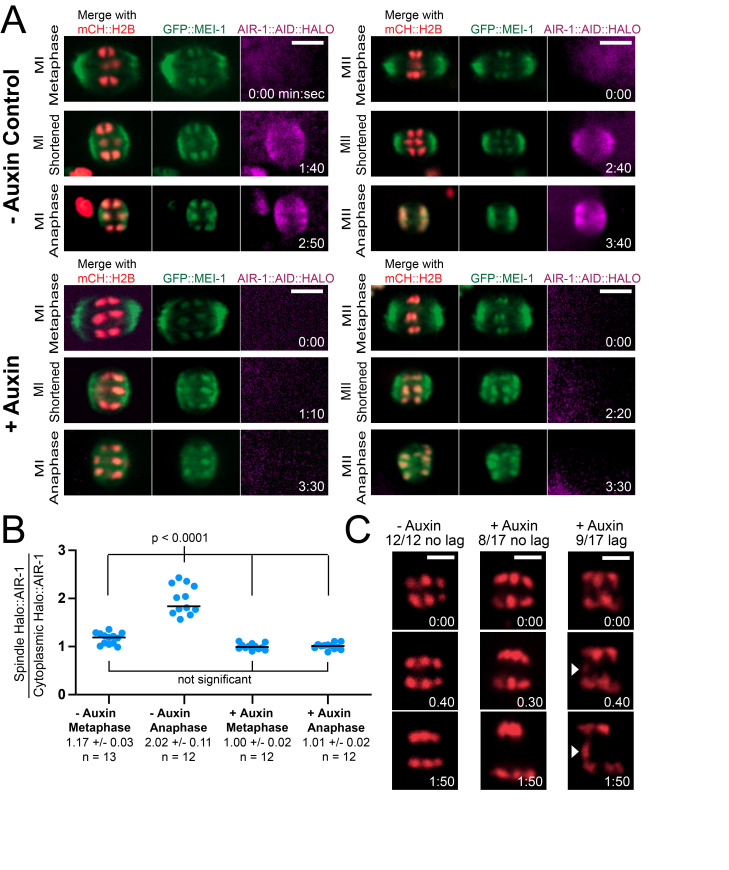 Figure 1
Peer Reviews
No public reviews on file for this paper yet. If you reviewed it on a platform where reviews are public (OpenReview, ICLR, NeurIPS, ICML), you can paste yours below so the community can read it here.
Videos
No videos yet. Explain this paper in a talk, walkthrough, or lecture? Add one.
Taxonomy
TopicsGenetics, Aging, and Longevity in Model Organisms · Photosynthetic Processes and Mechanisms · Microtubule and mitosis dynamics