Metagenome-assembled genomes from mineral tundra soils in Rásttigáisá, northern Norway
Igor S. Pessi, Aino Rutanen, Jenni Hultman

TL;DR
This paper presents 59 new microbial genomes from tundra soils in northern Norway, revealing insights into the diversity of these under-studied ecosystems.
Contribution
The study provides novel metagenome-assembled genomes from mineral tundra soils, expanding our understanding of tundra microbial diversity.
Findings
59 non-redundant MAGs were recovered from Rásttigáisá tundra soils.
MAGs were primarily from bacterial phyla Candidatus Dormibacterota, Verrucomicrobiota, and Acidobacteriota.
Four archaeal MAGs were identified, all belonging to the genus Candidatus Nitrosopolaris.
Abstract
Microbial communities in tundra soils remain largely unknown despite their important roles in the cycling of greenhouse gases. Here, we report 59 non-redundant metagenome-assembled genomes (MAGs) recovered from mineral tundra soils in Rásttigáisá, northern Norway. The MAGs were obtained by clustering contigs according to tetranucleotide frequency and differential coverage and were manually curated to remove contigs with outlying GC content and/or mean coverage. Most MAGs were assigned to the bacterial phyla Candidatus Dormibacterota (n=12), Verrucomicrobiota (n=10), and Acidobacteriota (n=9). All archaeal MAGs (n=4) belong to the genus Candidatus Nitrosopolaris (phylum Thermoproteota). The 59 Rásttigáisá MAGs expand our knowledge of the diversity and ecological roles of tundra microbiomes.
Genes, proteins, chemicals, diseases, species, mutations and cell lines named across the full text — each resolved to its canonical identifier and authoritative record.
Click any figure to enlarge with its caption.
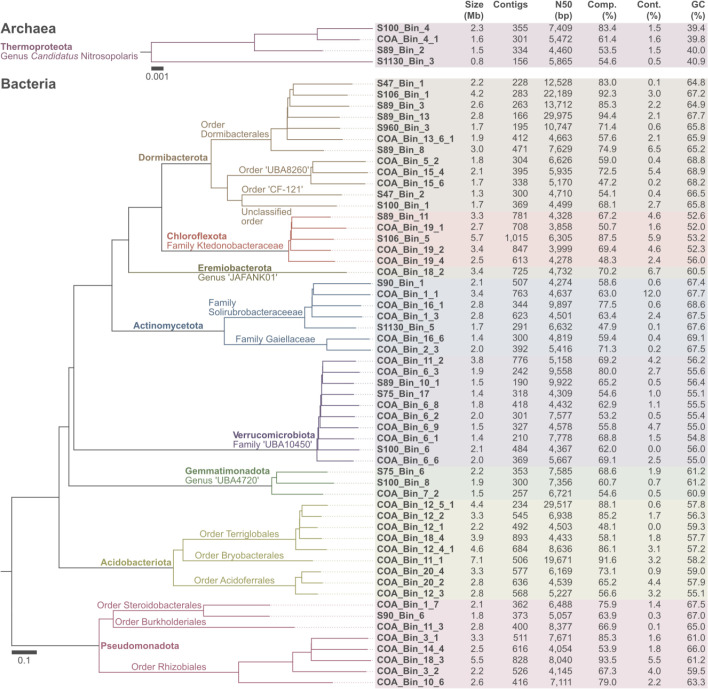 Fig. 1
- —Helsingin Yliopisto
- —Academy of Finland
Peer Reviews
No public reviews on file for this paper yet. If you reviewed it on a platform where reviews are public (OpenReview, ICLR, NeurIPS, ICML), you can paste yours below so the community can read it here.
Videos
No videos yet. Explain this paper in a talk, walkthrough, or lecture? Add one.
Taxonomy
TopicsGenomics and Phylogenetic Studies · Microbial Community Ecology and Physiology · Polar Research and Ecology
Data Summary
The data generated in this study have been submitted to the European Nucleotide Archive (ENA) under the project PRJEB49283. Raw reads are available under accessions ERR11584940–ERR11584949, and accession numbers for the assembled genomes are listed in Table S1, available in the online version of this article.
Introduction
Human activities such as unsustainable industrial and agricultural practices are driving irreversible changes in tundra soils and other polar ecosystems. Greenhouse gases (GHGs) play a major role in climate change and, if emissions are not curbed drastically, atmospheric temperatures in the Arctic may be 7 °C warmer by the end of the century [1]. Microbial communities in the tundra play key roles in both the production and consumption of greenhouse gases and are thus a crucial component of the global climate system [2, 3]. Despite harsh conditions, tundra soils harbour highly diverse and specialized micro-organisms, most of which still remain unknown [4–8]. Fuelled by ever-increasing sequencing and computational power, recent culture-independent metagenome investigations have revealed that uncultured micro-organisms – the so-called ‘microbial dark matter’ – play critical roles in the carbon [4–6] and nitrogen [6–8] cycles in the tundra. More studies on the diversity and functional capacity of tundra microbiomes are thus needed to understand better their contribution to global biogeochemical cycles and the GHG budget. Here, we report 59 metagenome-assembled genomes (MAGs) recovered from tundra soils in northern Norway.
Description of the dataset
We sampled soils across ten sites in an area of alpine tundra in the Rásttigáisá Fell (69 °59’ N, 26 °15′ E, 700 m.a.s.l), Finnmark, Norway. In each site, one sample was taken from the mineral layer (10–15 cm depth) with a soil corer and transferred immediately to dry ice. Soil water content ranged from 9.6–17.3 %, organic matter from 1.2–7.6 % and pH from 4.5 to 5.3. Metagenomic DNA was extracted with the DNeasy PowerSoil kit (QIAGEN, Hilden, Germany) and libraries were prepared with the Nextera XT kit (Illumina, San Diego, CA, USA) following the manufacturers’ instructions. Paired-end sequencing was done with the Illumina NextSeq500 platform (forward reads: 170 bp, reverse reads: 140 bp) at the Institute of Biotechnology, University of Helsinki. A total of 114 950 383 paired-end reads was obtained (35.6 Gb), ranging from 7 696 757 to 14 621 365 reads per sample (2.4–4.5 Gb).
Sequencing data was processed using a genome-resolved metagenomics approach. First, Cutadapt v1.10 [9] was used to remove adapters and base calls with Phred score <28, and the quality of the data was checked with FastQC v0.11.5 [10]. Sequences were then assembled into larger contiguous sequences with MEGAHIT v1.1.1 [11]. Assemblies were done for each sample individually and as one co-assembly consisting of pooled data from all samples. For each assembly, contigs≥2500 bp were binned with anvi’o v6.0 [12] according to Pessi et al. [8]. Briefly, MAGs were obtained by manually grouping the contigs according to tetranucleotide frequency and differential coverage using the anvi-interactive interface of anvi’o. MAGs were visually inspected to remove outlying contigs, and only MAGs with homogeneous sequence composition and coverage were kept (see Fig. S1 and merenlab.org/2015/05/11/anvi-refine for more information). MAGs from all assemblies were combined and dRep v2.3.2 [13] was used to yield a set of 59 non-redundant MAGs (≥99 % average nucleotide identity).
The 59 non-redundant MAGs range from 0.8 to 7.1 Mb and comprise 156–1015 contigs with N_50_ values of 3858–29 975 bp (Fig. 1, Table S1). Completeness and contamination levels estimated with CheckM2 v1.0.1 [14] are of 47.2–94.4 % and 0.0–12.0 %, respectively. These estimates are based on machine-learning models trained on simulated genomes, which seem to give more reliable estimates than previous single-copy gene-based approaches [14]. GC content ranges from 40.0–69.0 %. Taxonomic classification with GTDB-Tk v2.3.0 [15] and the Genome Taxonomy Database (GTDB) release R214 [16] placed the MAGs within the bacterial phyla Candidatus Dormibacterota (n=12), Verrucomicrobiota (n=10), Acidobacteriota (n=9), Pseudomonadota (n=8), Actinomycetota (n=7), Chloroflexota (n=5), Gemmatimonadota (n=3) and Eremiobacterota (n=1). The remaining MAGs (n=4) were assigned to the archaeal phylum Thermoproteota. These have been characterized elsewhere as part of the recently proposed genus Candidatus Nitrosopolaris [8].
Fifty-nine metagenome-assembled genomes (MAGs) from mineral tundra soils in Rásttigáisá, northern Norway. Maximum-likelihood trees obtained with GTDB-Tk v2.3.0 based on 53 archaeal and 120 bacterial single-copy genes. Completion and redundancy values were obtained with Checkm2 v1.0.1.
Future outlook
The 59 Rásttigáisá MAGs obtained here represent medium- and high-quality genomes from microbial populations in mineral tundra soils. Among other applications, these population genomes can be used in studies of microbial phylogenomics, biogeography and comparative genomics looking at adaptations to life under cold, oligotrophic conditions. An example of this is the study by Pessi et al. [8], in which four of the MAGs reported here were included in the description of a novel genus of putative ammonia-oxidizing archaea that appears to be restricted to polar and alpine environments. Our preliminary analysis of the Rásttigáisá MAGs suggests that other novel taxa might be represented in this dataset (Table S1), but further studies are needed for a better characterization of this potentially novel diversity. The prevalence of uncultured taxa has also been observed in other metagenomic investigations of tundra soils in Alaska [4, 5], Finland [6, 7], Sweden [17], as well as Antarctic soils [18, 19]. In particular, analysis of the MAGs assigned to Candidatus Dormibacterota, which is the most abundant phylum in the dataset, can cast light into the ecological roles of this quite enigmatic group of micro-organisms in cold and oligotrophic soils [18, 19]. Further functional annotation and metabolic reconstruction of the Rásttigáisá MAGs can provide clues about the potential roles of these populations in the cycling of GHGs [7, 17]. Despite the small scale when considered individually, this and other similar studies [20–22] contribute to increasing the coverage of the polar microbiome census.
Supplementary Data
Supplementary material 1Click here for additional data file.
The reference list from the paper itself. Each links out to its DOI / PubMed record.
- 1Post E Alley RB Christensen TR Macias-Fauria M Forbes BC et al The polar regions in a 2°C warmer world Sci Adv 20195 eaaw 988310.1126/sciadv.aaw 988331840060 PMC 6892626 · doi ↗ · pubmed ↗
- 2Hugelius G Loisel J Chadburn S Jackson RB Jones M et al Large stocks of peatland carbon and nitrogen are vulnerable to permafrost thaw Proc Natl Acad Sci U S A 2020117204382044610.1073/pnas.191638711732778585 PMC 7456150 · doi ↗ · pubmed ↗
- 3Voigt C Marushchak ME Abbott BW Biasi C Elberling B et al Nitrous oxide emissions from permafrost-affected soils Nat Rev Earth Environ 2020142043410.1038/s 43017-020-0063-9 · doi ↗
- 4Hultman J Waldrop MP Mackelprang R David MM Mc Farland J et al Multi-omics of permafrost, active layer and thermokarst bog soil microbiomes Nature 201552120821210.1038/nature 1423825739499 · doi ↗ · pubmed ↗
- 5TaşN Prestat E Wang S Wu Y Ulrich C et al Landscape topography structures the soil microbiome in arctic polygonal tundra Nat Commun 2018977710.1038/s 41467-018-03089-z 29472560 PMC 5823929 · doi ↗ · pubmed ↗
- 6Viitamäki S Pessi IS Virkkala A-M Niittynen P Kemppinen J et al The activity and functions of soil microbial communities in the finnish sub-arctic vary across vegetation types FEMS Microbiol Ecol 202298 fiac 07910.1093/femsec/fiac 07935776963 PMC 9341781 · doi ↗ · pubmed ↗
- 7Pessi IS Viitamäki S Virkkala A-M Eronen-Rasimus E Delmont TO et al In-depth characterization of denitrifier communities across different soil ecosystems in the tundra Environ Microbiome 2022173010.1186/s 40793-022-00424-235690846 PMC 9188126 · doi ↗ · pubmed ↗
- 8Pessi IS Rutanen A Hultman J Candidatus Nitrosopolaris, a genus of putative ammonia-oxidizing archaea with a polar/alpine distribution FEMS Microbes 20223 xtac 01910.1093/femsmc/xtac 01937332501 PMC 10117904 · doi ↗ · pubmed ↗