Assessment of multidimensional self-concept in the area of physical education: validation of a scale
Carmen Galán-Arroyo, Santiago Gomez-Paniagua, Antonio Castillo-Paredes, Jorge Rojo-Ramos

TL;DR
This study validates a 30-item scale to assess high school students' self-concept in physical education, showing it is reliable and easy to use.
Contribution
The study introduces a validated multidimensional self-concept scale specifically for the physical education context.
Findings
The scale has 30 items grouped into 5 factors with strong goodness-of-fit indices.
Internal reliability was good, with Cronbach's Alpha ranging from 0.76 to 0.88.
The scale is practical for quickly assessing self-concept in high school students.
Abstract
Self-concept is a person's perception of him/herself and how he/she performs in different situations. This aspect must be developed during the formative stages and Physical Education is a fundamental area due to its enormous methodological possibilities. Therefore, the aim of this study is to evaluate the factor structure and reliability of an instrument that allows to analyze the multidimensional self-concept of high school students in the context of Physical Education. The sample consisted of 1,155 secondary school students from public schools in the Autonomous Community of Extremadura, Spain. After the exploratory and confirmatory analyses, a structure composed of 30 items divided into 5 factors was. This design showed excellent goodness-of-fit indices as well as good internal reliability indicators (Cronbach's Alpha = 0.76 – 0.88). Therefore, this scale can be considered as a…
Genes, proteins, chemicals, diseases, species, mutations and cell lines named across the full text — each resolved to its canonical identifier and authoritative record.
Click any figure to enlarge with its caption.
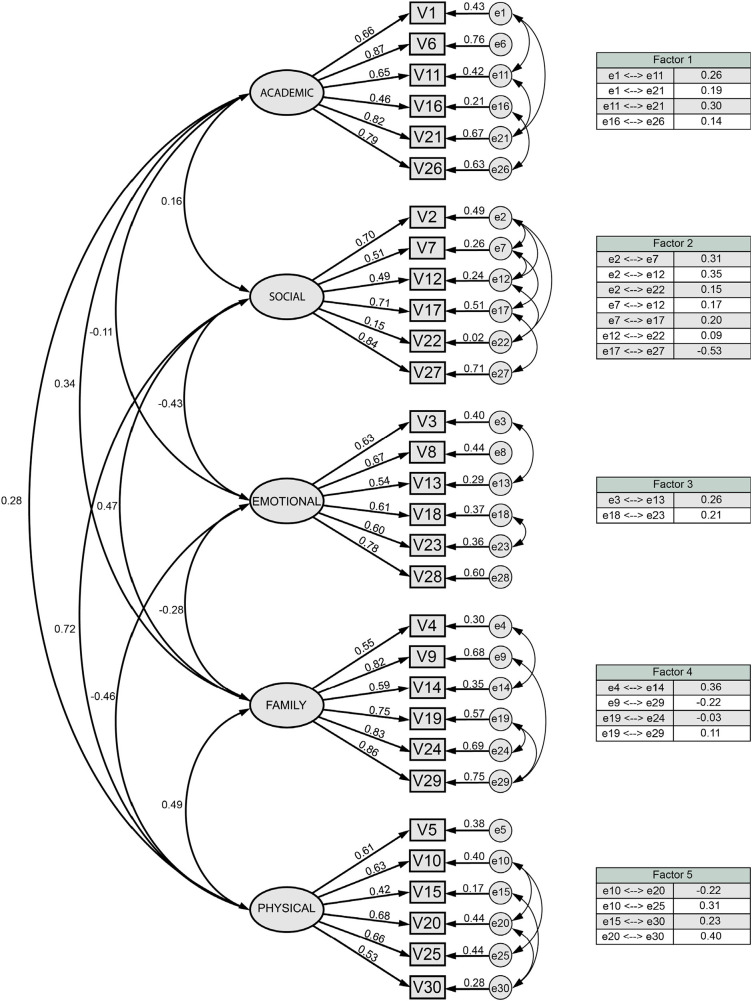 Figure 1
| Variable | Categories |
| % |
|---|---|---|---|
| Gender | Male | 564 | 48.8 |
| Female | 591 | 51.2 | |
| Grade | First (13 years old) | 221 | 19.1 |
| Second (14 years old) | 213 | 18.4 | |
| Third (15 years old) | 166 | 14.4 | |
| Fourth (16 years old) | 277 | 24.0 | |
| Fifth (17 years old) | 247 | 21.4 | |
| Sixth (18 years old) | 31 | 2.7 | |
| Province of the school | Cáceres | 627 | 54.3 |
| Badajoz | 528 | 45.7 | |
| School environment | Urban | 787 | 68.1 |
| Rural | 368 | 31.9 |
| Items | Family | Social | Physical | Emotional | Academic |
|---|---|---|---|---|---|
| 1. I do my schoolwork well | −0.003 | 0.080 | −0.063 | 0.028 | 0.778 |
| 2. I make friends easily | −0.024 | 0.956 | −0.063 | −0.018 | −0.045 |
| 3. I am afraid of some things | −0.061 | −0.035 | −0.129 | 0.612 | 0.062 |
| 4. I am criticized a lot at home | 0.744 | −0.081 | −0.039 | −0.099 | 0.004 |
| 5. I take care of myself physically | −0.060 | −0.093 | 0.717 | 0.073 | 0.101 |
| 6. My teachers consider me a good student | 0.004 | −0.027 | −0.034 | 0.045 | 0.895 |
| 7. I am a friendly person | 0.027 | 0.789 | −0.211 | 0.081 | 0.144 |
| 8. Many things make me nervous | −0.067 | 0.030 | −0.019 | 0.700 | −0.066 |
| 9. I am happy at home | 0.814 | 0.116 | −0.008 | 0.006 | 0.038 |
| 10. I am sought after for sports activities | −0.134 | 0.273 | 0.435 | −0.097 | 0.061 |
| 11. I work hard in class | 0.050 | −0.056 | −0.042 | 0.032 | 0.762 |
| 12. It is difficult for me to make friends | 0.041 | 0.768 | −0.151 | −0.087 | 0.001 |
| 13. I am easily frightened | −0.025 | −0.084 | −0.145 | 0.553 | 0.079 |
| 14. My family is disappointed with me | 0.568 | −0.025 | 0.029 | −0.070 | 0.281 |
| 15. I consider myself elegant | 0.012 | 0.224 | 0.347 | 0.131 | 0.111 |
| 16. My teachers esteem me | 0.018 | 0.144 | 0.011 | 0.024 | 0.582 |
| 17. I am a cheerful person | 0.294 | 0.595 | −0.031 | 0.022 | 0.032 |
| 18. When my elders tell me something I get very nervous | −0.127 | −0.112 | 0.061 | 0.598 | 0.061 |
| 19. My family would help me in any kind of problems | 0.843 | 0.063 | 0.113 | 0.039 | −0.026 |
| 20. I like the way I am physically | 0.247 | 0.010 | 0.565 | −0.013 | −0.005 |
| 21. I am a good student | 0.005 | 0.010 | −0.026 | 0.034 | 0.922 |
| 22. I find it hard to talk to strangers | −0.236 | 0.457 | −0.174 | 0.041 | −0.042 |
| 23. I get nervous when asked by the teacher | −0.002 | −0.065 | 0.004 | 0.580 | −0.068 |
| 24. My parents give me confidence | 0.815 | −0.032 | 0.108 | 0.024 | 0.020 |
| 25. I am good at sports | −0.102 | 0.132 | 0.649 | −0.121 | −0.021 |
| 26. My teachers consider me smart and hardworking | −0.010 | 0.002 | 0.051 | −0.060 | 0.848 |
| 27. I have many friends | 0.036 | 0.697 | 0.103 | −0.005 | 0.041 |
| 28. I feel nervous | −0.146 | −0.068 | 0.028 | 0.653 | −0.018 |
| 29. I feel loved by my parents | 0.840 | −0.040 | 0.229 | 0.025 | 0.033 |
| 30. I am an attractive person | 0.180 | 0.243 | 0.401 | 0.145 | 0.001 |
| Items | Family | Social | Physical | Emotional | Academic |
|---|---|---|---|---|---|
| 1. I do my schoolwork well | 0.778 | ||||
| 2. I make friends easily | 0.956 | ||||
| 3. I am afraid of some things | 0.612 | ||||
| 4. I am criticized a lot at home | 0.744 | ||||
| 5. I take care of myself physically | 0.717 | ||||
| 6. My teachers consider me a good student | 0.895 | ||||
| 7. I am a friendly person | 0.789 | ||||
| 8. Many things make me nervous | 0.700 | ||||
| 9. I am happy at home | 0.814 | ||||
| 10. I am sought after for sports activities | 0.435 | ||||
| 11. I work hard in class | 0.762 | ||||
| 12. It is difficult for me to make friends | 0.768 | ||||
| 13. I am easily frightened | 0.553 | ||||
| 14. My family is disappointed with me | 0.568 | ||||
| 15. I consider myself elegant | 0.347 | ||||
| 16. My teachers esteem me | 0.582 | ||||
| 17. I am a cheerful person | 0.595 | ||||
| 18. When my elders tell me something I get very nervous | 0.598 | ||||
| 19. My family would help me in any kind of problems | 0.843 | ||||
| 20. I like the way I am physically | 0.565 | ||||
| 21. I am a good student | 0.922 | ||||
| 22. I find it hard to talk to strangers | 0.457 | ||||
| 23. I get nervous when asked by the teacher | 0.580 | ||||
| 24. My parents give me confidence | 0.815 | ||||
| 25. I am good at sports | 0.649 | ||||
| 26. My teachers consider me smart and hardworking | 0.848 | ||||
| 27. I have many friends | 0.697 | ||||
| 28. I feel nervous | 0.653 | ||||
| 29. I feel loved by my parents | 0.840 | ||||
| 30. I am an attractive person | 0.401 |
| Factor 1 | Factor 2 | Factor 3 | Factor 4 | Factor 5 | |
|---|---|---|---|---|---|
| Factor 1 | 1 | ||||
| Factor 2 | 0.136 | 1 | |||
| Factor 3 | 0.018 | −0.245 | 1 | ||
| Factor 4 | 0.401 | 0.252 | −0.218 | 1 | |
| Factor 5 | 0.213 | 0.572 | −0.212 | 0.265 | 1 |
| Indices | Value |
|---|---|
| RMSEA | 0.041 |
| RMSR | 0.062 |
|
| 0.981 |
| CMIN/DF | 1.970 |
| NFI | 0.904 |
| CFI | 0.950 |
| Factor 1 | Factor 2 | Factor 3 | Factor 4 | Factor 5 | |
|---|---|---|---|---|---|
| Cronbach’s | 0.877 | 0.763 | 0.805 | 0.878 | 0.764 |
| McDonald's Omega | 0.844 | 0.780 | 0.806 | 0.878 | 0.768 |
| Explained variance | 4.196 | 3.553 | 2.520 | 4.284 | 2.081 |
- —Open Access Program of Universidad de Las Américas
Peer Reviews
No public reviews on file for this paper yet. If you reviewed it on a platform where reviews are public (OpenReview, ICLR, NeurIPS, ICML), you can paste yours below so the community can read it here.
Videos
No videos yet. Explain this paper in a talk, walkthrough, or lecture? Add one.
Taxonomy
TopicsMotivation and Self-Concept in Sports · Physical Education and Pedagogy · Education, Achievement, and Giftedness
Introduction
1
The prevalence of mental illness among young people has increased to 20% globally, making it a public health concern (1). In this sense, adolescence is a crucial stage for a person's development because it is during this time that many of the behaviors and routines that become a part of one's lifestyle are established (2). However, insufficient physical activity (PA) is present in 17.8% of boys and 31.9% of girls between the ages of 15 and 24, because their levels tend to fall with age (3). One of the most crucial elements in the prevention and treatment of various kinds of problems is PA (4), being school-based physical education (PE) one of the most accessible forms of PA for kids and adolescents (5). In general terms, PA produces an increase in executive function (6), psychological well-being (7), body satisfaction (8), and self-concept (9), as well as a decrease in depression and anxiety (10), have all been linked to PA in studies on the subject of mental health (11). In fact, given that it has a broad impact on mental health, psychological well-being, and behavior, self-concept is particularly important during the school years and is regarded as a major educational goal (12).
Self-concept has been defined as the individual's perceptions of himself, which are based on his experiences with others and the attributions he makes of his own behavior (13), as well as the individual's concept of himself as a physical, social and spiritual being (14). Under this view, there was a break with the theory prior to the 1980s, advocating a multidimensional structure of self-concept so that any person has a global self-evaluation of himself at the same time that he has more specific self-evaluations (15), differentially related to various areas of human behavior (16). In this context, adolescence is a critical period for the development of self-concept, during which physical, social and emotional changes occur and, therefore, negative self-perceptions may intensify (17), to which must be added the identity crisis that is usually experienced during this stage (18). However, the scientific literature is contradictory, with some studies finding an improvement in self-concept in early adolescence and a decline thereafter (19), while others argue for a U-shaped trend that reaches its lowest level in mid-adolescence (20), although this may be mainly due to the multidimensional nature of self-concept.
Conversely, school PE is acknowledged as a crucial opportunity to increase adolescents' PA mainly due to two perfectly described reasons, the possibility it offers to children and adolescents to accumulate moderate and/or vigorous PA (21) as well as providing them with motor skills, knowledge and a positive attitude towards PA (22). In addition, PA has recently been recognized as a potential marker of health among adolescents (23). In this sense, schools are urged to make sure that physical activity (PA) takes up the bulk of physical education (PE) class time and accounts for a sizable portion of students' daily PA requirements (24), however, most countries only offer a small number of weekly PE lessons, particularly throughout secondary education (25). In addition to the contribution of PE classes on the acquisition of PA habits, these generates an important improvement in self-concept through positive self-evaluation strategies, promoting self-esteem as well as developing students' skills and competences (26, 27).
Similarly, the literature shows numerous scales and questionnaires whose object of analysis is self-concept in adolescence (28, 29). However, and especially in the context of PE, these tools focus on the self-concept that students have at the physical level (30, 31), leaving aside other equally important dimensions such as academic or social, for example. This knowledge gap generates a series of limitations when implementing physical activity-based programs in the classroom that produce improvements in all dimensions of self-concept, because it will not be possible to understand how the socio-demographic characteristics of the students affect their self-concept, making it impossible to specifically design and adapt tasks and activities (32); to know how and to what extent each one of the dimensions of self-concept is related to the practice and acquisition of healthy lifestyle habits (33) and to assess how each of the dimensions is related in the adolescent stage in order to obtain a better self-concept at a general level (34).
In this direction, finding a gap that assesses the constructs of self-image within the physical education classroom, it has been considered important to investigate it for the benefits it could provide to the educational community. Therefore, the aim of this study is to present the psychometric properties, as well as validity and reliability issues of a questionnaire aimed at assessing the self-concept of secondary school students in the context of PE in one of the Autonomous Communities of Spain, Extremadura. In this way, it will be possible to know the current state of the self-concept of secondary school students so that the Ef curriculum can be adapted according to their needs and provide benefits to students at this educational level.
Methods
2
Sample
2.1
The sample consisted of 1,155 secondary school students from public schools in the Community of Extremadura. A convenience sampling method was used for recruitment. Table 1 shows the sociodemographic characteristics of the participants.
Instruments
2.2
First, a sociodemographic questionnaire composed of four questions (gender, grade, province of the school and school environment) was provided. The Spanish Five-Factor Self-Concept Questionnaire (AF-5) (35) was also used to analyze the students' self-concept. This scale is structured in 5 dimensions, each one of them containing 6 items. Dimension 1 (academic self-concept) refers to the student's perception of the quality of his/her role performance, either according to the feedback from his/her teachers or according to the qualities that the student perceives he/she possesses in this context. Dimension 2 (social self-concept), on the other hand, refers to the individual's social network and how easy or difficult it is to maintain and expand it, as well as to some important qualities in interpersonal relationships. The third dimension (emotional self-concept) states general perceptions about his or her general condition and specific situations where another person has a higher rank (teacher). The fourth dimension (family self-concept) analyzes aspects related to parents, family and home. Finally, the fifth dimension (physical self-concept) assesses the student's perceptions of his or her physical appearance and physical condition. The indirect items were swapped before data analysis such that they corresponded to each of the qualities stated above. The responses were based on a Likert scale of 1 (strongly disagree) to 5 (strongly agree). The authors reported an internal consistency value of 0.815 in the original paper, being greater than 0.70 for all tool dimensions (35).
Procedure
2.3
The questionnaire was created using the Google Forms tool and included the AF-5 and sociodemographic items. The use of an electronic questionnaire was chosen because it facilitated distribution, saved time, and allowed for the storage of all responses in a single database, increasing the return rate (36).
In order to access the sample, the Department of Education and Employment of the Regional Government of Extremadura's database of public schools in the Autonomous Community of Extremadura (Spain) was used (available at: http: http://estadisticaeducativa.educarex.es/?centros/ensenanzas/&curso=17&ensenanza_centro=101200001, accessed on September 2022). Contact information was chosen for centers offering courses belonging to secondary education (13–18 years). The physical education teachers were then informed about the study and asked to participate through email. The informed consent form was distributed to the schools that expressed interest in taking part, and legal guardians were required to sign it. Then, a researcher visited each educational facility to gather information from the students there. The socio-demographic questionnaire was first completed by the participants in the usual classroom while the researcher and teacher were present. The teacher told the adolescents whether to mark rural or urban depending on the features of their school (previously agreed upon with the researcher based on whether the localities had more or less than 30,000 residents). According to the Diputación de Cáceres website (https://www.dip-caceres.es, visited on September 2022), areas with fewer than 30,000 residents were regarded as rural. Next, the AF-5 scale was provided to the students. The surveys were distributed using tablets that belonged to the study team and were set up for this purpose in order to prevent technical mistakes. The entire data was collected anonymously, and the typical response time was 6 min. Data were collected between October, November, and December 2022.
Statistical analysis
2.4
Using a free statistical program called FACTOR v.10.10.02 (Rovira I Virgili University: Tarragona, Spain) (37), the exploratory analyses (EFA) were performed. This program took into account the ordinal nature of the data collected using a 5-choice Likert scale. A robust unweighted least squares (RULS) method with Promin rotation (38) was used for the factor extraction, presuming that there existed a correlation between them (39). The character of the data was taken into account using a polychoric correlation matrix (40), and the proper number of dimensions was established using parallel analysis (41). Once the number of dimensions was established, a normalized weighted oblimin (42) was selected as the rotation technique for determining factor simplicity and structure. Also, the Kaiser–Meyer–Olkin (KMO) and Bartlett tests of sphericity were used as sampling adequacy measures (43).
The AMOS v.26.0.0 software program (IBM Corporation, Wexford, PA, USA) was then used to do the confirmatory factor analysis (CFA). The components with loads lower than 0.60, crossloads greater than 0.40, and communalities lower than 0.30 were eliminated (44). Indicators were employed to gauge the model's goodness-of-fit, including: a root mean square error of approximation (RMSEA) (45), a root mean square of residuals (RMSR) (46), a chi-square per degree of freedom ratio (CMIN/DF) (47), the required non-significant values (p > 0.05) for the chi-squared probability calculation (48), a non-normed fit index (NFI) (49), and a comparative fit index (CFI) (50). Additionally, reliability indices such as Cronbach's alpha and McDonald's omega were employed to assess the questionnaire's final design (51).
Results
3
Using an RULS technique (52) with Promin rotation in the first half of the sample, five components linked to explained variance based on eigenvalues (53) and the validity of expected a posteriori (EAP) scores (54) were supplied. The sample adequacy indexes produced positive results (Bartlett test = 6518.2; df = 435; p = 0.000; and KMO test = 0.86769), which led to the execution of the EFAs. A weighted oblimin rotation method was selected once the number of dimensions was established since the quantity of kurtosis (kurtosis = 41.712; p = 0.000) called for non-parametric methods. The rotational loading matrix for 30 items and 5 factors is shown in Table 2.
Table 3 displays each item's structure and factor loadings (Spanish version can be found in Appendix B). The five correlated factors in the factor solution were as follows: (1) Academic self-concept; (2) Social self-concept; (3) Emotional self-concept; (4) Family self-concept and (5) Physical self-concept.
The relationship between the five dimensions of the AF-5 questionnaire—Academic self-concept, Social self-concept, Emotional self-concept, Family self-concept and Physical self-concept—is shown in Table 4.
Following the definition of the questionnaire's structure, a CFA was conducted with the remaining half of the sample to create a conclusive model (Figure 1).
Factor model of the AF-5.
Figure 1 shows the questionnaire's final format, which consists of 30 items separated into 5 dimensions and lists the following values from left to right: (1) correlations between factors, (2) normalized regression weights, (3) squared multiple correlations of each variable, and (4) correlations between exogenous variables (tables).
Table 5 displays the AF-5 goodness-of-fit indices that were obtained after the CFA, demonstrating each one of them a strong fit between the data and the model (55). The RMSEA was within the permitted range (0.010–0.050), and the RMSR, at less than 0.08, qualifies as accurate. Additionally, the non-significant values contributed to the excellent chi-squared probability. The CMIN/DF index also exhibited excellent values given that it must be less than 2 to be an acceptable model fit. Finally, NFI and CFI values greater than 0.9 demonstrated a good fit to the model.
Table 6 shows the reliability indices for the AF-5 questionnaire dimensions using Cronbach's alpha, McDonald's omega, and the explained variance of each factor.
For each of the components, the Cronbach's alpha and McDonald's omega scores were satisfactory because they were higher than 0.7 (56). The explained variance is the proportion of the variance in the responses that was not attributable to hazard (residual values) but was instead assigned to each of the model's components.
Discussion
4
The main contribution of this study is the assessment of the psychometric properties of the AF-5 scale that allows the evaluation of general self-concept and its dimensions specifically within the context of PE in secondary school students. Similarly, reliability and validity issues were analyzed so that the application of the instrument could be repeated in future research studies focusing on this population. The results yield a configuration of 30 items encompassed in 5 interrelated dimensions, all of them with excellent goodness-of-fit indices. In addition, reliability indicators showed great values. Originally, the validation and initial development of this scale took place in the Spanish population, to be later translated and adapted to different dialects and languages (35). In this sense, Malo-Cerrato (57) adapted and validated this scale to Catalan, evaluating its psychometric properties in a population sample from 11 to 63 years old, and although they eliminated one factor for convenience, the results of reliability and validity were satisfactory. Likewise, García and colleagues (58) adapted and validated the English version of the AF-5 in a sample of 600 American adolescents with results very similar to the original Spanish version. Later, Garcia et al. (59). adapted the scale again but to the Portuguese language, collecting a large sample of Brazilian adolescent participants and showing excellent results in each of the dimensions of the questionnaire. In addition, validations have been carried out in university populations in Spanish-speaking countries belonging to the South American continent (60, 61). However, to the authors’ knowledge, the AF-5 questionnaire has not been specifically validated in a secondary school population in Spain, much less in the context of PE.
Academic self-concept is the dimension understood as the attitude that conditions behavior and performance in the academic context, related to motivation and determining the behavior to be followed in the face of failure (62), depending not only on the academic achievement of each student, but also on the achievement of everyone in the school (63). Overall, research indicates that higher self-concept scores lead to better academic achievement and other desirable educational outcomes such as confidence and other related academic skills (64). This aspect is crucial because it would help teachers and others involved in the training process to better understand how students' self-concepts are formed and consolidated, enabling them to comprehend students better and give more appropriate feedback, especially to students who are less capable (65). As early as the 1990s, Marsh (66) observed that the subjects of Physical Education and Art were more closely related to dimensions of self-concept other than academic self-concept, such as physical or social. However, Goñi and Zulaika demonstrated that specific pedagogical strategies in the PE classroom can improve students' academic self-concept (67). Therefore, current research is focused on developing programs in the context of PE to promote the improvement of students' academic self-concept (68).
As for social self-concept, researchers have long recognized that self-evaluations are formed in relation to social and temporal comparisons, the better the performance in relation to others and in relation to their past accomplishments the more positive an individual's self-evaluations are (69). Thus, social self-concept is the social creation shaped by a person's interactions with others, his or her past and current afflictions and experiences within social and institutional contexts, and his or her location within the culture and social structure (70). In this context, Baena–Extremera found associations between the improvement of general self-concept and social relations in students participating in adventure programs in PE classes (71). Likewise, establishing a fearless atmosphere to increase students' mutual social acceptance and reduce indirect negative peer comments is a proven strategy in PE classrooms (72). Finally, another study highlights the importance of gender differences, with women perceiving less favorable climates than men and with the most unfavorable perceptions being held by women who have only sisters or no brothers, thus necessitating sports interventions that favor women's participation (73).
Emotional self-concept is related to the person's perception of his or her emotional state and the responses he or she gives to situations in his or her daily life (35). This self-concept also includes motivation, personality development and, in general, the social relationships and affective contact that the person has with him/herself (74). Similar to how behaviors that cannot be separated from an educational setting are heavily influenced by an individual's cultural heritage, emotions are as well (75). Empirical evidence indicates that low scores in this dimension tend to make people more prone to experience anxiety, depression and low performance in activities in general (76). Gómez–Mármol has already demonstrated the great possibilities available to PE teachers to design activities that improve students' emotional expression (77). Similarly, the area of PE has been pointed out as a context of innumerable possibilities to improve the emotional self-concept of students due to the diverse methodologies to propose motor games (78).
The family self-concept dimension focuses on a person's appreciation of relationships, involvement and implications in the family environment (35). High scores on this dimension indicate that people are more adaptive, more stable and their interpersonal relationships are stronger; low scores are associated with imbalance, immaturity and maladjustment (76). However, other authors, such as Loayza Gonzales (62), consider that social and family self-concept should form a single category. Amado-Alonso and collaborators proposed an intervention program based on organized sports practice, finding improvements in the family self-concept of students in the last cycle of primary education (79). Also, another study pointed out that family self-concept was the one that showed the best scores in adolescents who practiced basketball and that the longer the hours of practice, the better the results (80).
Finally, regarding physical self-concept, there is evidence of great theoretical and empirical development, where ability and physical appearance are determinants (81). In general terms, this dimension is relevant, because in adolescence it plays a fundamental role in the conception of self, specifically in the formation of self-image (76). Fernández-Bustos explored generated a theoretical model in adolescents with great results in which PA was positively related to self-concept and the mediators are family self-concept and body image (33). In order to strengthen students’ physical self-concept, it is critical that the subject of physical education considers experiences that support students' sense of personal identity and self-worth through the enhancement of quality motivation (82). Moreover, Spanish primary school students have a better physical self-concept than secondary school students, so that PE teachers at this stage should promote pedagogical strategies to ensure greater adherence to sports practice (83).
Limitations and future lines
4.1
The present study has a series of limitations like any other, for example, the analysis is focused on a specific autonomous community (Extremadura), so there are several oscillating demographic and cultural variables that affect the responses of the participants. Likewise, no randomization of the sample was carried out; instead, convenience sampling was used. In addition, the validation of an instrument requires more time and involves many different methodologies and large samples. Finally, the responses were collected through online questionnaires and not through a face-to-face interview method, so the results may vary to a lesser or greater extent. As future lines of research, it is suggested that larger samples from other autonomous communities be collected to validate the instrument throughout Spain. In the same way, results should be compared with other educational levels, such as primary and/or university education, in order to analyze how self-concept evolves throughout various stages of the life cycle.
Conclusions
5
This research presents the validity and reliability of a tool to assess the self-concept of secondary school students in the context of the PE area.
Students' self-concept about themselves reveals valuable information about their educational needs, which is even more important in a subject full of possibilities for developing and implementing pedagogical strategies to improve it. Knowing the validity and reliability of the instrument that measures the different dimensions of self-image allows educational authorities, teachers, parents and the whole school community to establish the basis of the construction and to be able to evaluate the tools and methodologies that can be implemented to improve the development of self-image in secondary school physical education students and to reduce the bad mental consequences that follow a poor self-concept in adolescent development.
The reference list from the paper itself. Each links out to its DOI / PubMed record.
- 1Belfer ML. Child and adolescent mental disorders: the magnitude of the problem across the globe. J Child Psychol Psychiat. (2008) 49:226–36. 10.1111/j.1469-7610.2007.01855.x 18221350 · doi ↗ · pubmed ↗
- 2Bogin B. Adolescence in evolutionary perspective. Acta Paediatr. (1994) 83:29–35. 10.1111/j.1651-2227.1994.tb 13418.x 7734808 · doi ↗ · pubmed ↗
- 3Ministerio de Sanidad Encuesta Europea de Salud En España. Available at: https://www.sanidad.gob.es/estad Estudios/estadisticas/Encuesta Europea/Enc_Eur_Salud_en_Esp_2020.htm (Accessed on 23 January 2023).
- 4Ahn S Fedewa AL. A meta-analysis of the relationship between children’s physical activity and mental health. J Pediatr Psychol. (2011) 36:385–97. 10.1093/jpepsy/jsq 10721227908 · doi ↗ · pubmed ↗
- 5Beasley EK Garn AC. An investigation of adolescent girls’ global self-concept, physical self-concept, identified regulation, and leisure-time physical activity in physical education. J Teach Phys Educ. (2013) 32:237–52. 10.1123/jtpe.32.3.237 · doi ↗
- 6Xue Y Yang Y Huang T. Effects of chronic exercise interventions on executive function among children and adolescents: a systematic review with meta-analysis. Br J Sports Med. (2019) 53:1397–404. 10.1136/bjsports-2018-09982530737201 · doi ↗ · pubmed ↗
- 7Mc Mahon EM Corcoran PO’Regan G Keeley H Cannon M Carli V Physical activity in European adolescents and associations with anxiety, depression and well-being. Eur Child Adolesc Psychiatry. (2017) 26:111–22. 10.1007/s 00787-016-0875-927277894 · doi ↗ · pubmed ↗
- 8Hartman-Munick SM Gordon AR Guss C. Adolescent body image: influencing factors and the clinician’s role. Curr Opin Pediatr. (2020) 32:455–60. 10.1097/MOP.000000000000091032487854 · doi ↗ · pubmed ↗