Translation, Cultural Adaptation, Validation and Reliability of Persian Left Ventricular Dysfunction–36 Questionnaire
Mehrbod Vakhshoori, Niloofar Bondariyan, Sayed Ali Emami, Niyousha Sadeghpour, Farbod Khanizadeh, Mahmood Emami, Davood Shafie

TL;DR
This study translated and validated a questionnaire to assess the impact of heart failure on Iranian patients' daily lives.
Contribution
The Persian version of the LVD-36 questionnaire was validated for use in Iranian heart failure patients.
Findings
The Persian LVD-36 questionnaire had high content validity (CVI 0.85–1.00, CVR 0.57–1.00).
The questionnaire showed excellent reliability with Cronbach’s alpha of 0.971 and ICC of 0.981.
Translation was completed without significant alterations and with full participant compliance.
Abstract
The left ventricular dysfunction 36 (LVD-36) questionnaire is considered to be a tool to assess the impact of left ventricle impairment on patients’ daily life. This methodological study was aimed to translate and assess the validity and reliability of the Persian draft of the LVD-36 questionnaire among Iranian heart failure (HF) patients. We recruited stable HF patients who referred to an outpatient heart clinic in Isfahan, Iran. The LVD-36 questionnaire was translated using the forward-backward method. Twenty HF patients were recruited for content validity assessment and were asked to express their opinions about the comprehensibility and meaningfulness of each item. We invited 14 experts to assess validity through content validity index (CVI) and content validity ratio (CVR). Reliability was assessed by Cronbach’s alpha and intraclass correlation coefficient (ICC), with the latter…
Genes, proteins, chemicals, diseases, species, mutations and cell lines named across the full text — each resolved to its canonical identifier and authoritative record.
Click any figure to enlarge with its caption.
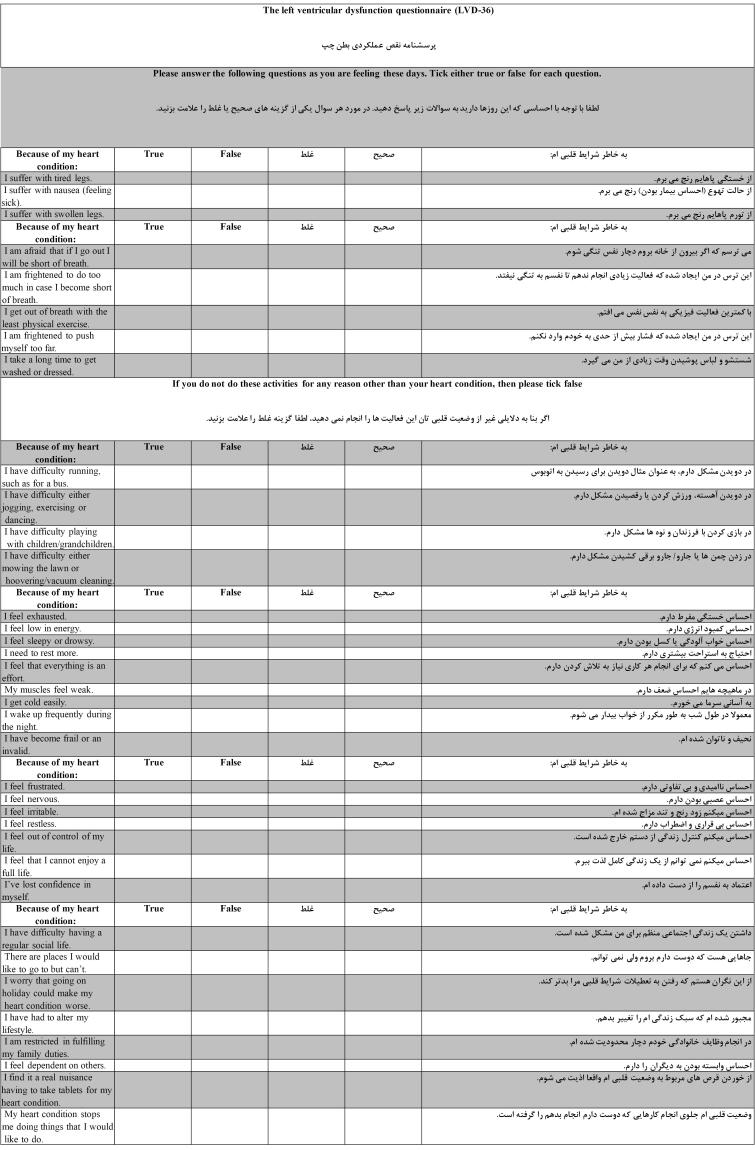 Figure 1
|
|
|
|
| Item 1 | 0.85 | 0.86 |
| Item 2 | 0.92 | 0.57 |
| Item 3 | 1.00 | 0.86 |
| Item 4 | 0.92 | 0.71 |
| Item 5 | 1.00 | 0.57 |
| Item 6 | 1.00 | 0.71 |
| Item 7 | 1.00 | 0.71 |
| Item 8 | 0.85 | 0.86 |
| Item 9 | 0.85 | 0.57 |
| Item 10 | 0.85 | 1.00 |
| Item 11 | 0.92 | 0.86 |
| Item 12 | 0.92 | 1.00 |
| Item 13 | 1.00 | 0.86 |
| Item 14 | 0.92 | 0.86 |
| Item 15 | 0.85 | 0.86 |
| Item 16 | 0.85 | 0.57 |
| Item 17 | 1.00 | 0.86 |
| Item 18 | 1.00 | 0.71 |
| Item 19 | 0.92 | 1.00 |
| Item 20 | 0.85 | 0.71 |
| Item 21 | 1.00 | 1.00 |
| Item 22 | 0.92 | 1.00 |
| Item 23 | 0.92 | 0.71 |
| Item 24 | 1.00 | 1.00 |
| Item 25 | 0.92 | 1.00 |
| Item 26 | 1.00 | 0.57 |
| Item 27 | 0.85 | 1.00 |
| Item 28 | 1.00 | 1.00 |
| Item 29 | 1.00 | 0.71 |
| Item 30 | 0.85 | 0.86 |
| Item 31 | 0.92 | 1.00 |
| Item 32 | 1.00 | 0.71 |
| Item 33 | 0.85 | 1.00 |
| Item 34 | 0.92 | 1.00 |
| Item 35 | 0.85 | 1.00 |
| Item 36 | 0.92 | 0.57 |
|
|
|
| ||
|
|
|
|
| |
| Item 1 | 140 (93) | 10 (15) | 117 (78) | 33 (22) |
| Item 2 | 141 (93) | 9 (15) | 138 (92) | 12 (15) |
| Item 3 | 107 (71) | 43 (29) | 67 (45) | 83 (55) |
| Item 4 | 136 (91) | 14 (9) | 139 (93) | 11 (15) |
| Item 5 | 140 (93) | 10 (15) | 140 (93) | 10 (15) |
| Item 6 | 142 (95) | 8 (5) | 142 (95) | 8 (5) |
| Item 7 | 142 (95) | 8 (5) | 142 (95) | 8 (5) |
| Item 8 | 133 (89) | 17 (11) | 134 (90) | 16 (10) |
| Item 9 | 147 (98) | 3 (2) | 147 (98) | 3 (2) |
| Item 10 | 136 (91) | 14 (9) | 138 (92) | 12 (15) |
| Item 11 | 135 (90) | 15 (10) | 134 (90) | 16 (10) |
| Item 12 | 140 (93) | 10 (15) | 141 (93) | 9 (15) |
| Item 13 | 144 (96) | 6 (4) | 141 (93) | 9 (15) |
| Item 14 | 146 (97) | 4 (3) | 146 (97) | 4 (3) |
| Item 15 | 145 (97) | 5 (3) | 145 (97) | 5 (3) |
| Item 16 | 145 (97) | 5 (3) | 143 (95) | 7 (5) |
| Item 17 | 145 (97) | 5 (3) | 145 (97) | 5 (3) |
| Item 18 | 147 (98) | 3 (2) | 146 (97) | 4 (3) |
| Item 19 | 147 (98) | 3 (2) | 144 (96) | 6 (4) |
| Item 20 | 145 (97) | 5 (3) | 142 (95) | 8 (5) |
| Item 21 | 144 (96) | 6 (4) | 141 (93) | 9 (15) |
| Item 22 | 145 (97) | 5 (3) | 144 (96) | 6 (4) |
| Item 23 | 138 (92) | 12 (15) | 138 (92) | 12 (15) |
| Item 24 | 141 (93) | 9 (15) | 141 (93) | 9 (15) |
| Item 25 | 143 (95) | 7 (5) | 143 (95) | 7 (5) |
| Item 26 | 141 (93) | 9 (15) | 141 (93) | 9 (15) |
| Item 27 | 141 (93) | 9 (15) | 141 (93) | 9 (15) |
| Item 28 | 141 (93) | 9 (15) | 141 (93) | 9 (15) |
| Item 29 | 139 (93) | 11 (15) | 139 (93) | 11 (15) |
| Item 30 | 142 (95) | 8 (5) | 142 (95) | 8 (5) |
| Item 31 | 142 (95) | 8 (5) | 142 (95) | 8 (5) |
| Item 32 | 144 (96) | 6 (4) | 144 (96) | 6 (4) |
| Item 33 | 143 (95) | 7 (5) | 143 (95) | 7 (5) |
| Item 34 | 144 (96) | 6 (4) | 144 (96) | 6 (4) |
| Item 35 | 145 (97) | 5 (3) | 145 (97) | 5 (3) |
| Item 36 | 145 (97) | 5 (3) | 145 (97) | 5 (3) |
| Total score | 94.09 ± 16.3% | 92.7 ± 16.3% | ||
|
|
|
|
| Item 1 | 0.621 | 0.970 |
| Item 2 | 0.789 | 0.969 |
| Item 3 | 0.387 | 0.974 |
| Item 4 | 0.674 | 0.970 |
| Item 5 | 0.727 | 0.970 |
| Item 6 | 0.753 | 0.970 |
| Item 7 | 0.775 | 0.970 |
| Item 8 | 0.748 | 0.970 |
| Item 9 | 0.625 | 0.970 |
| Item 10 | 0.662 | 0.970 |
| Item 11 | 0.614 | 0.971 |
| Item 12 | 0.640 | 0.970 |
| Item 13 | 0.535 | 0.971 |
| Item 14 | 0.696 | 0.970 |
| Item 15 | 0.690 | 0.970 |
| Item 16 | 0.690 | 0.970 |
| Item 17 | 0.637 | 0.970 |
| Item 18 | 0.234 | 0.971 |
| Item 19 | 0.483 | 0.971 |
| Item 20 | 0.677 | 0.970 |
| Item 21 | 0.748 | 0.970 |
| Item 22 | 0.499 | 0.971 |
| Item 23 | 0.831 | 0.969 |
| Item 24 | 0.672 | 0.970 |
| Item 25 | 0.740 | 0.970 |
| Item 26 | 0.902 | 0.969 |
| Item 27 | 0.902 | 0.969 |
| Item 28 | 0.713 | 0.970 |
| Item 29 | 0.884 | 0.969 |
| Item 30 | 0.943 | 0.969 |
| Item 31 | 0.943 | 0.969 |
| Item 32 | 0.784 | 0.970 |
| Item 33 | 0.883 | 0.969 |
| Item 34 | 0.852 | 0.969 |
| Item 35 | 0.750 | 0.970 |
| Item 36 | 0.717 | 0.970 |
Peer Reviews
No public reviews on file for this paper yet. If you reviewed it on a platform where reviews are public (OpenReview, ICLR, NeurIPS, ICML), you can paste yours below so the community can read it here.
Videos
No videos yet. Explain this paper in a talk, walkthrough, or lecture? Add one.
Taxonomy
TopicsHeart Failure Treatment and Management · Chronic Disease Management Strategies · Health Education and Validation
Introduction
Heart failure (HF) is defined as impaired ventricular filling or decreased heart ability to pump blood to meet systemic needs. It is divided into right and left HF with different signs and symptoms. Left ventricle dysfunction (LVD) is the most common cause of congestive HF in the context of several etiologies including hypertension, ischemic heart disease, diabetes, and structural problems of the heart.^1-3^ Left HF manifestations are paroxysmal nocturnal dyspnea, shortness of breath, orthopnea, and/or symptoms of volume overload (including increased abdominal girth, weight gain, leg swelling, or right upper quadrant pain due to liver congestion)^1^, which are disabling and negatively impact patients’ quality of life.^4^ HF is also known as a major growing medical and economic problem worldwide.^5,6^ According to the World Health Organization (WHO), the quality of life (QoL) is defined as: “an individual’s perception of their position in life in the context of the culture and value systems in which they live and their goals, expectations, and standards, and concerns”. This concept is influenced by various factors, including physical health, personal beliefs, psychological well-being, social relationships, and the individual’s interaction with salient features of their environment.^7^
QoL is one of the most critical aspects of health which is affected by illnesses, and without a doubt, chronic diseases are more serious. They are increasingly becoming more and more common in recent decades.^4^ For patients with chronic conditions like mental disorders, asthma, kidney disease, chronic obstructive pulmonary disease, and congestive HF, evaluating the “quality of life” through health status measurement has become crucial in assessing the disease impact and effectiveness of treatment.^8^
Questionnaires are used as tools to measure the QoL. Due to the variety of illnesses and their consequent morbidities, several QoL questionnaires are needed for further evaluation. In terms of congestive HF, several related questionnaires are available such as Chronic Heart Failure Assessment Tool (CHAT), Cardiac Health Profile congestive heart failure (CHPchf), Chronic Heart Failure Questionnaire (CHFQ), Kansas City Cardiomyopathy Questionnaire (KCCQ), Minnesota Living with Heart Failure Questionnaire (MLHFQ) and Quality of Life Questionnaire in Severe Heart Failure (QLQ-SHF), each of which has a specific application and is sometimes used in combination with or instead of others.^9-14^ However, using these questionnaires might be associated with difficulties regarding the required time in order to fill out the questionnaire completely as well as the total questionnaire length. Left Ventricular Disease Questionnaire (LVDQ) is a new short questionnaire designed for patients suffering from left ventricular impairment and can be completed in a timely manner. It is composed of 36 questions with true/false answers, and the results will be presented in the range 0–100%, which are the best and the worst scores, respectively.^15^ This questionnaire is also known as the left ventricular dysfunction questionnaire (LVD-36) and has been reported as a reliable and suitable tool for use to assess quality of life among patients with LVD.^16,17^
The LVD-36 is originally in English and has been translated into other languages like Italian.^18^ Due to its importance and appliance and lack of a Persian version of the questionnaire, it needs to be translated into Persian for use in Iran. In this article, we decided to translate the questionnaire into Persian and examine its validity and reliability among Persian-speaking patients in Iran.
Materials and Methods
LVD-36 Questionnaire
The LVD-36 questionnaire is specifically designed to assess the impact of left ventricular impairment on the daily life of HF patients. It consists of 36 items, each with a true or false answering scale. The responses are summed, and the final score is reported as a percentage ranging from 0 (indicating the best possible score) to 100 (representing the worst possible score).^15^
Translation
The translation process of the questionnaire, reported by Beaton et al, involved five phases.^19^ First, two bilingual translators, both native Persian speakers with fluency in English, were enlisted to independently translate the questionnaire from English to Persian. Only one of the translators had familiarity with medical terminology. They were asked to use meaningful and straightforward terms for translation at the second step. The first translated version was created after a final consensus between translators. Next, this Persian draft was translated backward to English. A meeting was held to discuss the pre-final version of the questionnaire with two translators and methodologists in the fourth step. Finally, we distributed the questionnaire among 20 patients who suffered from HF. They were asked to express their understanding of each question to the principal investigator. Their comments and probable questions were reviewed for possible modification of the questionnaire.
Validity
A total of 14 experts, including 5 cardiologists, 2 general practitioners, 2 pharmacists, 1 statistician, and 4 nurses, were invited to assess the validity of the questionnaire. Each expert provided their feedback regarding the relevance, understandability, and comprehensibility of each item using a 4-point rating scale. The scale options were as follows: (1) not suitable, (2) suitable with minor adjustments, (3) suitable but requiring some modifications, and (4) very suitable. To calculate the CVI, the number of experts who rated an item as 3 or 4 was divided by the total number of experts. We considered the value of 0.80 as acceptable. Lower item CVI was defined as 0.70–0.79: re-evaluation required, < 70: candidate for omission.^20,21^ For CVR measurement, the experts were required to declare their opinions about each provided item on the questionnaire with a 3-item scale (essential, important but not essential, not essential). A ratio of at least 0.57 was defined as acceptable.^22^
Reliability
We evaluated the internal consistency of the questionnaire using Cronbach’s alpha coefficient, which is a measure of reliability. The interpretation of Cronbach’s alpha values is as follows: ≥ 0.9 indicates excellent internal consistency, 0.8–0.9 indicates good internal consistency, 0.7–0.79 indicates acceptable internal consistency, 0.6–0.69 indicates questionable internal consistency, 0.5–0.59 indicates poor internal consistency, and < 0.5 indicates unacceptable internal consistency.^23^ We measured test-retest reliability by asking the recruited participants to answer the questionnaire questions for the second time after approximately two weeks, and the calculated ICC was characterized as follows: ≥ 0.75: excellent, 0.4–0.75: fair to good, and < 0.4: poor.^24^
Floor and Ceiling Effect
We evaluated the presence of floor and ceiling effects by examining whether more than 15% of the study population obtained the lowest and highest scores, respectively.
Statistical Analysis
The distribution of the participants’ answers on each questionnaire item was reported as frequency (percentage). Also, mean ± standard deviation (SD) was used to report total scores. All analyses were done with the Statistical Package for Social Sciences (SPSS) version 22 (IBM Corp., Armonk, NY, USA).
Ethical Considerations
The Ethics Committee of Isfahan University of medical sciences (IUMS) approved this study (IR.MUI.MED.REC.1400.562). At the start of the study, the principal investigator provided a comprehensive explanation of the main objectives to each participant. Ample time was given to participants to ask any questions they had about the project. Moreover, all individuals were assured that their personal information would remain confidential and not divulged publicly. Finally, each patient was provided with a written consent form to sign.
Results
Questionnaire Performance
Out of 20 HF patients who fulfilled the questionnaire, most declared that all the questions were easily understandable in the translated version and no major changes were made in the final questionnaire. Figure 1 shows the Persian version of the LVD-36 questionnaire in comparison to the original one. The final Persian draft of the LVD-36 questionnaire is presented in Supplementary file 1.
**
Questionnaire Validity
Table 1 presents data on the CVI and CVR of each questionnaire item. All questions had CVI ranging from 0.85 to 1.00. Moreover, each item showed acceptable CVR (minimum: 0.57, maximum: 1.00).
Participants’ Characteristics
A total of 150 HF patients completed the questionnaire on two separate occasions, with a two-week interval between each administration (age: 64.6 ± 16 years, males: 58.6%). The distribution of their answers based on each item on the first and second round of questionnaire completion is shown in Table 2. The mean LVD score after the first completion was 94.09 ± 16.3%.
Questionnaire Reliability
The Cronbach’s alpha coefficient of the current Persian version of the LVD-36 questionnaire was 0.971, showing excellent internal consistency. The ICC of the questionnaire two weeks after the second round of completion was found to be 0.981 (95% confidence interval [CI]: 0.977-0.985). The reliability indices of questionnaire items are shown in Table 3. The minimum and maximum values of corrected item-total correlation (CITC) were 0.234 (item 18) and 0.943 (items 30 and 31), respectively. Also, all items contributed desirably to internal reliability in a way that deletion of questions did not significantly increase the value of Cronbach’s alpha.
Floor and Ceiling Effect
No instances of the highest or lowest scores were observed in our study population, indicating the absence of both floor and ceiling effects.
Discussion
In this study, we aimed to investigate the validity and reliability of the Persian version of the LVD-36 questionnaire. We found that this questionnaire could appropriately assess the main health issues of Iranian patients suffering from HF. The prevalence of HF has increased during recent years, and assessing its effect on patients’ daily life could significantly aid in better implementation of therapeutic strategies.
This questionnaire was first developed based on 179 items collected from multiple sources, including prior questionnaires, published records, patient interviews, and physician consultations. After the completion of all items by 139 individuals suffering from left ventricular impairment and further analysis, 36 items were finally selected, and the final version of the LVD-36 questionnaire was officially introduced.^25,26^
We used one of the most common translation methods, namely the forward-backward method. The dual-panel is another method using two different phases, including a bilingual panel and a lay panel. The first panel conducts the initial translation of the questionnaire, while the second group, consisting of monolingual individuals, is asked to provide feedback on the clarity and comprehensibility of the translated version.^27,28^ It has been reported that the dual-panel method has fewer missing items during the translation process. However, this method is more time-consuming and might be associated with difficulties to perform thoroughly.^29^ Moreover, it has been recommended that the translated draft of the questionnaire is needed to be combined with backward translation.^27,30^ Therefore, we decided to use the common forward-backward translation method. Also, our findings revealed that there was not any missing item during translation of the original LVD-36 questionnaire. The respondents declared that the questionnaire had appropriately understandable questions and needed approximately five minutes for completion.
Our results in terms of reliability, as an index to evaluate the ability of the questionnaire for accurate measurement, revealed a Cronbach’s alpha of 0.971. Also, after completing the questionnaire for the second time by all participants, the ICC value was found to be 0.981 (95% CI: 0.977–0.985), that indicates this questionnaire is a reliable tool for assessing general health among HF patients. O’Leary and Jones recruited 60 patients with chronic left ventricle dysfunction to assess the reliability of the LVD-36 questionnaire. All patients completed the questionnaire for the first time, with 53 subjects re-completing one to three weeks later. The mean time reported to be taken in order to complete the questionnaire was approximately 5 minutes. The internal consistency of the LVD-36 questionnaire was 0.95 with a similar ICC (0.95). They suggested that this questionnaire has a high degree of reliability with unambiguous wording.^15^ Moreover, Miani et al recruited 50 patients with congestive HF and translated the original questionnaire to the Italian language. After assessing reliability, they suggested that this instrument was a reliable tool among Italian patients.^18^ The floor and ceiling effect values in another study were 0 and 3%, respectively.^15^ However, we did not observe this effect among our responders.
This study demonstrates that the Persian version of the LVD-36 questionnaire showed good content validity, indicating that the instrument accurately measured its intended constructs. Additionally, a comparison between the LVD-36 and the short-form 36 (SF-36) questionnaire revealed stronger correlations in physical well-being and weaker correlations in psychosocial well-being.^15^ Another study revealed that the Italian version of the LVD-36 questionnaire correlated well with the MLHF questionnaire.^18^
To the best of our knowledge, this study is the first in the literature to assess the reliability and validity of the Persian-translated LVD-36 questionnaire among Iranian HF patients. Completing by a large number of study samples twice without any missing data could be considered another strength of the current study. However, some limitations also exist. This study was implemented in a single center, and our findings might not be generalizable to other Iranian individuals living in other Iranian cities. We also did not assess the educational levels of the enrolled participants, which might have affected our outcomes.
Conclusion
In conclusion, the Persian version of the LVD-36 questionnaire is as accurate and reliable as the original version. It is simple and understandable, has a high reliability and validity index, and can be used in clinical settings to assess the quality of life and general health status of Iranian HF patients.
Supplementary Files
Supplementary file 1 contains Figure S1. Click here for additional data file.
The reference list from the paper itself. Each links out to its DOI / PubMed record.
- 1Pazos-López P Peteiro-Vázquez J Carcía-Campos A García-Bueno L de Torres JP Castro-Beiras A The causes, consequences, and treatment of left or right heart failure Vasc Health Risk Manag 201172375410.2147/vhrm.s 1066921603593 PMC 3096504 · doi ↗ · pubmed ↗
- 2Mant J Doust J Roalfe A Barton P Cowie MR Glasziou P Systematic review and individual patient data meta-analysis of diagnosis of heart failure, with modelling of implications of different diagnostic strategies in primary care Health Technol Assess 200913321207, iii 10.3310/hta 1332019586584 · doi ↗ · pubmed ↗
- 3Megari K Quality of life in chronic disease patients Health Psychol Res 201313 e 2710.4081/hpr.2013.e 2726973912 PMC 4768563 · doi ↗ · pubmed ↗
- 4Lesyuk W Kriza C Kolominsky-Rabas P Cost-of-illness studies in heart failure: a systematic review 2004-2016 BMC Cardiovasc Disord 20181817410.1186/s 12872-018-0815-329716540 PMC 5930493 · doi ↗ · pubmed ↗
- 5Agbor VN Ntusi NAB Noubiap JJ An overview of heart failure in low- and middle-income countries Cardiovasc Diagn Ther 20201022445110.21037/cdt.2019.08.0332420107 PMC 7225422 · doi ↗ · pubmed ↗
- 6WHOQOL Group Study protocol for the World Health Organization project to develop a Quality of Life assessment instrument (WHOQOL)Qual Life Res 199322153910.1007/bf 004357348518769 · doi ↗ · pubmed ↗
- 7Diederichs C Berger K Bartels DB The measurement of multiple chronic diseases--a systematic review on existing multimorbidity indices J Gerontol A Biol Sci Med Sci 20116633011110.1093/gerona/glq 20821112963 · doi ↗ · pubmed ↗
- 8Dunderdale K Thompson DR Beer SF Furze G Miles JN Development and validation of a patient-centered health-related quality-of-life measure: the chronic heart failure assessment tool J Cardiovasc Nurs 20082343647010.1097/01.JCN.0000317439.82704.e 818596501 · doi ↗ · pubmed ↗