Radiotherapy dose escalation using pre-treatment diffusion-weighted imaging in locally advanced rectal cancer: a planning study
Nathan Hearn, Alexandria Leppien, Patrick O’Connor, Katelyn Cahill, Daisy Atwell, Dinesh Vignarajah, Myo Min

TL;DR
This study explores using MRI scans to guide higher radiation doses in rectal cancer patients, aiming to improve treatment effectiveness.
Contribution
This is the first study to evaluate the feasibility of diffusion-weighted imaging (DWI)-targeted upfront radiotherapy boost in locally advanced rectal cancer.
Findings
Dose escalation to diffusion-restricted tumor regions was feasible in all cases with conformality constraints mostly met.
Combined boost and long-course plans generally met dose constraints for organs at risk, though bladder and bowel spillage occurred in some cases.
Plans passed quality assurance tests, supporting the feasibility of this approach with proper patient selection.
Abstract
Diffusion-weighted MRI (DWI) may provide biologically relevant target volumes for dose-escalated radiotherapy in locally advanced rectal cancer (LARC). This planning study assessed the dosimetric feasibility of delivering hypofractionated boost treatment to intra-tumoural regions of restricted diffusion prior to conventional long-course radiotherapy. Ten patients previously treated with curative-intent standard long-course radiotherapy (50 Gy/25#) were re-planned. Boost target volumes (BTVs) were delineated semi-automatically using 40th centile intra-tumoural apparent diffusion coefficient value with expansions (anteroposterior 11 mm, transverse 7 mm, craniocaudal 13 mm). Biased-dosed combined plans consisted of a single-fraction volumetric modulated arc therapy flattening-filter-free (VMAT-FFF) boost (phase 1) of 5, 7, or 10 Gy before long-course VMAT (phase 2). Phase 1 plans were…
Genes, proteins, chemicals, diseases, species, mutations and cell lines named across the full text — each resolved to its canonical identifier and authoritative record.
Click any figure to enlarge with its caption.
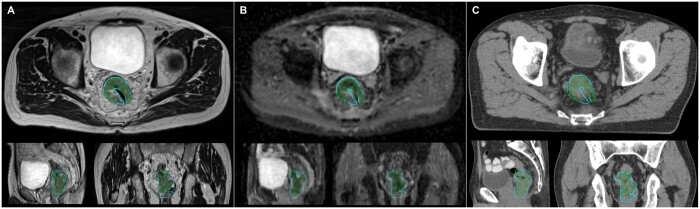 Figure 1
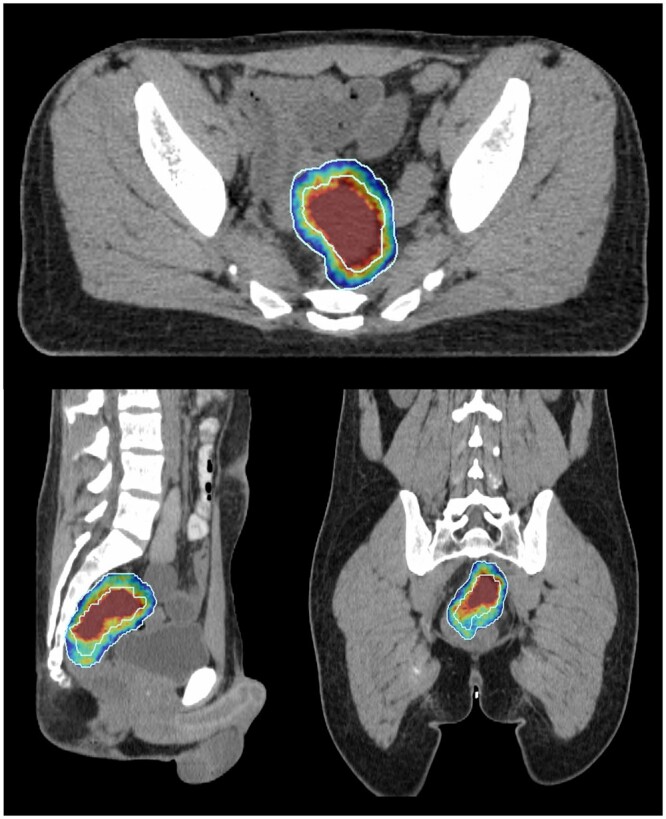 Figure 2
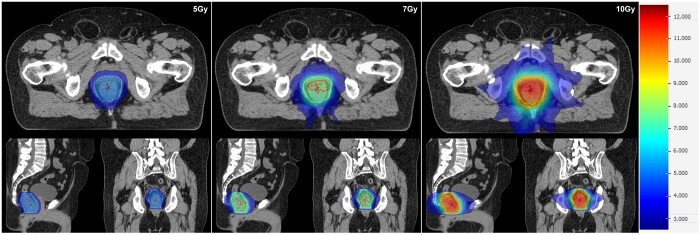 Figure 3
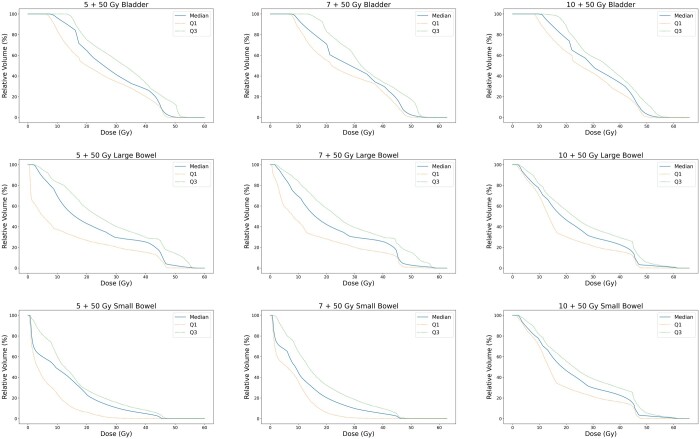 Figure 4
Peer Reviews
No public reviews on file for this paper yet. If you reviewed it on a platform where reviews are public (OpenReview, ICLR, NeurIPS, ICML), you can paste yours below so the community can read it here.
Videos
No videos yet. Explain this paper in a talk, walkthrough, or lecture? Add one.
Taxonomy
TopicsColorectal Cancer Surgical Treatments · MRI in cancer diagnosis · Radiomics and Machine Learning in Medical Imaging