Goiter in the paintings by Rogier van der Weyden (1399–1464)
H. Ashrafian

Abstract
Genes, proteins, chemicals, diseases, species, mutations and cell lines named across the full text — each resolved to its canonical identifier and authoritative record.
Click any figure to enlarge with its caption.
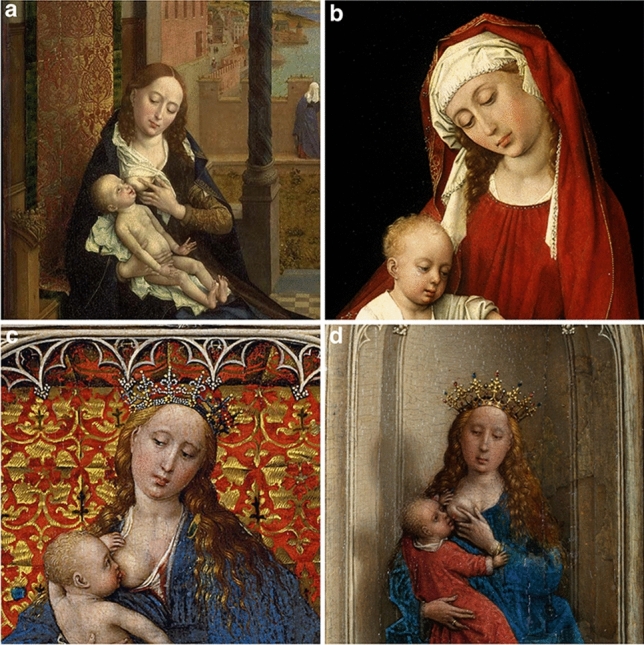 Figure 1
Peer Reviews
No public reviews on file for this paper yet. If you reviewed it on a platform where reviews are public (OpenReview, ICLR, NeurIPS, ICML), you can paste yours below so the community can read it here.
Videos
No videos yet. Explain this paper in a talk, walkthrough, or lecture? Add one.
Taxonomy
TopicsRegional Development and Innovation
Rogier van der Weyden (1399–1464) is regarded as one of the forefathers of Northern Renaissance art. Born in Tournai, Belgium in 1399/1400 he became a painter notably influenced by Jan van Eyck [1], and rapidly demonstrated his own innovation, for example presenting a character (Saint Luke most likely as a self-portrait) directly in the presence of the Virgin character, a novel stylistic revolution for that time.
I now note examples of Goiters in several paintings by Rogier van der Weyden (Fig. 1a–d.). While other examples do exist in Northwestern Europe and Southern Europe, where goiter is presented through fullness and the signs of da Vinci Sign (loss or shallowing of the suprasternal notch recess) or Botticelli (cranio-cervical neck flexion accentuating thyroid enlargement) [2], the cases presented by van der Weyden are among the earliest.Fig. 1. Rogier van der Weyden a Saint Luke Drawing the Virgin (1435–40) © Boston Museum of Fine Arts, Boston, USA b The Durán Madonna (c.1435–38) © Museo del Prado, Madrid, Spain c The Madonna Standing (c.1430–1432) © Kunsthistorisches Museum, Vienna, Austria d The Virgin and Child Enthroned (1433) © Thyssen-Bornemisza Museum, Madrid, Spain
The goiters presented (concomitant with the stylism of icon paintings in the eyelids and skin color hues), could have been representative of realistic underlying pathology that may have originated from endemic iodine deficiency (rather than autoimmunity and orbitopathy seen in other Renaissance paintings) [3, 4]. This early Northern Renaissance work highlights the pertinence of thyroid disease in across the breadth of Renaissance Europe presented through the hands of genius master artists of the era.
The reference list from the paper itself. Each links out to its DOI / PubMed record.
- 1Ashrafian H Hypothyroidism in the “Arnolfini Portrait” (1434) by Jan Van Eyck (1390–1441)J Endocrinol Invest 20184114514710.1007/s 40618-017-0751-628889340 PMC 5754372 · doi ↗ · pubmed ↗
- 2Ashrafian H Goiters in the renaissance era multiple cases of thyroid autoimmunity and iodine deficiency Best Pract Res Clin Endocrinol Metab 20233710174810.1016/j.beem.2023.10174836868952 · doi ↗ · pubmed ↗
- 3Ashrafian H Differential diagnosis of a Thyroid mass, Gottron’s papules, Calcinosis Cutis and Ptosis on the Saint Mary Magdalen and two depictions of a madonna and baby by Bartolomeo Vivarini (1432–1499)J Endocrinol Invest 2023461043104510.1007/s 40618-023-02004-836633790 PMC 10105650 · doi ↗ · pubmed ↗
- 4Trimarchi F Martino E Endemic goiter in two masterpieces by Piero della Francesca (c.1415–1492)J Endocrinol Invest 202310.1007/s 40618-023-02005-736609774 · doi ↗ · pubmed ↗