Desvenlafaxine-Triggered Acneiform Eruptions on the Hand: A Compelling Case Report
Anupam S Yadav, Sonali Singh, Jaismeen Randhawa, Chinaza M Akuma, Ogbonnaya Akuma, Hassan A Chaudhry

TL;DR
A 45-year-old man developed a skin rash on his hand after taking desvenlafaxine, and the symptoms resolved after stopping the medication.
Contribution
This case report highlights desvenlafaxine as a potential cause of acneiform eruptions, emphasizing the need for awareness of rare drug side effects.
Findings
The patient's skin eruption resolved after discontinuing desvenlafaxine.
The Naranjo score indicated a probable drug-induced skin reaction.
The case suggests a possible adverse effect of desvenlafaxine not widely reported.
Abstract
A 45-year-old male developed a skin eruption after starting Desvenlafaxine for depressive symptoms associated with schizophreniform disorder. The patient developed a rash on the hand, hyperpigmentation, and itching, which resolved after discontinuing the medication. The Naranjo score suggested a probable link between desvenlafaxine and the skin reaction. Stable vital signs and normal labs supported this conclusion. The case underscores the importance of recognizing and reporting adverse drug reactions, even with generally safe medications like desvenlafaxine. Further research with larger samples is needed to explore this relationship in more depth.
Genes, proteins, chemicals, diseases, species, mutations and cell lines named across the full text — each resolved to its canonical identifier and authoritative record.
Click any figure to enlarge with its caption.
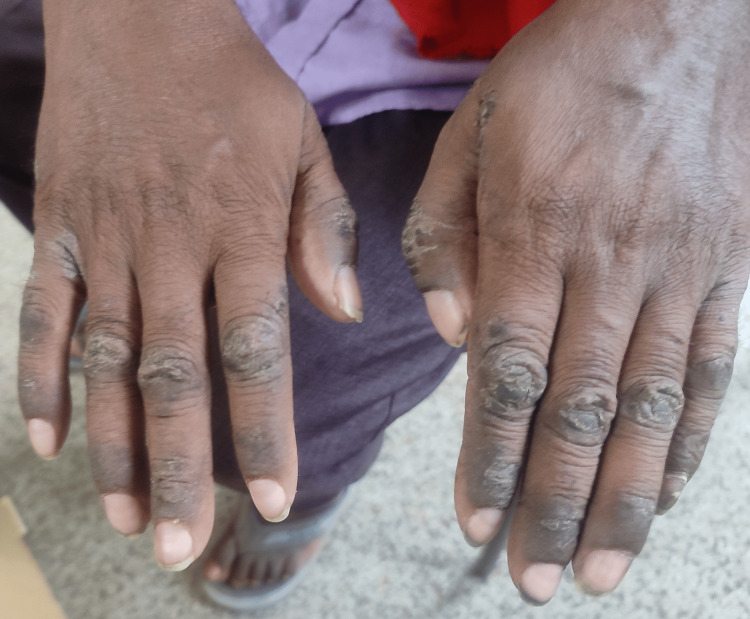 Figure 1
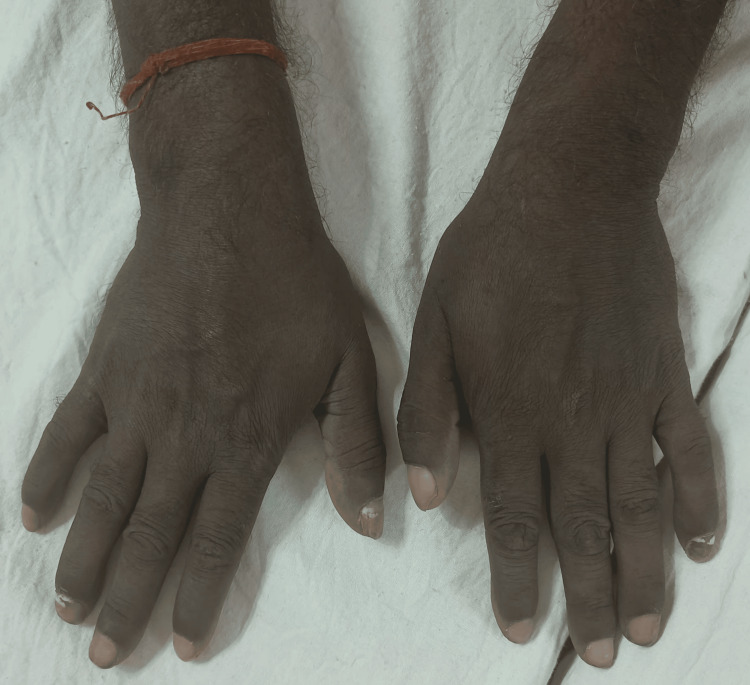 Figure 2
| Naranjo scoring | ||||
| Question | Yes | No | Do Not Know | Score |
| 1. Are there previous conclusive reports on this reaction? | +1 | 0 | 0 | +1 |
| 2. Did the adverse event appear after the suspected drug was administered? | +2 | -1 | 0 | +2 |
| 3. Did the adverse reaction improve when the drug was discontinued or a specific antagonist was administered? | +1 | 0 | 0 | +1 |
| 4. Did the adverse reaction reappear when the drug was readministered? | +2 | -1 | 0 | 0 |
| 5. Are there alternative causes (other than the drug) that could on their own have caused the reaction? | -1 | +2 | 0 | +2 |
| 6. Did the reaction reappear when a placebo was given? | -1 | +1 | 0 | 0 |
| 7. Was the drug detected in the blood (or other fluids) in concentrations known to be toxic? | +1 | 0 | 0 | 0 |
| 8. Was the reaction more severe when the dose was increased, or less severe when the dose was decreased? | +1 | 0 | 0 | 0 |
| 9. Did the patient have a similar reaction to the same or similar drugs in any previous exposure? | +1 | 0 | 0 | 0 |
| 10. Was the adverse event confirmed by any objective evidence? | +1 | 0 | 0 | 0 |
| Total | +6 | |||
Peer Reviews
No public reviews on file for this paper yet. If you reviewed it on a platform where reviews are public (OpenReview, ICLR, NeurIPS, ICML), you can paste yours below so the community can read it here.
Videos
No videos yet. Explain this paper in a talk, walkthrough, or lecture? Add one.
Taxonomy
TopicsDrug-Induced Ocular Toxicity · Drug-Induced Adverse Reactions · Chemotherapy-related skin toxicity
Introduction
Drug-induced skin reactions, also known as drug eruptions, can be categorized as simple/mild or complex/severe based on their potential to cause harm. Simple drug reactions typically manifest as rashes, with one common type being exanthem. These rashes tend to appear within 7 to 10 days after starting a medication. Drug exanthems are the most frequent skin reactions to medications and can present as morbilliform or maculopapular reactions on the skin [1].
Among psychotropic drugs, desvenlafaxine is a commonly prescribed SNRI (dual serotonin and norepinephrine reuptake inhibitor) [2]. While it is generally well-tolerated, adverse cutaneous reactions associated with desvenlafaxine are extremely rare, with only a limited number of cases documented in the medical literature. The reported incidence of drug-induced skin reactions linked to psychotropic drugs is low, at 0.1%. Among these reactions, antidepressants account for 29%. The likelihood of experiencing a rash or pruritus (itchiness) varies among different psychotropic drugs, with bupropion having the highest rate at 3.7% and fluoxetine, paroxetine, sertraline, and venlafaxine having the lowest rates, all less than 1% [3].
Interestingly, there have been very few reports of skin reactions associated with desvenlafaxine. Therefore, we present a case report of a middle-aged man who developed drug-induced skin eruptions due to desvenlafaxine.
Case presentation
A 45-year-old male presented at the psychiatric outpatient department with a three-month history of anxiety, social withdrawal, suspiciousness, forgetfulness, sleep disturbances, and reduced appetite, without any identifiable precipitating factor. During the mental status examination, he exhibited reduced eye contact, slowed physical movements, brief and hesitant speech, delusions of persecution, and limited emotional expression. He was diagnosed with schizophreniform disorder as per DSM-5 criteria and initiated on a daily dose of 5 mg of olanzapine, which was gradually titrated to 10 mg per day over the next four to six weeks.
In the ensuing 1.5 months, notable amelioration of symptoms was noted. Nonetheless, the patient subsequently reported enduring fatigue, bodily discomfort of the body being too heavy and lethargic, persistent, albeit not overwhelming, anxiety, a low mood, and reduced interest in previously enjoyable activities. These emerging symptoms may be ascribed to either the negative manifestations of schizophrenia or the onset of concurrent depressive symptoms. A more thorough evaluation of the symptom progression and its nature was suggestive of a depressive origin [4].
During a follow-up visit at three months, the patient was initiated on a morning dose of 50 mg of desvenlafaxine to address the aforementioned complaints along with the ongoing treatment. Notably, he had no prior history of allergies, drug reactions, or medical illnesses. Approximately one week after initiating the medication, a rash appeared on the extensor aspect of his hand. Despite this, the patient continued to take desvenlafaxine, and within the subsequent week, he observed a worsening of the rash on his hand, accompanied by hyperpigmentation, acne-like lesions, and itching. Consequently, he discontinued the medication and noted a mild reduction in itching without further exacerbation of the rash when he returned for a review.
Upon examination, an exanthematous rash comprising papules, hyperpigmentation mostly on the extensor aspect of proximal and distal inter-phalangeal joints, and mild localized erythema was observed, as illustrated in Figure 1. Notably, this condition was confined to the affected area, with no involvement of the oral or conjunctival mucosa. The patient did not exhibit any fever, joint swelling, or any other tissue involvement. Vital signs were stable, with only a slight increase in local temperature. A comprehensive systemic examination yielded results within normal parameters. Consequently, the patient was referred to the dermatology department for a professional assessment and treatment of the rash.
Exanthematous rash comprising papules, hyperpigmentation mostly on the extensor aspect of proximal and distal inter-phalangeal joints, intertriginous spaces and mild localized erythema.
The diagnosis rendered by the dermatology team was drug-induced exanthem, leading to the prescription of a local steroid ointment and antihistamine medication. Laboratory investigations, including a complete blood count and liver and renal function tests, revealed values within the normal range (TLC: 10,770 cells/mm^3^, DLC: neutrophils: 72%, lymphocytes: 22%, eosinophils: 4%, monocytes: 2%, basophils: 0%, IgE: 176 IU/mL) except for an elevated erythrocyte sedimentation rate (ESR: 73 mm/h), which was monitored to rule out organ involvement and gauge severity. Importantly, there was no history of recent cosmetic product usage, local application of creams or lotions on the face, dietary changes, or any other medication that could be linked to the condition. The patient noted the rash and its associated itching subsided within two weeks following the complete cessation of desvenlafaxine (Figure 2, Table 1).
Two weeks after complete cessation of desvenlafaxine.
Since we chose not to reintroduce Desvenlafaxine in case the rash reappeared, given the patient's Naranjo score of 6, we determined and reported the presumed drug reaction as probable. A score in the range of 5-8 indicates a probable adverse drug reaction [5]. The patient's depressive symptoms were managed with psychotherapeutic interventions in the following follow-up sessions, due to the patient's low tolerance for the SNRI and reluctance to try any other medication.
Discussion
The emergence of the rash and associated symptoms following the initiation of desvenlafaxine establishes a temporal relationship and strongly suggests an adverse drug reaction. The Naranjo score of 6, indicating a probable relationship between the drug and the adverse event, supports this conclusion. The fact that the rash improved upon discontinuation of desvenlafaxine further reinforces the likelihood of a drug-induced reaction. It is crucial for healthcare providers to be vigilant about adverse events and conduct thorough causality assessments to ensure patient safety.
It is noteworthy that the patient's vital signs remained stable throughout the course of the adverse event, and systemic involvement was absent. Laboratory investigations, including a complete blood count and liver and renal function tests, were within normal parameters, except for an elevated ESR. This comprehensive evaluation ruled out organ involvement and helped gauge the severity of the reaction. Regular monitoring and appropriate laboratory assessments are essential to effectively managing adverse drug reactions.
Discontinuation of the offending medication, desvenlafaxine, was a crucial step in managing the adverse event. Given the likelihood of a recurrence, it was prudent not to reintroduce the drug. This decision aligns with the principle of avoiding potentially causative agents in cases of suspected drug-induced reactions. Additionally, the patient's depressive symptoms were addressed through psychotherapeutic interventions after discontinuing desvenlafaxine, highlighting the importance of considering alternative treatment strategies when adverse reactions limit the use of a particular medication.
Cutaneous drug reactions can stem from either immunological or non-immunological mechanisms, or sometimes their origin remains unknown. These reactions often result from the release of inflammatory mediators by mast cells, which can occur either directly or via IgE-specific antibodies. Additionally, the production and accumulation of toxic drug metabolites can also contribute to these reactions [6].
Serotonin plays a pivotal role in the intricate interplay between the neuroendocrine system and the skin. Platelets are the primary source of serotonin in the skin, releasing it when activated. This released serotonin interacts with membrane-bound serotonin (5-HT) and serotonin transporter receptors present in skin cells. The nature, intensity, and duration of the cutaneous serotonergic response, whether it is an intended effect or an unintended side effect, depend on this interaction [7].
Research conducted in animal studies has identified one mechanism responsible for SSRI-induced pruritis, which involves the mediation of the 5-hydroxytryptamine (HT) receptor 7 and the TRPA1 (transient receptor potential ankyrin 1) ion channel [8].
It is important to acknowledge the limitations of this case report. The Naranjo score, while a valuable tool, relies on subjective assessments and may not definitively establish causality. Furthermore, the reported reaction, along with other probable side effects, should be evaluated in a study with a large sample size and multiple sites.
Conclusions
Desvenlafaxine is a commonly prescribed antidepressant medication, primarily attributable to its notable efficacy, well-tolerated nature, and favorable safety profile. Skin reactions induced by desvenlafaxine are exceptionally rare, with only a few case reports in the literature, despite its widespread use as an antidepressant.
Recognizing and diligently reporting drug-related side effects and adverse drug reactions, whether they are of a serious or non-serious nature, holds profound importance. Such vigilance and documentation are instrumental in facilitating a comprehensive understanding, review, and dissemination of drug-related information.
The reference list from the paper itself. Each links out to its DOI / PubMed record.
- 1Current Medical Diagnosis and Treatment 2023 Papadakis MA Mc Phee SJ Rabow MW New York Mc Graw Hill Professional 2023 https://accessmedicine.mhmedical.com/book.aspx?book ID=3212
- 2Indian Psychiatric Society multicentric study: prescription patterns of psychotropics in India Indian J Psychiatry Grover S Avasthi A Sinha V 2532645620142531693610.4103/0019-5545.140632 PMC 4181180 · doi ↗ · pubmed ↗
- 3Dermatologic side effects of psychotropic medications Psychosomatics Mitkov MV Trowbridge RM Lockshin BN Caplan JP 1205520142409968610.1016/j.psym.2013.07.003 · doi ↗ · pubmed ↗
- 4Clinical practice guidelines for management of schizophrenia Indian J Psychiatry Grover S Chakrabarti S Kulhara P Avasthi A 03359201710.4103/0019-5545.196972 PMC 531009828216783 · doi ↗ · pubmed ↗
- 5A method for estimating the probability of adverse drug reactions Clin Pharmacol Ther Naranjo CA Busto U Sellers EM 239245301981724950810.1038/clpt.1981.154 · doi ↗ · pubmed ↗
- 6Harrison’s Principles of Internal Medicine, Twentieth Edition (Vol.1 & Vol.2) Kasper D Fauci A Hauser S Longo D Jameson J New York Mc Graw-Hill Education/Medical 2018 https://accessmedicine.mhmedical.com/content.aspx?bookid=2129§ionid=191734545
- 7The skin as a mirror of the soul: exploring the possible roles of serotonin Exp Dermatol Nordlind K Azmitia EC Slominski A 3013111720081817734910.1111/j.1600-0625.2007.00670.x · doi ↗ · pubmed ↗
- 8HTR 7 mediates serotonergic acute and chronic itch Neuron Morita T Mc Clain SP Batia LM 1241388720152607400610.1016/j.neuron.2015.05.044PMC 4536073 · doi ↗ · pubmed ↗