Hydrangeaxinfeniae (Hydrangeaceae), a new species from Sichuan, China

Abstract
Genes, proteins, chemicals, diseases, species, mutations and cell lines named across the full text — each resolved to its canonical identifier and authoritative record.
Click any figure to enlarge with its caption.
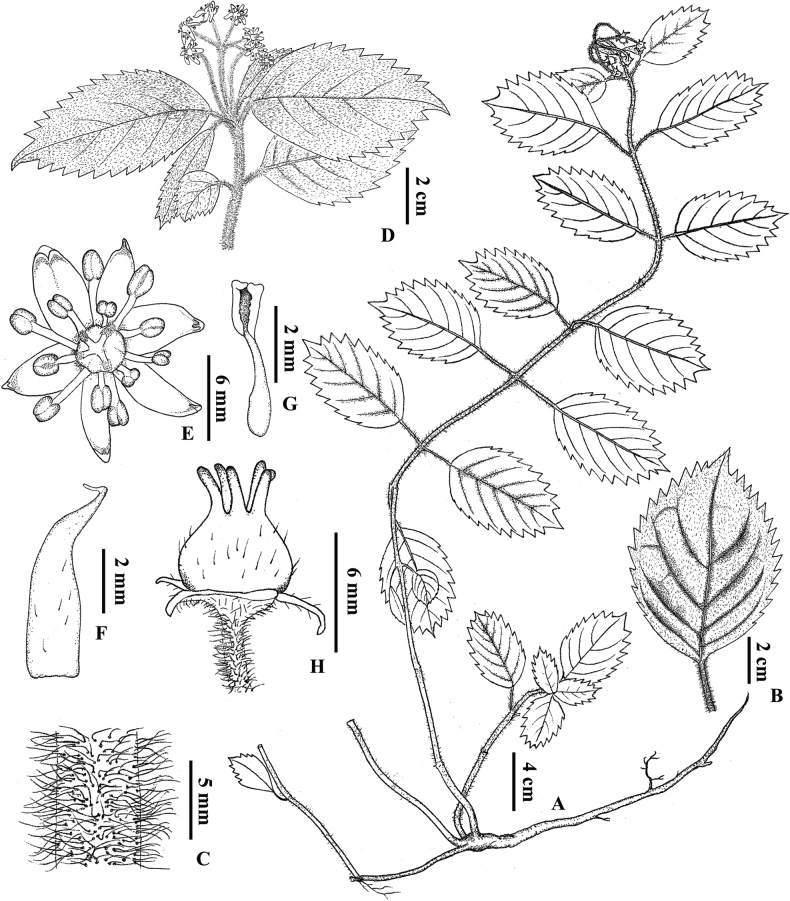 Figure 1
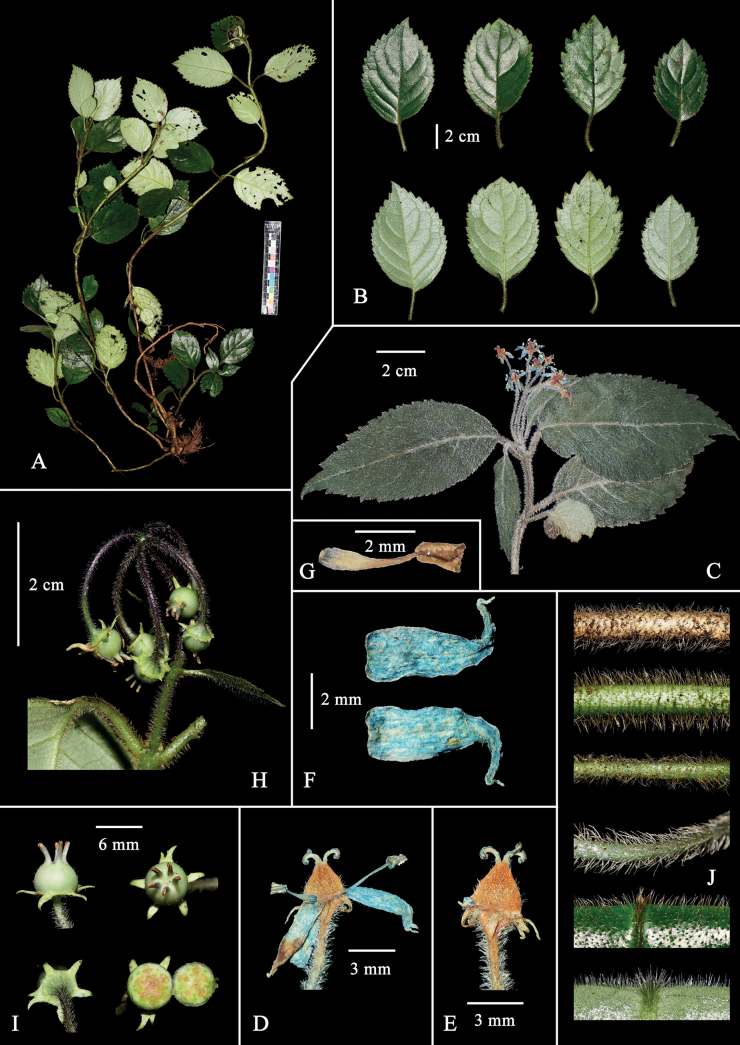 Figure 2
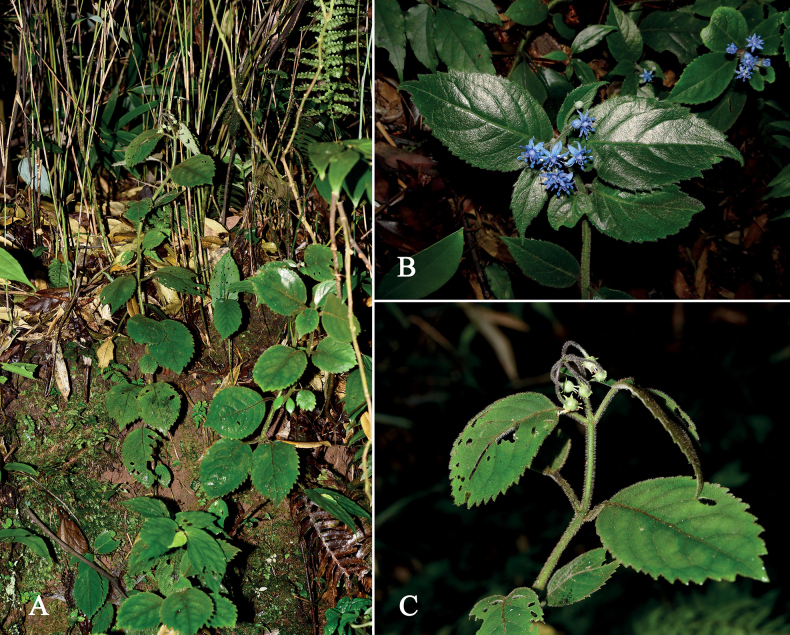 Figure 3
| Characters | ||
|---|---|---|
| Habit | shrub, 55–80 cm tall | subshrub, up to 30 cm tall |
| Indumentum | branchlets, leaves, peduncles and pedicels densely covered with hirsute trichomes | branchlets, petioles, veins, and inflorescences covered with crisped pubescence and slightly pellucid hirsute trichomes |
| Leaf blade | broadly elliptic or rectangular-elliptic | elliptic or ovate-elliptic |
| leaf base with nearly rounded, entire margins | leaf base cuneate or gradually narrowing, entire margins | |
| leaf margin with sparse coarse teeth | leaf margin serrate | |
| 3–4 lateral veins on each side of midvein | 5–11 lateral veins on each side of midvein | |
| Inflorescence | corymbose cyme, loose, bract lanceolate | corymbose cyme, aggregate |
| peduncle 0.4–1.2 cm | peduncle 0.5–1 cm | |
| Pedicel | ca. 2 cm | ca. 5 mm |
| Calyx | calyx tube sparsely covered with hirsute trichomes | calyx tube densely covered with crisped pubescence and hirsute trichomes |
| lobes ca. 2 mm long, with sparse hirsute trichomes only on the margins | lobes ca. 2.5–4 mm long, densely covered with hirsute trichomes on the outer and upper inner surfaces | |
| Petal | glabrous on the inner surface, scattered hirsute trichomes on the outer surface | both surfaces densely covered with hirsute trichomes or without hairs on the inner surface |
| Stamen | outer whorl filaments are linear, inner ones are awl-shaped | filaments filiform |
| Pistil | styles glabrous | styles sparsely covered with hirsute trichomes at the lower part |
| ovary nearly superior | ovary subinferior |
Peer Reviews
No public reviews on file for this paper yet. If you reviewed it on a platform where reviews are public (OpenReview, ICLR, NeurIPS, ICML), you can paste yours below so the community can read it here.
Videos
No videos yet. Explain this paper in a talk, walkthrough, or lecture? Add one.
Taxonomy
TopicsPlant and Fungal Species Descriptions · Synthesis and Biological Activity · Plant Disease Resistance and Genetics
Introduction
Hydrangea L. (Linnaeus 1753) had been treated to be a member of the tribe Hydrangeeae in Hydrangeaceae, comprising approximately 73 species distributed from Eastern to Southeastern Asia, as well as from Southeastern North America to Central America and Western South America (Huang et al. 1995; Wei and Bartholomew 2001). However, morphological and phylogenetic studies have indicated that Hydrangea is not monophyletic (Hufford 1995, 1997; Soltis et al. 1995; Ge 2003; Jacobs 2010; Samain et al. 2010; Zhang et al. 2021). Based on molecular phylogenetic analyses, De Smet et al. (2015) proposed the broad concept of Hydrangea, which encompasses Hydrangea**s. str. and the remaining eight satellite genera within Hydrangeeae, including Broussaisia Gaudich., Cardiandra Siebold & Zucc., Decumaria L., Deinanthe Maxim., Dichroa Lour., Pileostegia Hook.f. & Thomson, Platycrater Siebold & Zucc., Schizophragma Siebold & Zucc., grouped as a section within Hydrangeas. l. Furthermore, Platycrater is merged into Hydrangeasect.Asperae (Rehder) Y.De Smet & Samain. The broad concept of Hydrangea has been supported by Yang (2022). In this study, we also adopt the broad concept of Hydrangea.
Hydrangeasect.Dichroa (De Smet et al. 2015) comprises 12 species, widely distributed in the tropical and subtropical regions of Southeast Asia, with only a few species extending to Pacific islands. In China, there are six species of this section, distributed from the southwestern to eastern regions (Huang 1987; Huang et al. 1995; Wei and Bartholomew 2001). In recent years, new species from this section have been discovered in China (Huang et al. 2018; Deshmukh and Shende 2021).
During field investigations in Huagaoxi National Nature Reserve of Shuwei Town, Xuyong County, Sichuan Province, an unknown population of Hydrangea was discovered. After conducting a comprehensive review of relevant taxonomic literature (Chun 1954; Huang 1987; Huang et al. 1995; Wei and Bartholomew 2001; Jacobs 2010; Huang et al. 2018) and meticulously examining voucher specimens from various herbaria (A, B, C, CAS, CDBI, E, IBK, IBSC, P, PE, K, KUN, L, NYBG, US), we have identified that it represents a new species within Hydrangeasect.Dichroa, exhibiting morphological similarity with H.yaoshanensis (De Smet et al. 2015). In this study, we provide a detailed morphological characterization of this species based on our field observations and a thorough examination of the holotype specimen, and describe it as a new species.
Material and methods
The voucher specimens of the new species in this study were collected from the type locality, Huagaoxi National Nature Reserve, and are deposited in CDBI and KUN. The morphological description of characteristics of the new species was conducted through both living plants in the field and voucher specimens. The morphological measurements of the new species were based on living plants. We examined available online specimen images of Hydrangeasect.Dichroa species stored in A, B, C, CAS, CDBI, E, IBK, IBSC, P, PE, K, KUN, L, NYBG, and the US through the Chinese Virtual Herbarium (https://www.cvh.ac.cn/) and JSTOR Global Plants (https://plants.jstor.org/). Additionally, we compared the morphological characteristics of the new species with those of similar species, relying on online voucher specimen images and published literature (Huang 1987; Huang et al. 1995; Huang et al. 2018; Deshmukh and Shende 2021).
Taxonomic treatment
Hydrangea
xinfeniae
Taxon classificationPlantaeCornalesHydrangeaceae
W.B.Ju & J.Ru sp. nov.
2F35B923-3E53-5BA6-BF91-1CBA1DA040DF
urn:lsid:ipni.org:names:77335528-1
Diagnosis.
Hydrangeaxinfeniae can be distinguished from the morphologically similar species H.yaoshanensis by the presence of densely hirsute trichomes on branchlets, leaves, peduncles and pedicels; leaf blades that are broadly elliptic to rectangular-elliptic with a nearly rounded base and coarse teeth along the leaf margin, lateral veins 3–4 on each side of the midvein; a corymbose cyme with few, loosely arranged branches and lanceolate bract; calyx tube sparsely covered with hirsute trichomes, with only the edges of the lobes bearing such hairs; a glabrous adaxial surface of the petals, while the abaxial surface is adorned with scattered hirsute trichomes; outer whorl filaments are linear, inner ones are awl-shaped; styles are glabrous, and a nearly superior ovary.
Type.
China. Sichuan Province: Xuyong County, Shuiwei Town,Huagaoxi National Nature Reserve, growing on the moist soil under the broadleaved forest, 28°13′29.97″N, 105°36′40.39″E, alt. 1368 m, 22 Jul. 2023, W.B.Ju & R.Jiang J–1290 (holotype: CDBI!; isotype: KUN!).
Description.
Shrub, 55–80 cm tall, slightly curved in the upper part, usually prostrate in the lower part. Branchlets densely covered with hirsute trichomes. Leaves papery, opposite; petioles 2–4.5 cm long, densely covered with hirsute trichomes; blades broadly elliptic to rectangular-elliptic, 6–8 cm long, 4–6 cm wide, covered with hirsute trichomes on both surfaces, denser on the abaxial surface, apex acute or shortly acuminate, base entire and nearly rounded, non-decurrent, margin with coarse teeth, midrib and lateral veins conspicuous, raised on the abaxial surface, 3–4 lateral veins on each side of the midvein, not reaching the leaf margin, extending obliquely. Inflorescence corymbose cymose, loosely few branches; bracts lanceolate, 3.5–4.5 cm long, 1.5–1.8 cm wide, covered with hirsute trichomes on both surfaces; peduncle 0.4–1.2 cm long, densely covered with hirsute trichomes. Flower buds ovate; pedicels ca. 2 cm long, covered with densely hirsute trichomes; calyx tube inverted conical, ca. 2 mm long, sparsely covered with hirsute trichomes, lobes 5–6, lanceolate, ca. 2 mm long, with sparse hirsute trichomes only on the margin; corolla blue, lobes 5–6, free, narrowly ovate-triangular, base flat, gradually narrowing towards the apex, ca. 6 mm long, ca. 2 mm wide, slightly inwardly curved at the apex to form a hook, glabrous adaxially, covered with scattered hirsute trichomes abaxially; stamens 10–12 in two whorls, the outer stamens alternate the petals, and the inner stamens opposite the petals; anthers ovoid, longitudinally split; outer whorl filaments are linear, the base sometimes slightly widens, 2.8–3 mm long, inner ones awl-shaped, slightly wider at the base, gradually narrowing upwards, 2.2–2.3 mm long; styles 3–6, ca. 3 mm long, glabrous, ovary nearly superior, with numerous ovules. Berry nearly spherical, 5.5–6 mm in diameter, sparsely covered with hirsute trichomes. Mature seeds not observed.
Hydrangeaxinfeniae W.B.Ju & J.Ru, sp. nov. A plant B leaf adaxial C twig D a branch with inflorescence E flower F petal G stamen H berry. Illustration drawn based on living plants (flower and berry) combined with specimens from the holotype by Zhenlong Liang.
Phenology.
Flowering from May to June; Fruiting from July to October.
Distribution and habitat.
Hydrangeaxinfeniae sp. nov. is found in its type locality, the Huagaoxi National Nature Reserve in Shuiwei Town, Xuyong County, Sichuan Province, China. It grows on moist soils under the broadleaved forest at an elevation of 1200–1300 meters.
Hydrangeaxinfeniae W.B.Ju & J.Ru, sp. nov. A plant B leaves (upper: adaxial, lower: abaxial) C a branch with inflorescence D, E flower F petal (upper: adaxial, lower: abaxial) G stamen H infructescence I young berry J indumentum on different organs, from upper to lower, including old branchlet, young branchlet, petiole, carpopodium, leaf adaxial, and leaf abaxial.
Etymology.
The species epithet xinfeniae is in honor of Prof. Xinfen Gao, a distinguished female botanist who made significant contributions to the plant diversity survey of Huagaoxi National Nature Reserve.
Vernacular name.
Simplified Chinese: 信芬常山; Chinese pinyin: Xìnfēn cháng shān.
Additional specimens examined
(paratypes). China. Sichuan Province: Xuyong County, Shuiwei Town, Huagaoxi National Nature Reserve, 28°15′26.33″N, 105°28′58.89″E, alt. 1220 m, 5 Jun. 2015, W.B.Ju J–441 (CDBI); ibid., 28°13′51.04″N, 105°37′3.80″E, alt. 1272 m, 10 Sep. 2023, W.B.Ju & J.Ru J–1374 (CDBI).
Preliminary conservation assessment.
Based on the currently available survey data, only three relatively small populations have been discovered in Huagaoxi National Nature Reserve. Our knowledge regarding the status and distribution range of populations outside this area is limited. According to IUCN red list categories and criteria (IUCN 2022), the conservation status of the new species is temporarily assessed as Data Deficient (DD) due to insufficient available data. Further comprehensive surveys in similar environments and neighboring regions are necessary to provide a better assessment of the distribution and abundance of this species.
Hydrangeaxinfeniae W.B.Ju & J.Ru, sp. nov. in the wild A habit B a branch with inflorescence C fruiting branch.
Discussion
Hydrangeasect.Dichroa is distinguished from related sections within Hydrangea by characteristics such as being an erect shrub, inflorescences with all fertile flowers, calyx lobes never petaloid, and fruit as berry. Based on a series of morphological characteristics, including shrub, opposite leaves, bisexual and isomorphic flowers, an inverted conical calyx tube attached to the ovary, petals with slightly inwardly curled tips forming hooks, outer whorl filaments are linear, inner whorl filaments awl-shaped, and separated styles, Hydrangeaxinfeniae sp. nov. is classified within the Hydrangeasect.Dichroa (Huang 1987; Huang et al. 1995; Wei and Bartholomew 2001; De Smet et al. 2015). Species within Hydrangeasect.Dichroa were previously treated as members of the genus Dichroa Lour. (Loureiro 1790) in Hydrangeeae. In China, Hydrangeasect.Dichroa comprises six known species, including H.daimingshanensis (Y.C.Wu) Y.De Smet & C.Granados, H.febrifuga (Lour.) Y.De Smet & C.Granados, H.hirsuta (Gagnep.) Y.De Smet & C.Granados, H.mollissima (Merr.) Y.De Smet & C.Granados, H.yaoshanensis, H.yunnanensis (S.M.Hwang) Y.De Smet & C.Granados, as well as one new species, H.fistulosa (G.H.Huang & G.Hao) U.B.Deshmukh & M.B.Shende (Huang et al. 1995; Huang et al. 2018; Deshmukh and Shende 2021). Among the aforementioned species distributed in China, H.xinfeniae sp. nov. exhibits morphological resemblances to H.yaoshanensis in having the shape of leaf blade, corymbose cymose, inverted conical calyx tube and spherical-shaped berry. However, H.xinfeniae sp. nov. can be distinguished by its dense hirsute trichomes on branchlets, leaves, peduncles, and pedicels, as well as its broadly elliptic to rectangular-elliptic leaf blades, nearly entire circular leaf basis, coarse teeth on the leaf margin, 3–4 lateral veins on each side, corymbose cyme with sparsely and loosely branched, calyx tube with sparse hirsute trichomes, lobes with sparse hirsute trichomes only on the margins, glabrous on the inner surface of the petals, scattered hirsute trichomes on the outer surface, outer whorl filaments are linear, inner ones are awl-shaped, styles are glabrous, and nearly superior ovary. Notably, the nearly superior ovary is a unique characteristic of H.xinfeniae sp. nov. compared to other species within Hydrangeasect.Dichroa. For a detailed comparison of features, please refer to Table 1.
Supplementary Material
XML Treatment for Hydrangea xinfeniae
The reference list from the paper itself. Each links out to its DOI / PubMed record.
- 1Chun WY (1954) A census and preliminary study of the Chinese Hydrangeoideae.Journal of Systematics and Evolution 3(2): 101–205.
- 2De Smet Y Granados Mendoza C Wanke S Goetghebeur P Samain MS (2015) Molecular phylogenetics and new (infra)generic classification to alleviate polyphyly in tribe Hydrangeeae (Cornales: Hydrangeaceae).Taxon 64(4): 741–753. 10.12705/644.6 · doi ↗
- 3Deshmukh UB Shende MB (2021) One new combination in the genus Hydrangea (Hydrangeaceae).Phytotaxa 512(2): 125–126. 10.11646/phytotaxa.512.2.6 · doi ↗
- 4Ge LP (2003) Systematics of the tribe Hydrangeeae DC. (Hydrangeaceae). Ph D Thesis, Institute of Botany, Chinese Academy of Sciences, Beijing.
- 5Huang SM (1987) A preliminary study on Dichroa Lour.Zhiwu Fenlei Xuebao 25(5): 384–389. https://www.jse.ac.cn/CN/Y 1987/V 25/I 5/384
- 6Huang SM Wei ZF Lu LD Gu CZ Jin SY (1995) Flore Reipublicae Popularis Sinicae (Vol. 35). Science Press, Beijing, 10–362.
- 7Huang GH Yan XK Hao G (2018) Dichroafistulosa (Hydrangeaceae), a new species from Guangdong, China.Redai Yaredai Zhiwu Xuebao 26(4): 429–432.
- 8Hufford L (1995) Seed morphology of Hydrangeaceae and its phylogenetic implications.International Journal of Plant Sciences 156(4): 555–580. 10.1086/297279 · doi ↗