Exploration of Preservation Methods for Utilizing Porcine Fetal-Organ-Derived Cells in Regenerative Medicine Research
Kenji Matsui, Hidekazu Sekine, Jun Ishikawa, Shin Enosawa, Naoto Matsumoto, Yuka Inage, Yoshitaka Kinoshita, Keita Morimoto, Shutaro Yamamoto, Nagisa Koda, Shuichiro Yamanaka, Takashi Yokoo, Eiji Kobayashi

TL;DR
This study explores how to best preserve porcine fetal organs to use their cells in regenerative medicine and xenotransplantation research.
Contribution
The study identifies optimal preservation methods for porcine fetal kidney, heart, and liver cells to enhance their viability for regenerative applications.
Findings
Kidney cells dissociated and aggregated after whole-organ vitrification differentiated into glomeruli and tubules in vivo.
Heart cells frozen after dissociation retained pulsating muscle cells similar to non-frozen samples.
A direct tissue perfusion technique successfully obtained viable liver parenchymal cells.
Abstract
Human pluripotent stem cells have been employed in generating organoids, yet their immaturity compared to fetal organs and the limited induction of all constituent cell types remain challenges. Porcine fetal progenitor cells have emerged as promising candidates for co-culturing with human progenitor cells in regeneration and xenotransplantation research. This study focused on identifying proper preservation methods for porcine fetal kidneys, hearts, and livers, aiming to optimize their potential as cell sources. Extracted from fetal microminiature pigs, these organs were dissociated before and after cryopreservation–thawing, with subsequent cell quality evaluations. Kidney cells, dissociated and aggregated after vitrification in a whole-organ form, were successfully differentiated into glomeruli and tubules in vivo. In contrast, freezing hearts and livers before dissociation yielded…
Genes, proteins, chemicals, diseases, species, mutations and cell lines named across the full text — each resolved to its canonical identifier and authoritative record.
Click any figure to enlarge with its caption.
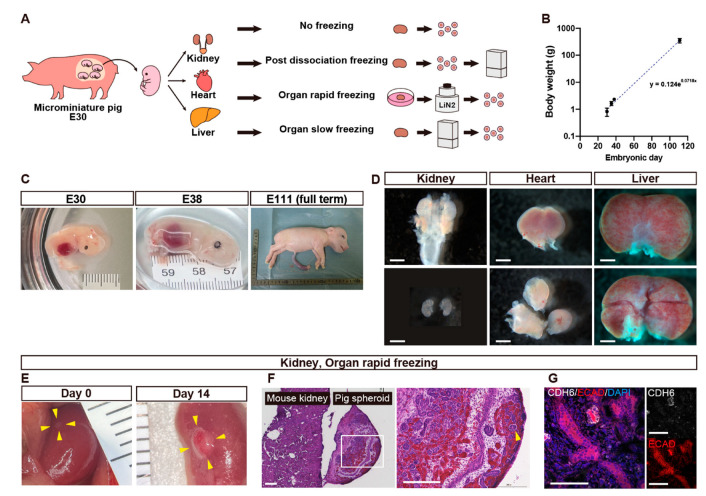 Figure 1
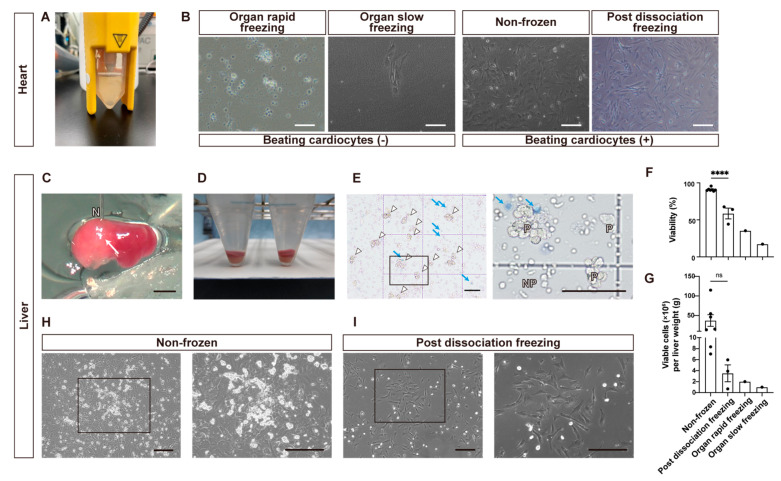 Figure 2
Peer Reviews
No public reviews on file for this paper yet. If you reviewed it on a platform where reviews are public (OpenReview, ICLR, NeurIPS, ICML), you can paste yours below so the community can read it here.
Videos
No videos yet. Explain this paper in a talk, walkthrough, or lecture? Add one.
Taxonomy
TopicsRenal and related cancers · Pluripotent Stem Cells Research · Tissue Engineering and Regenerative Medicine