Aberrant neural computation of social controllability in nicotine-dependent humans
Xiaosi Gu, Caroline McLaughlin, Qixiu Fu, Soojung Na, Matthew Heflin, Vincenzo Fiore

TL;DR
The study shows that nicotine-dependent individuals have trouble estimating their influence in social situations, which is linked to brain activity differences.
Contribution
The paper introduces a neurocomputational model linking nicotine dependence to impaired social controllability estimation.
Findings
Smokers underestimated their influence and reported reduced control in social decision-making.
Smokers showed reduced tracking of choice values in the ventromedial prefrontal cortex.
Impaired social prediction error computation was observed in the midbrain of smokers.
Abstract
Social controllability, defined as the ability to exert influence when interacting with others, is crucial for optimal decision-making. Inability to do so might contribute to maladaptive behaviors such as drug use, which often takes place in social settings. Here, we examined nicotine-dependent humans using fMRI, as they made choices that could influence the proposals from simulated partners. Computational modeling revealed that smokers under-estimated the influence of their actions and self-reported a reduced sense of control, compared to non-smokers. These findings were replicated in a large independent sample of participants recruited online. Neurally, smokers showed reduced tracking of forward projected choice values in the ventromedial prefrontal cortex, and impaired computation of social prediction errors in the midbrain. These results demonstrate that smokers were less accurate…
Genes, proteins, chemicals, diseases, species, mutations and cell lines named across the full text — each resolved to its canonical identifier and authoritative record.
Click any figure to enlarge with its caption.
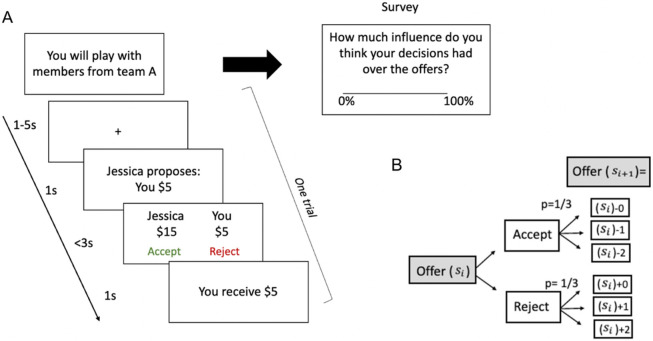 Figure 1
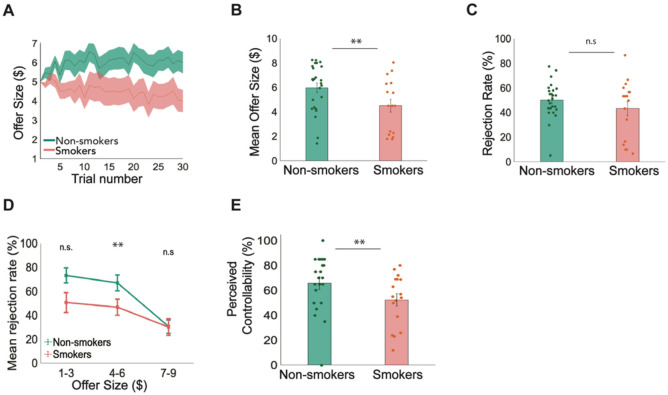 Figure 2
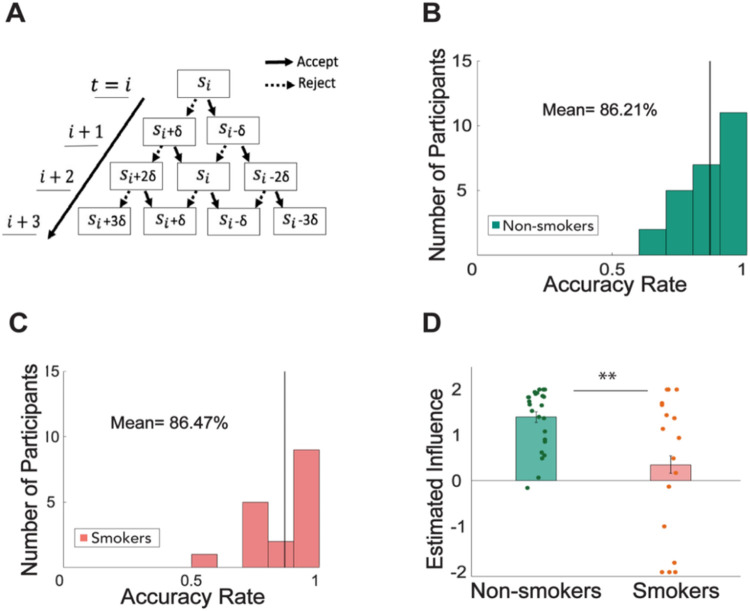 Figure 3
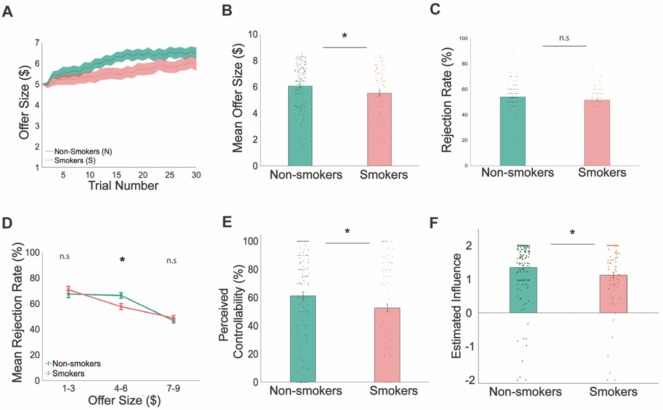 Figure 4
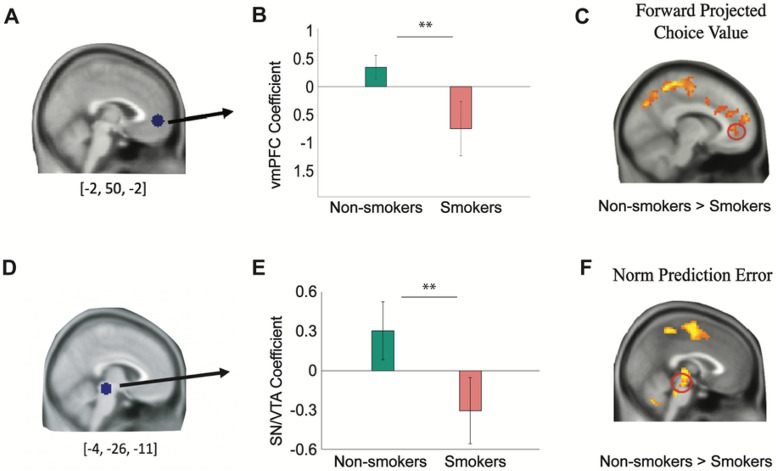 Figure 5
Peer Reviews
No public reviews on file for this paper yet. If you reviewed it on a platform where reviews are public (OpenReview, ICLR, NeurIPS, ICML), you can paste yours below so the community can read it here.
Videos
No videos yet. Explain this paper in a talk, walkthrough, or lecture? Add one.
Taxonomy
TopicsNeural and Behavioral Psychology Studies · Functional Brain Connectivity Studies · Behavioral Health and Interventions