Vertebrate-conserved Schnurri zinc fingers restrain Drosophila vein patterning
Katrina Toraason, Nathan Johnson, Jenna Guernsey, Allen Laughon

TL;DR
This study explores how specific zinc fingers in the Schnurri protein influence vein patterning in fruit flies, revealing insights into Dpp signaling.
Contribution
The study identifies the role of vertebrate-conserved Schnurri zinc fingers in Dpp-dependent patterning in Drosophila.
Findings
Mutation of zinc coordination residues in Shn zinc finger pairs leads to ectopic venation.
Vertebrate-conserved zinc finger pairs 1,2 and 4,5 are involved in Dpp signaling sensitivity.
These findings highlight the importance of Schnurri in tissue repair and patterning.
Abstract
The Drosophila Smad-interacting co-factor, Schnurri (Shn) confers transcriptional repression in response to Decapentaplegic (Dpp) signaling. Shn zinc fingers 6-8 mediate this Smad interaction but are lacking in vertebrate Shn homologs. In contrast, the vertebrate-conserved zinc finger 1,2 and 4,5 pairs have been reported to engage in Smad-mediated transcriptional activation in fly and vertebrate systems, and to contribute to Dpp-dependent tissue repair in the fly retina. We report that mutation of zinc coordination residues within vertebrate-conserved Shn zinc finger pairs 1,2 and 4,5 results in ectopic venation that is sensitive to Dpp signaling.
Genes, proteins, chemicals, diseases, species, mutations and cell lines named across the full text — each resolved to its canonical identifier and authoritative record.
Click any figure to enlarge with its caption.
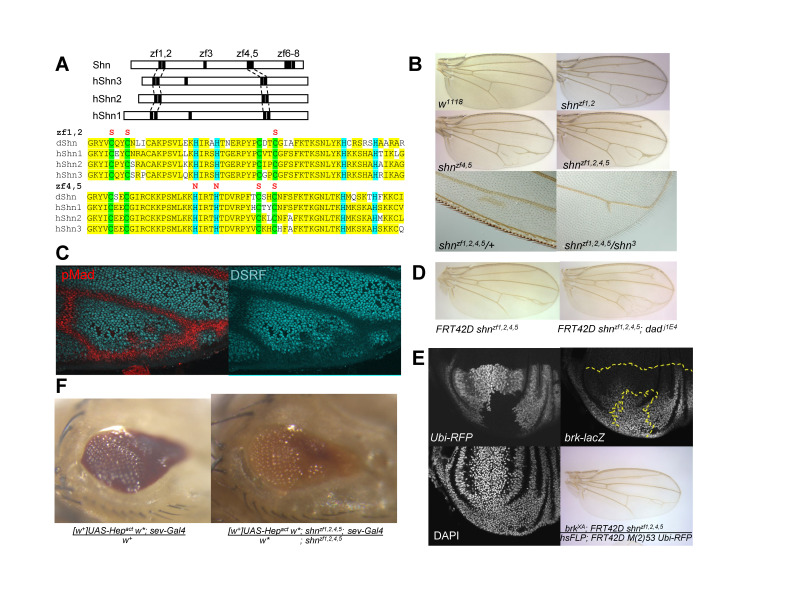 Figure 1
Peer Reviews
No public reviews on file for this paper yet. If you reviewed it on a platform where reviews are public (OpenReview, ICLR, NeurIPS, ICML), you can paste yours below so the community can read it here.
Videos
No videos yet. Explain this paper in a talk, walkthrough, or lecture? Add one.
Taxonomy
TopicsDevelopmental Biology and Gene Regulation · Cancer-related gene regulation · Kruppel-like factors research