A novel locomotion-based prepulse inhibition assay in zebrafish larvae
Emily Read, Robert Hindges

TL;DR
Researchers developed a new method to study sensory gating in zebrafish larvae using movement instead of high-speed cameras.
Contribution
A novel PPI assay using locomotion instead of c-bend startle behaviors in zebrafish larvae is introduced.
Findings
PPI percentage reached a maximum of 87% in the new assay.
Administration of MK-801 significantly reduced PPI, indicating its effect on sensory gating.
Abstract
Sensory gating, measured using prepulse inhibition (PPI), is an endophenotype of neuropsychiatric disorders that can be assessed in larval zebrafish models. However, current PPI assays require high-speed cameras to capture rapid c-bend startle behaviours of the larvae. In this study, we designed and employed a PPI paradigm that uses locomotion as a read-out of zebrafish larval startle responses. PPI percentage was measured at a maximum of 87% and strongly reduced upon administration of the NMDA receptor antagonist, MK-801. This work provides the foundation for simpler and more accessible PPI assays using larval zebrafish to model key endophenotypes of neurodevelopmental disorders.
Genes, proteins, chemicals, diseases, species, mutations and cell lines named across the full text — each resolved to its canonical identifier and authoritative record.
Click any figure to enlarge with its caption.
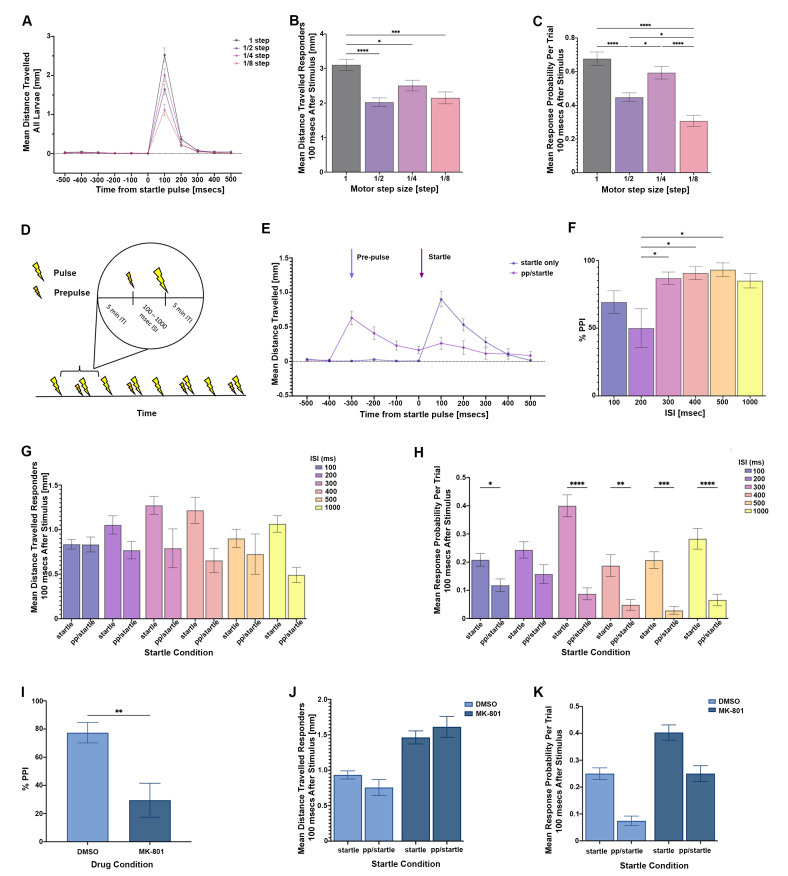 Figure 1
Peer Reviews
No public reviews on file for this paper yet. If you reviewed it on a platform where reviews are public (OpenReview, ICLR, NeurIPS, ICML), you can paste yours below so the community can read it here.
Videos
No videos yet. Explain this paper in a talk, walkthrough, or lecture? Add one.
Taxonomy
TopicsZebrafish Biomedical Research Applications · Neuroscience and Neuropharmacology Research · Sleep and Wakefulness Research