Deletion of Kallikrein-related peptidases ( Klks ) has no effect on fertility in mice
Ryan M. Finnerty, Erin M. Carulli, Miranda L. Bernhardt, Lisette A. Maddison, Wipawee Winuthayanon

TL;DR
Deleting four kallikrein-related peptidase genes in mice did not affect fertility or health, suggesting these genes are not essential for reproduction.
Contribution
Generated a mouse model with deletions of four Klk genes and demonstrated their non-essential role in fertility.
Findings
Male and female knockout mice were fertile with no health defects.
The Klk1b3, Klk1b4, Klk1b5, and Klk1 genes are not required for reproductive function in mice.
Abstract
Kallikreins (KLKs) are serine peptidases. It was established that Klks are estrogen-target genes in mouse uteri. However, the functional requirement of KLK family in the uterine function during reproduction is unknown. Here we generated a compound deletion of Klk1b3, Klk1b4, Klk1b5, and Klk1 in a mouse model using CRISPR/Cas9 strategy with four single guide RNAs (sgRNAs) to target the second exon of these four genes that are aligned back-to-back in a single locus spanning 32.95 kb on chromosome 7. We found that both male and female knockout mice are fertile with no apparent health defect compared to wild-type controls. Our data suggest that Klk1b3, Klk1b4, Klk1b5, and Klk1 are not necessary for male and female reproductive function in mice.
Genes, proteins, chemicals, diseases, species, mutations and cell lines named across the full text — each resolved to its canonical identifier and authoritative record.
Click any figure to enlarge with its caption.
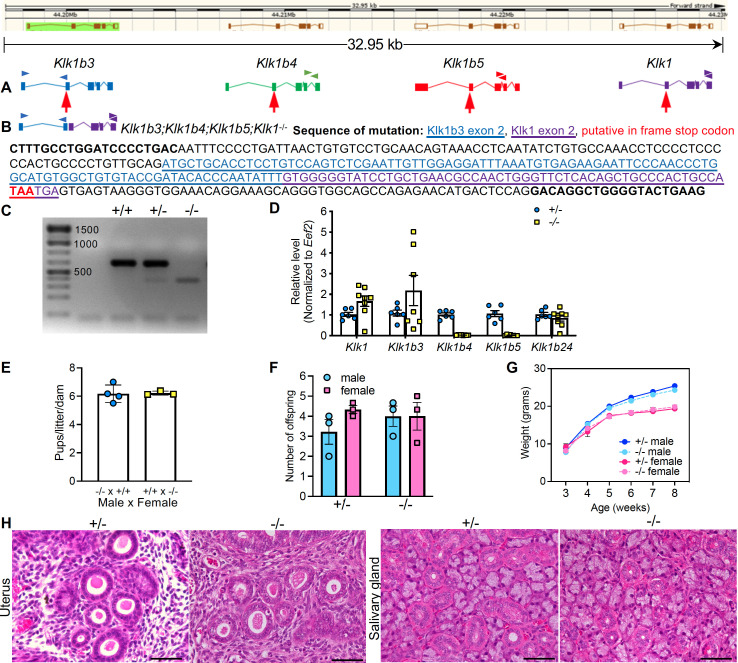 Figure 1
Peer Reviews
No public reviews on file for this paper yet. If you reviewed it on a platform where reviews are public (OpenReview, ICLR, NeurIPS, ICML), you can paste yours below so the community can read it here.
Videos
No videos yet. Explain this paper in a talk, walkthrough, or lecture? Add one.
Taxonomy
TopicsCoagulation, Bradykinin, Polyphosphates, and Angioedema · Reproductive System and Pregnancy · Estrogen and related hormone effects