Exploring the relationship of supernumerary recurrent renal calculi formation and tick-borne infections: a case report
Dean C. Paz, Abigael C. Gunther, Michael C. Higham, Lynne G. Stephenson, Anthony J. Laporta, K. Dean Gubler, Rebecca J. Ryznar

TL;DR
A 51-year-old man with a rare disease and tick-borne infections has recurring kidney stones, raising questions about possible immune issues and infection effects.
Contribution
This case report explores a potential link between tick-borne infections and recurrent kidney stone formation in a patient with Cacchi-Ricci disease.
Findings
The patient has a history of multiple tick-borne infections and an unusually high number of kidney stones.
Despite various medical interventions, the cause of the recurrent stones remains unclear.
The case suggests a possible connection between microbial history and stone formation.
Abstract
A 51-year-old male with a history of Cacchi-Ricci disease and long-standing infection with various species of Borrelia, Babesia, and Bartonella presented with recurrent symptoms of right-sided flank pain. Numerous renal calculi were identified on imaging. The etiology of the calculi had not been previously elucidated. Symptoms intermittently date back to 2002 when uric acid stones were identified. Subsequent calculi analysis revealed calcium oxalate stones. Despite the commonality of nephrolithiasis in patients with Cacchi-Ricci disease, the extreme number of calculi and recurrent presentation of symptoms persisted despite a plethora of medical evaluations, dietary changes, and hereditary testing. This case raises questions of etiology including possible immune deficiency and whether his uncommon microbial history contributes to recurrent stone formation.
Genes, proteins, chemicals, diseases, species, mutations and cell lines named across the full text — each resolved to its canonical identifier and authoritative record.
Click any figure to enlarge with its caption.
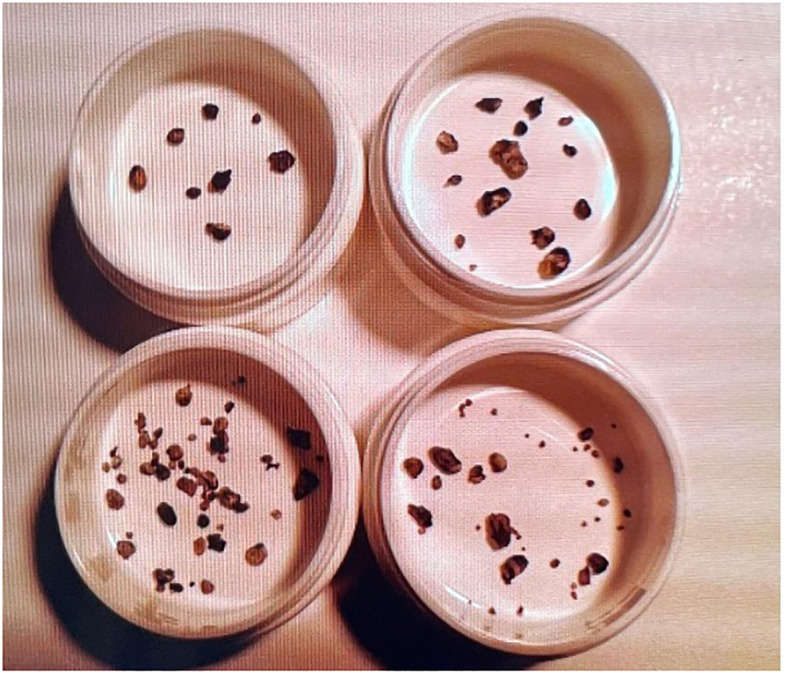 Figure 1
 Figure 2
 Figure 3
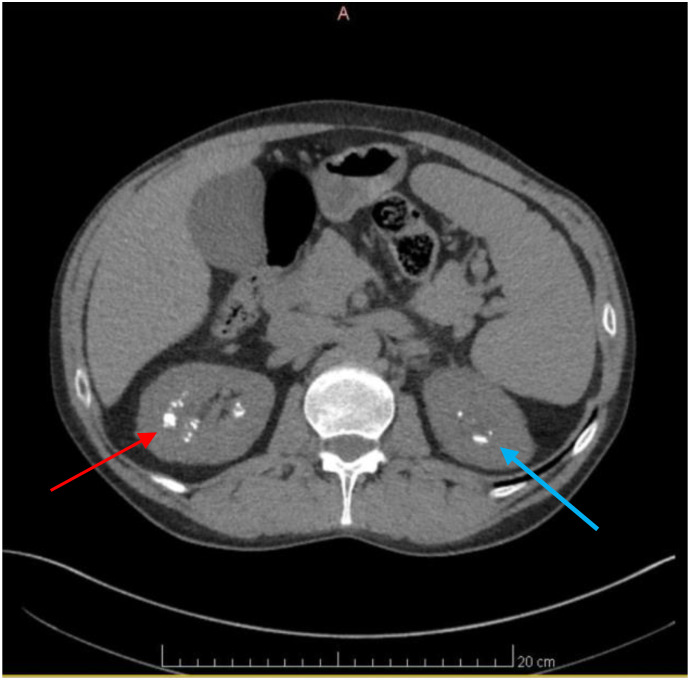 Figure 4
Peer Reviews
No public reviews on file for this paper yet. If you reviewed it on a platform where reviews are public (OpenReview, ICLR, NeurIPS, ICML), you can paste yours below so the community can read it here.
Videos
No videos yet. Explain this paper in a talk, walkthrough, or lecture? Add one.
Taxonomy
TopicsKidney Stones and Urolithiasis Treatments · Bartonella species infections research · Paleopathology and ancient diseases