Strengthened, and weakened, by belief
Tue Trinh

TL;DR
The paper explores how adjectives and adverbs like 'certain' and 'possibly' differ in how they relate to knowledge and belief.
Contribution
The paper introduces a novel hypothesis that adjectives quantify over knowledge while adverbs quantify over belief.
Findings
Adjectival modals like 'certain' are interpreted as universal quantifiers over knowledge.
Adverbial modals like 'certainly' are interpreted as quantifiers over belief.
The analysis relies on the claim that knowledge implies belief.
Abstract
This paper discusses a set of observations, many of which are novel, concerning differences between the adjectival modals certain and possible and their adverbial counterparts certainly and possibly. It argues that the observations can be derived from a standard interpretation of certain/certainly as universal and possible/possibly as existential quantifiers over possible worlds, in conjunction with the hypothesis that the adjectives quantify over knowledge and the adverbs quantify over belief. The claims on which the argument relies include the following: (i) knowledge implies belief, (ii) agents have epistemic access to their belief, (iii) relevance is closed under speakers’ belief, and (iv) commitment is pragmatically inconsistent with explicit denial of belief.
Genes, proteins, chemicals, diseases, species, mutations and cell lines named across the full text — each resolved to its canonical identifier and authoritative record.
Click any figure to enlarge with its caption.
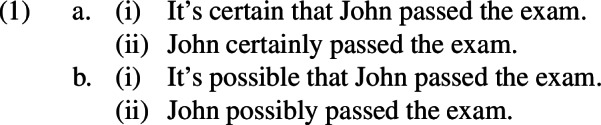 Figure 1
 Figure 2
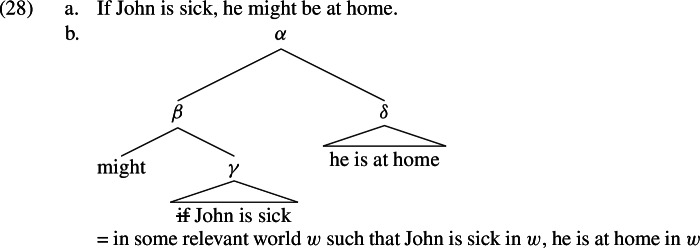 Figure 3
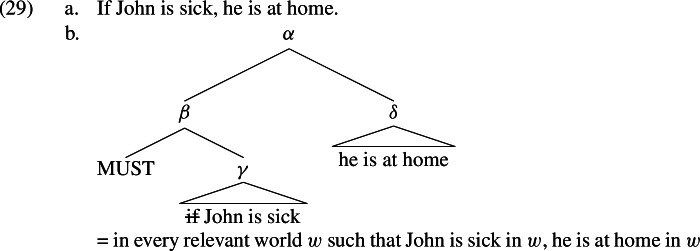 Figure 4
 Figure 5
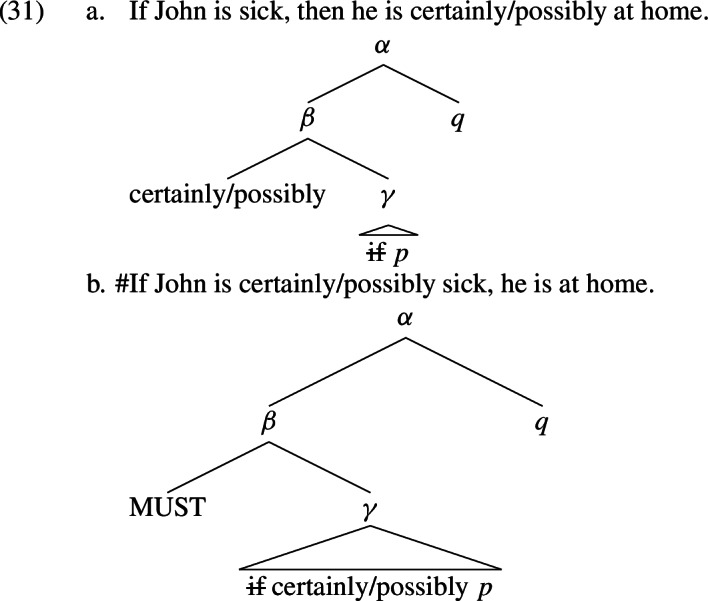 Figure 6
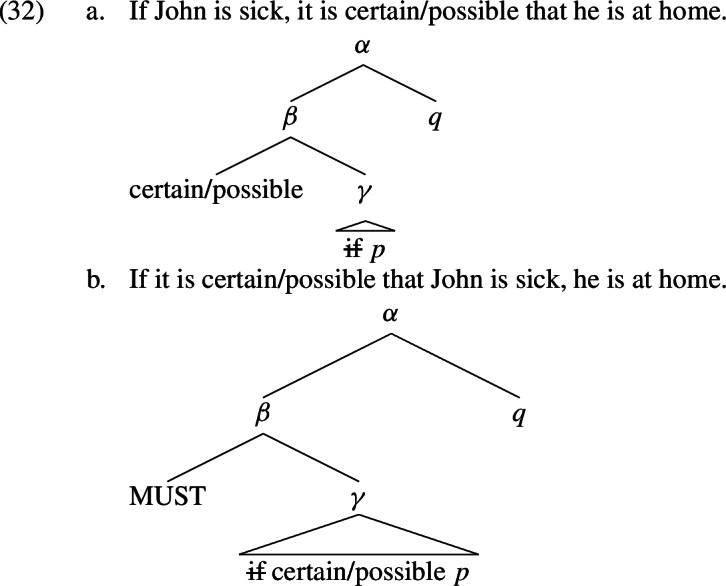 Figure 7
 Figure 8
 Figure 9
 Figure 10
 Figure 11
 Figure 12
 Figure 13
 Figure 14
 Figure 15
 Figure 16
 Figure 17
 Figure 18
 Figure 19
 Figure 20
 Figure 21
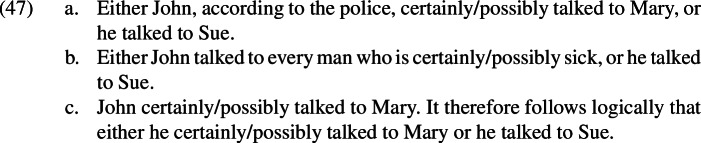 Figure 22
 Figure 23
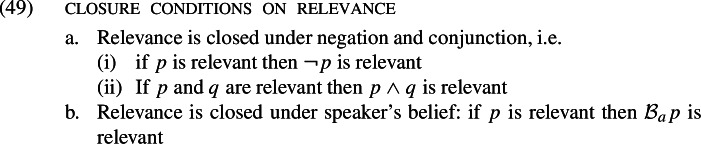 Figure 24
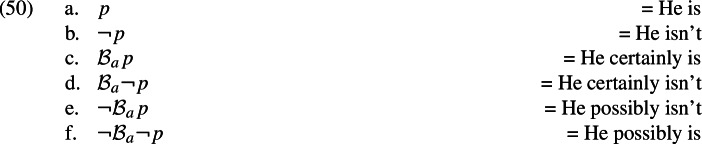 Figure 25
 Figure 26
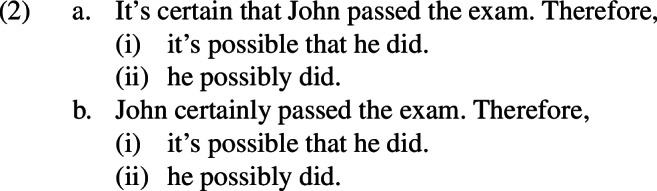 Figure 27
 Figure 28
 Figure 29
 Figure 30
 Figure 31
 Figure 32
 Figure 33
 Figure 34
 Figure 35
 Figure 36
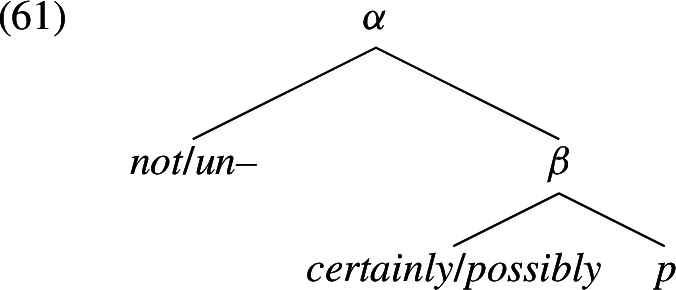 Figure 37
 Figure 38
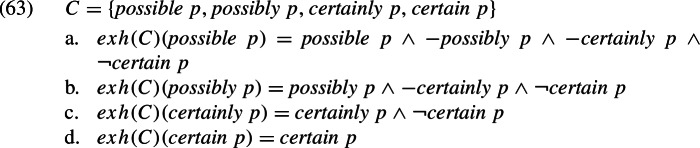 Figure 39
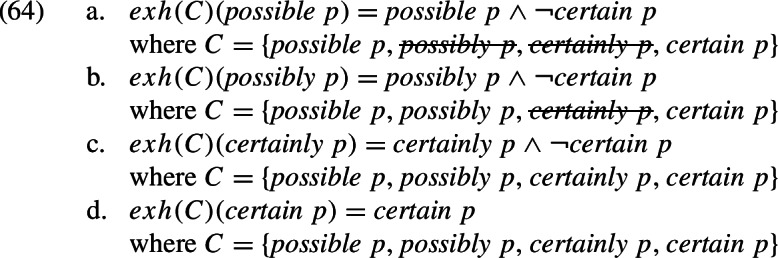 Figure 40
 Figure 41
 Figure 42
 Figure 43
 Figure 44
 Figure 45
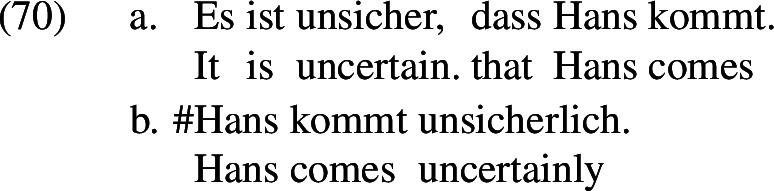 Figure 46
 Figure 47
 Figure 48
 Figure 49
 Figure 50
Peer Reviews
No public reviews on file for this paper yet. If you reviewed it on a platform where reviews are public (OpenReview, ICLR, NeurIPS, ICML), you can paste yours below so the community can read it here.
Videos
No videos yet. Explain this paper in a talk, walkthrough, or lecture? Add one.
Taxonomy
TopicsEpistemology, Ethics, and Metaphysics · Philosophy and Theoretical Science · Logic, Reasoning, and Knowledge