An evaluation of techniques to diagnose Dioctophyme renale in dogs
Gabriela de Almeida Capella, Josaine Cristina da Silva Rappeti, Natalia Berne Pinheiro, Soliane Carra Perera, Micaele Quintana de Moura, Marlete Brum Cleff, Caroline Maciel da Costa, Adriane Leites Strothmann, Guilherme Borges Weege, Carolina Silveira Mascarenhas

TL;DR
This study compares diagnostic methods for detecting Dioctophyme renale in dogs, showing that indirect ELISA is highly effective.
Contribution
The study introduces and validates the use of indirect ELISA with D. renale antigens for diagnosing dioctophimosis in dogs.
Findings
Indirect ELISA showed 97.4% sensitivity, outperforming urinalysis and ultrasound.
ELISA detected D. renale regardless of parasite number, sex, or location.
Post-surgery antibody levels in dogs decreased progressively over time.
Abstract
Dioctophyme renale is a nematode with zoonotic potential that affects the kidneys of carnivorous, wild, and domestic mammals. In this study, we sought to evaluate the indirect ELISA method against routine methods used to diagnose dioctophimosis. Hence, 38 dogs parasitized by D. renale, as confirmed by surgery, were selected. The dogs were evaluated by abdominal ultrasound and urinalysis, and their sera were tested by indirect ELISA using D. renale adult secretion and excretion antigen (DES). Five dogs were followed up with serum collections on day 0 (day of surgery) and 30, 60, and 90 days after surgery to evaluate antibody kinetics. Abdominal ultrasound and indirect ELISA successfully diagnosed 37 dogs parasitized by D. renale, while urinalysis diagnosed 29 animals. The positive animals were parasitized with 1-7 parasites; 17 dogs were infected by male and female parasites, 15 only by…
Genes, proteins, chemicals, diseases, species, mutations and cell lines named across the full text — each resolved to its canonical identifier and authoritative record.
Click any figure to enlarge with its caption.
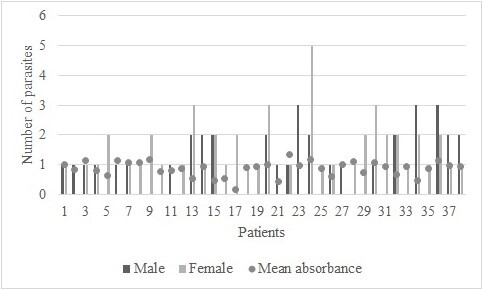 Figure 1
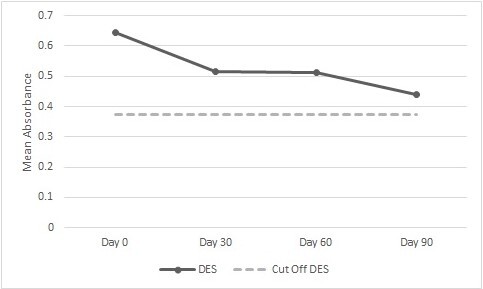 Figure 2
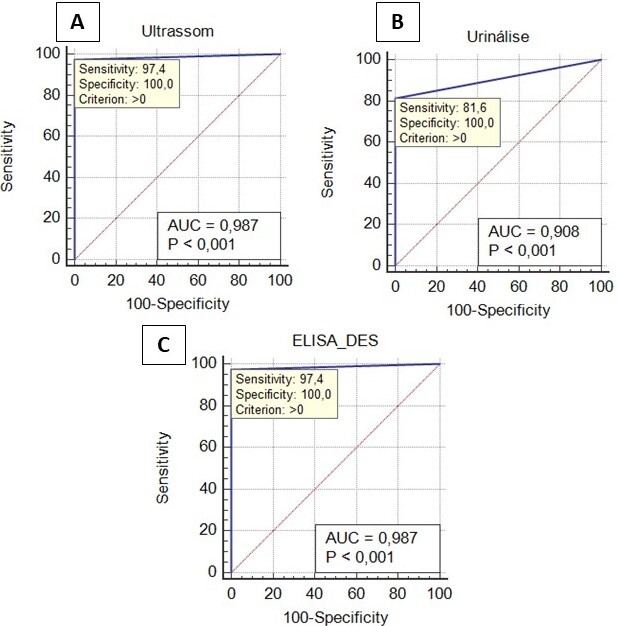 Figure 3
Peer Reviews
No public reviews on file for this paper yet. If you reviewed it on a platform where reviews are public (OpenReview, ICLR, NeurIPS, ICML), you can paste yours below so the community can read it here.
Videos
No videos yet. Explain this paper in a talk, walkthrough, or lecture? Add one.
Taxonomy
TopicsComparative constitutional jurisprudence studies · Criminal Justice and Penology · Human Rights and Immigration