Non-invasive cardiac activation mapping and identification of severity of epicardial substrate in Brugada Syndrome: a case report
Saverio Iacopino, Paolo Sorrenti, Giuseppe Campagna, Gennaro Fabiano, Emmanuel Fabiano, Jacopo Colella

TL;DR
This case report shows how non-invasive cardiac mapping can assess arrhythmia risk in Brugada Syndrome patients during drug testing.
Contribution
The study introduces a novel method to stratify sudden cardiac death risk in Brugada Syndrome using the dST-Tiso interval and ECGi during ajmaline testing.
Findings
Multiple conduction blocks were identified in the right ventricular overflow tract using non-contact cardiac mapping.
The dST-Tiso interval combined with ECGi effectively predicted arrhythmia inducibility in Brugada Syndrome.
The approach allowed non-invasive risk stratification for sudden cardiac death during ajmaline infusion.
Abstract
It has recently been shown that electrocardiographic imaging (ECGi) can be employed in individuals undergoing an ajmaline test who have Brugada Syndrome (BrS), to evaluate the extent of substrate-involved arrhythmia in the right ventricular overflow tract (RVOT). For the first time, we stratify the risk of sudden cardiac death (SCD) in BrS during ajmaline testing using the dST-Tiso interval (a robust predictor of the inducibility of ventricular arrhythmias (VAs) in the presence of drug-induced BrS type-1 pattern) in combination with ECGi technology. We studied a 48-year-old man with BrS ECG type-2 pattern and presence of J-wave without a family history of SCD but with a previous syncope. Transthoracic echocardiography and cardiac magnetic resonance imaging were performed, showing normal results. The ECG was performed to assess the novel ECG marker “dST-Tiso interval.” The 3D epicardial…
Genes, proteins, chemicals, diseases, species, mutations and cell lines named across the full text — each resolved to its canonical identifier and authoritative record.
Click any figure to enlarge with its caption.
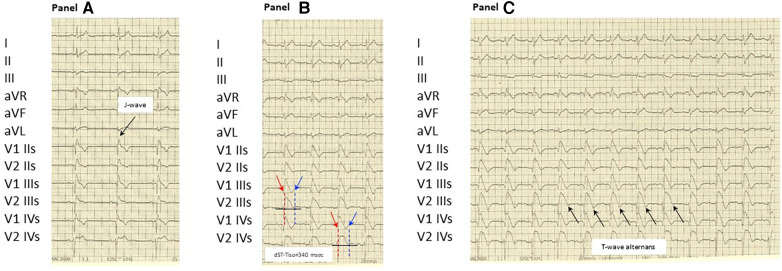 Figure 1
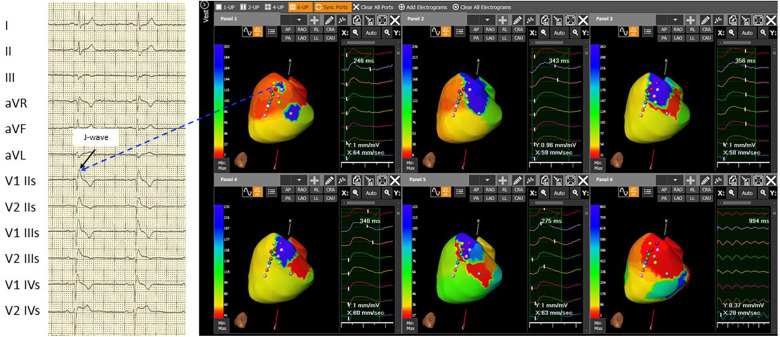 Figure 2
Peer Reviews
No public reviews on file for this paper yet. If you reviewed it on a platform where reviews are public (OpenReview, ICLR, NeurIPS, ICML), you can paste yours below so the community can read it here.
Videos
No videos yet. Explain this paper in a talk, walkthrough, or lecture? Add one.
Taxonomy
TopicsCardiac electrophysiology and arrhythmias · ECG Monitoring and Analysis · Cardiac pacing and defibrillation studies