Exploring the triggers of premature and early menopause in India: a comprehensive analysis based on National Family Health Survey, 2019–2021
Sampurna Kundu, Sanghmitra Sheel Acharya

TL;DR
This study analyzes factors contributing to premature and early menopause in Indian women using data from the National Family Health Survey.
Contribution
The study identifies key lifestyle and socioeconomic factors linked to early menopause in India.
Findings
Premature menopause prevalence is 2.2% and early menopause is 16.2% in India.
Factors like low education, poor economic status, smoking, and fried food consumption are associated with early menopause.
Abstract
Due to ovarian insufficiency, some women attain menopause at an early age due to lifestyle factors and hormonal imbalances. Menopause occurring before the age of 40 is premature and between 40 and 44 years age is early, since the natural age of menopause lies between 45 and 50. The study estimated the prevalence of both premature and early menopause, and examined the potential associated factors that could trigger its occurrence in India. The National Family Health Survey, conducted during 2019–2021, was used to fulfil the study objective. The study sample was divided into two parts, with age group 15–39 and 40–44 for estimating premature and early menopause, respectively. Cox-proportional hazard model was used for the multivariate analysis. The estimated prevalence of premature menopause is 2.2% and early menopause is 16.2%. Lower educational level, poor economic condition, smoking,…
Genes, proteins, chemicals, diseases, species, mutations and cell lines named across the full text — each resolved to its canonical identifier and authoritative record.
Click any figure to enlarge with its caption.
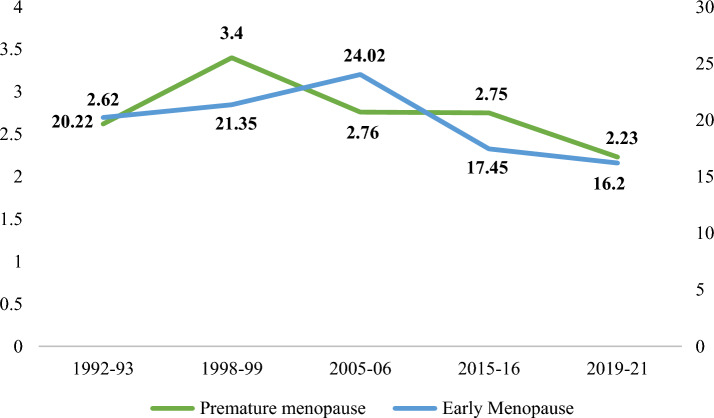 Figure 1
Peer Reviews
No public reviews on file for this paper yet. If you reviewed it on a platform where reviews are public (OpenReview, ICLR, NeurIPS, ICML), you can paste yours below so the community can read it here.
Videos
No videos yet. Explain this paper in a talk, walkthrough, or lecture? Add one.
Taxonomy
TopicsMenopause: Health Impacts and Treatments · Sex and Gender in Healthcare · Pharmacology and Nanomedicine Research
Introduction
The event of ovarian failure is termed as menopause. Majority women normally attains menopause in the age bracket of 45 and 55^1^. According to the World Health Organization (WHO), natural menopause is defined as “permanent cessation of menstruation resulting from the loss of ovarian follicular activity”, which is normally recognized after a year-long consecutive amenorrhea^2^. This is an essential physical and hormonal event in a healthy woman’s reproductive cycle. With increasing age, the ovarian function depletes and decreases its production of oestrogen and progesterone hormones, and thus the gradual decline in fecundity^3,4^. So basically, menopause is the transition of a woman’s life from reproductive phase to a non-reproductive phase, which has biological, emotional, sociocultural significance^5^.
The age distribution of menopause is like a Gaussian curve ranging from age 40 to 54, but the general clustering is around 45–55^6^. Some women, due to ovarian insufficiency attains menopause at an early age due to lifestyle factors and hormonal imbalances. Menopause occurring before the age of 40 is premature and between 40 and 44 years age is early, since the natural age of menopause lies between 45 and 50. The cessation of menses is marked by amenorrhea, rise in gonadotrophin levels and oestrogen deficiency^7,8^.
According to a PAN India study by Ahuja (2016), there is a strong association between early onset of menopause and various factors such as illiteracy, poor socio-economic background, underweight, parity, and age at pregnancy^9^. Studies have shown that age at menarche, breastfeeding of previous child, age at first pregnancy, plays a very important role in determining the onset of menopause^10^. There are also effects of nulliparity, usage of oral contraceptive pills, having a live birth or not, on the onset of natural menopause^11,12^. Menopausal age is associated with a number of factors with includes smoking^13,14^, level of education^15^, working status^16^, abortion^17^, body mass index^16^ and food habits^18^. Smoking specifically have shown adverse impacts on reproductive health and heavy smokers were observed to reach menopause earlier^19,20^, thus making it important to study its association. Tobacco consumption has anti-estrogenic impacts on the female body which can lead to estrogen function resistance^20^. There has not been any consistent association between the onset of menopause and the above stated factors.
In the coming decades, both the proportion and total number of Indian women aged 45 and beyond are expected to rise sharply. In India, there were around 96 million women who were 45 years of age or older as of the 2011 census, and this figure is projected to rise to 401 million by 2026^21^. Women in India could, on average, spend 30 years in the postmenopausal stage of life because the average life expectancy at age 45 is 30 years. The post-menopausal population may provide significant problems to the provision of public healthcare in the future due to the health concerns associated with these years, including hypertension, heart disease, osteoporosis, and a deterioration in overall quality of life^22,23^. Increasing urbanization and changing lifestyle pose greater challenges to public health. Identifying factors associated with early menopause are necessary. The age at menopause is associated with the risk of several chronic diseases such as cardiovascular diseases, breast and endometrial cancers, and osteoporosis^24–27^. Although this issue is ignored in India, premature or early menopause has numerous short- and long-term negative health consequences. Health problems related to early onset menopause are not well known in India because the determinants and prevalence of premature menopause are not well documented, and thus comes our major research question regarding the same.
The hypothesis is, to test.
H0
There is no significant effect of socio-economic, demographic, medical and lifestyle behaviour on premature and early onset of menopause against
H1
There is a significant effect of socio-economic, demographic, medical and lifestyle behaviour on premature and early onset of menopause.
Thus, the study aims to estimate the prevalence of both premature and early menopause, and examine the potential associated factors in India.
Data and methods
Data source
The study utilizes the latest round of National Family Health Survey, conducted during 2019–2021. The first (1993–1993), second (1998–1999), third (2005–2006), fourth (2015–2016) and fifth (2019–2021) round of National Family Health Survey (NFHS) for analysing the overall trend and the recent round for the rest of the study. The National family health survey (NFHS) is a large-scale, multi-round survey conducted in representative sample of household throughout India. The NFHS is a collaborative project of the International Institute for Population Sciences (IIPS), Mumbai, India; ORC Macro, Calverton, Maryland, USA and the East–West center, Honolulu, Hawaii, USA. The Ministry of Health and Family Welfare (MoHFW), Government of India, designated IIPS as nodal agency, responsible for providing coordination and technical guidance for the NFHS. The fifth round of NFHS was conducted in 2019–2021, with the interruption of Covid-19 pandemic in between. The survey was carried out for 707 districts, as of 31st March 2017. Due to the pandemic lockdown, the fieldwork was in two phases- Phase I covered 17 states and union territories from 17th June 2019 to 30th January 2020; and Phase II covered 11 states and union territories from 2nd January 2020 to 30th April 2021. There were 17 field agencies who collected information from 636,699 households, 724,115 women and 101,839 men^28^.
The pregnant women and lactating mothers during the time of survey are excluded from the analysis. Women who had undergone hysterectomy, that is, having surgical menopause are also excluded. Two separate datasets are created for the analysis and the sample sizes for analysis of premature menopause is 429,446 (ages 15–39), and early menopause is 79,643 (ages 40–44).
Variable description
Outcome
The women who had their last menstrual cycle one or more year ago is considered to be menopausal women, and those who had their last menstrual cycle beyond 12 months below the age of 40, is identified as prematurely menopausal women, while menopause between 40 and less than 45 years as early menopause. Both are dichotomized as ‘1’ and ‘0’.
Predictors
Socio-economic and demographic
The socio-economic and demographic factors considered in the study to observe the patterns of premature and early menopause across the population subgroups. The educational level of women is categorized as no education, primary, secondary and higher education. Caste is grouped into four categories: scheduled caste (SC), scheduled tribe (ST), other backward class (OBC), and others. Religion is categorized as Hindu, Muslims and Others (including Sikh, Buddhist/Neo-Buddhist, Jain, Jewish, Parsi/Zoroastrian, no religion, and other). Place of residence is given as rural and urban in the survey. In the survey, a household wealth index was calculated by combining household amenities, assets, and durables and categorizing households in a range from poorest to richest, corresponding to wealth quintiles from lowest to highest. The working status of the woman are taken as employed and not employed. Marital status is categorized as- never married, currently married, and widowed/divorced/separated. The states and union territories are recoded according to regions as- North (Chandigarh, Delhi, Haryana, Himachal Pradesh, Jammu and Kashmir, Punjab, Rajasthan); North East (Assam, Arunachal Pradesh, Manipur, Meghalaya, Mizoram, Nagaland and Tripura); Central (Chhattisgarh, Madhya Pradesh, Uttarakhand Uttar Pradesh); East (Bihar, Jharkhand, Odisha, West Bengal); West (Dadra and Nagar Haveli and Daman and Diu, Goa, Gujarat, Maharashtra); South (Andhra Pradesh, Karnataka, Kerala, Puducherry, Tamil Nadu, Telangana, Andaman and Nicobar Islands, Lakshadweep)^29^.
Lifestyle behavior
The lifestyle behavior were considered for observing the effect of it on the occurrence of premature and early menopause. Consumption of tobacco is considered from the survey as smoking categorized as no and yes. Regular drinking of alcohol is also dichotomized as no and yes. Unhealthy diet pattern is indicated by regular consumption of fried foods and aerated drinks, again grouped as no and yes.
Reproductive
The biological or reproductive factors were considered to observe the plausible determining factors of premature and early menopause. The age at menarche is the age of onset of menstrual cycle, and is grouped as ‘12 or less’, ‘13–15’, and ‘more than 15’. Women with no children ever born, that is, with zero parity were considered as nulliparous and the variable is dichotomized. Age at first birth provided details about the respondents' ages at the time of the birth of their first child. These categories were ‘below 18 years’, ‘18–24 years’, and ‘25 + years’ for this variable. The usage of contraceptive methods to delay or prevent pregnancy was a question that respondents were asked. Injectables, pills, and emergency contraception were all regarded in this study as hormonal contraceptives. Menstrual hygiene was categorized as—hygienic methods (sanitary napkins, locally prepared napkins, tampons, menstrual cup), unhygienic methods (cloths, nothing, others) and both. Termination of pregnancy was dichotomized as yes or no.
Anthropometric and Bio-chemical
The respondent's measured mass (weight) and height at the time of the interview were used to calculate body mass index (BMI). The SECA 874 U digital scale was used to measure weight, while the SECA 213 stadiometer was used to measure height. Underweight (18.5 kg/m2), normal (18.5–24.9 kg/m2), and obese/overweight (25 kg/m2) were the outcomes of dividing body weight by square of body height, or BMI. During the survey, blood samples from the respondents were taken for anaemia testing. In this study, haemoglobin levels below 12 g/dL were deemed anaemic, and those above 12 g/dL were deemed not to be anaemic. A finger-stick blood sample was used to measure random blood glucose using an Accu-Chek Performa glucometer and glucose test strips. Diabetics were defined as those with a random blood glucose level of 200 mg/dl or higher.
Statistical methods
The study variables are described using descriptive statistics at first. Bivariate analysis including cross-tabulation and chi-square tests are done to observe significant associations between premature/early menopause and the correlates.
Estimates of the hazard ratio (HR) for the explanatory variables that are expected to influence menopausal state are obtained using Cox proportional hazard regression models. In the survival analysis, the median age (median survival time) was the age at which 50% of the women were anticipated to still be in their reproductive years. A survival technique is chosen over alternative models, such as logit analysis, because it appropriately handles censored observations, which are a feature of this data set, and takes into consideration the duration from menarche to the event of interest, that is, menopause. The assumption of proportional hazards is tested to eliminate bias in the estimates of HRs by looking at plots of the Schoenfeld residuals and by using time-dependent variables. When computing the Cox partial likelihood using the Efron technique^30^, modifications are performed to account for linked observations (several women reaching menopause at the same age).
Cox-proportionate hazard model will be as follows:
\documentclass[12pt]{minimal} \usepackage{amsmath} \usepackage{wasysym} \usepackage{amsfonts} \usepackage{amssymb} \usepackage{amsbsy} \usepackage{mathrsfs} \usepackage{upgreek} \setlength{\oddsidemargin}{-69pt} \begin{document}$$h\left( {t|X} \right) = h_{0} \left( t \right){\text{exp}}\left( {\beta \cdot X} \right)$$\end{document}where
ti represents the survival time (premature or early menopause age) for the ith individual.
h(t) is the hazard function determined by a set of covariates.
Xi is the vector of covariates for the i^th^ individual.
β is the vector of model coefficients that measure the impact of covariates.
The term h(0) is called the baseline hazard, that corresponds to the value of the hazard if all the x_i_’s are equal to zero.
The likelihood function of the model is given by
\documentclass[12pt]{minimal} \usepackage{amsmath} \usepackage{wasysym} \usepackage{amsfonts} \usepackage{amssymb} \usepackage{amsbsy} \usepackage{mathrsfs} \usepackage{upgreek} \setlength{\oddsidemargin}{-69pt} \begin{document}$$L\left( \beta \right) = \mathop \prod \limits_{i = 1}^{n} \left[ {\frac{{e^{{\left( {\beta_{i} \cdot X_{i} } \right)}} }}{{\mathop \sum \nolimits_{{j \in R\left( {t_{i} } \right)}} e^{{\left( {\beta_{j} \cdot X_{j} } \right)}} }}} \right]^{{C_{i} }}$$\end{document}where
n is the sampled women.
R(ti) is set of women who are at risk of premature or early menopause at time ti* ,* for the i^th^ individual.
Ci indicates censored observations for the i^th^ individual.
With respect to the parameter vector β, the likelihood function aims to maximise the probability of observing the data.
The model coefficients are usually estimated by partial likelihood estimation techniques, which take into account just those who witness the event or are censored at the time ti .
The exponential of the associated coefficient represents the hazard ratio (HR) for a predictor variable:
\documentclass[12pt]{minimal} \usepackage{amsmath} \usepackage{wasysym} \usepackage{amsfonts} \usepackage{amssymb} \usepackage{amsbsy} \usepackage{mathrsfs} \usepackage{upgreek} \setlength{\oddsidemargin}{-69pt} \begin{document}$$HR = e^{{\beta_{j} }}$$\end{document}Hazard ratios are interpretated as-
HR = 1: No effect.
HR < 1: Reduction in the hazard.
HR > 1: Increase in Hazard.
A total of four models were fitted with the covariates taken in the following manner:
Model 1 Socio-economic and demographic factors.
Model 2 Socio-economic and demographic factors + Lifestyle behaviour.
Model 3 Socio-economic and demographic factors + Lifestyle behaviour + Reproductive factors.
Model 4 Socio-economic and demographic factors + Lifestyle behaviour + Reproductive factors + Anthropometric and Bio-chemical factors.
Ethics approval
The analysis is based on secondary data available in public domain for research; thus, no approval was required from any institutional review board (IRB). The survey agencies had conducted the field work with prior consent from the respondents. The NFHS survey was conducted in accordance with the relevant ethical guidelines and regulations.
Results
Sample characteristics
The sample of age 15–39 consists of 2.23% of premature menopausal women. Around 34% of the women resided in urban areas and 66% in rural areas. About 15.15% of the sample women did not have schooling/education. Majority of the sample belonged to Hindu religion (81.17%) and 26% belonged to scheduled caste or scheduled tribe. Around 37% women belong to poor wealth index. About 57.7% of the samples were currently married, 39.5% never married and 2.78% were widowed/divorced/separated. The age at menarche is 13 to 15 years for 79% of these women. Around 48% of the sample is nulliparous. The age at first birth is 18 to 24 years for 66% of the women. There are 8.8% and 10.3% women who use hormonal contraceptives and had terminated pregnancies, respectively. According to the body mass index of the sample, 21.7% are underweight, 15.3% are overweight and 5.2% are obese. There are 53.2% women in the age-group 15–39 who are anemic and 0.8% diabetic (Table 1).Table 1. Percentage distribution of the sample by the study variables for the sample.Aged 15–39Aged 40–44n%n%Premature Menopause No4,19,87197.77 Yes95752.23Early Menopause No66,74083.8 Yes12,90316.2Current age 15–191,14,46226.65 20–2473,36017.08 25–2970,84716.5 30–3480,14518.66 35–3990,63221.1 4024,09530.25 4112,21615.34 4216,78321.07 4313,75417.27 4412,79616.07Residence Urban1,45,46733.8728,01335.17 Rural2,83,97966.1351,63064.83Education No education65,04515.1531,88040.03 Primary43,86610.2112,09215.18 Secondary2,40,81756.0828,84236.21 Higher79,71818.5668298.58Employment Not employed48,48475.1759464.13 Employed16,07424.9424935.87Wealth index Poorest74,53217.3613,16616.53 Poorer84,83019.7515,21619.11 Middle89,07020.7416,24920.4 Richer91,89621.417,00621.35 Richest89,11820.7518,00622.61Caste SC93,64621.8116,06120.17 ST39,4089.1869908.78 OBC1,84,84143.0434,58743.43 Others1,11,55125.9822,00527.63Religion Hindu3,48,56181.1765,63682.41 Muslim58,43313.61940211.81 Others22,4525.2346055.78Marital status Never married1,69,58839.4910101.27 Currently married247,91957.7371,66389.98 Widowed/divorced/separated11,9392.7869708.75Regions Northern77,90018.1415,91719.99 Western144,49533.6522,95228.82 Southern72,50316.8813,96217.53 Eastern42150.987931.00 Central40,7179.4877919.78 North-Eastern89,61620.8718,22922.89Smoking No4,26,22399.2578,19098.18 Yes32230.7514531.82Drinking No4,26,84199.3978,68298.79 Yes26050.619611.21Regular consumption of fried foods and aerated drinks No2,23,60952.0744,00955.26 Yes2,05,83747.9335,63444.74Age at Menarche 12 or less32,49717.17 13–151,49,36378.93 More than 1573713.9Nulliparity No2,24,48152.2776,57896.15 Yes2,04,96547.7330653.85Menstrual hygiene Hygienic methods99,12052.45 Unhygienic methods37,90220.06 Both51,94827.49Age at first birth Below 1849,29022.7116,65121.76 18–241,43,88766.347,73562.39 25+23,84610.9912,12015.84Hormonal contraceptive use No3,91,32691.1269,57087.35 Yes38,1208.8810,07312.65Had terminated pregnancy No3,85,10489.6766,73483.79 Yes44,34210.3312,90916.21BMI category Underweight89,90221.7771469.25 Normal weight2,38,13857.6641,50953.75 Overweight63,37115.3420,13026.06 Obese21,6165.23844610.94Anemic No2,01,07546.8237,02146.48 Yes2,28,37153.1842,62253.52Glucose level Non-diabetic4,12,94299.2274,46596.69 Diabetic32380.7825493.31N4,16,18077,014
Coming to the sample of 40 to 44 aged women, 16.2% of them attained early menopause. The socio-economic and demographic variable distribution are almost similar to the former sample, however here 40% women had no schooling/education. About 89.9% of the samples were currently married, 1.27% never married and 8.75% were widowed/divorced/separated. Around 3.8% of the sample is nulliparous. The age at first birth is 18 to 24 years for 62.4% of the women. There are 12.6% and 16.2% women who use hormonal contraceptives and had terminated pregnancies, respectively. According to the body mass index of the sample, 9.3% are underweight, 26.1% are overweight and 10.9% are obese. There are 3.3% women in the age-group 15–39 who are diabetic (Table 1).
Trends and patterns of premature and early menopause
The prevalence of premature and early menopause has decreased gradually over time. Premature menopause was highest during 1998–1999, 3.4% and reduced to 2.76% in 2005–2006 and remained almost constant in the next five years also, and further reduced to 2.23% in recent years. Early menopause was around 21% during the 90 s, increased to 24% in 2005–06, then reduced to 17.5% in the next five years, to 16% in recent years (Fig. 1).Figure 1. Trends in prevalence of premature and early menopause from 1992 to 2021.
Correlates of premature and early menopause
The bivariate analysis results for premature menopause sample aged 15–39 are displayed in Table 2. Premature menopause is highest in the age-group 35–39, with 6.1%. Women residing in rural areas (2.6%), has no education (6.1%), employed (2.7%), belonging to poor wealth quintile (2.8%), and other backward class (2.5%), has significantly higher percentage of experiencing premature menopause. Marital status showed and significant association with premature menopause, with around 4.1% prevalence among those who were widowed/divorced/separated. Regional prevalences showed that Northern (2.65%) and Western (2.63%) regions had relatively higher proportions of premature menopause.Table 2. Cross-tabulations and chi-square tests of premature menopause with the possible correlates (age group 15–39).Premature Menopause (%)χ^2^ valueDFp-valueAge-group 15–190.429.00E+034 < 0.001 20–240.55 25–291.07 30–342.96 35–396.13Residence Urban1.5244.051 < 0.001 Rural2.6Education No education6.125.40E+033 < 0.001 Primary3.45 Secondary1.5 Higher0.6Employment Not employed1.9136.251 < 0.001 Employed2.7Wealth index Poorest2.86413.084 < 0.001 Poorer2.87 Middle2.45 Richer1.99 Richest1.12Caste SC2.24235.753 < 0.001 ST1.99 OBC2.46 Others1.93Religion Hindu2.31170.822 < 0.001 Muslim2 Others1.63Marital status Never married0.434.20E+032 < 0.001 Married3.37 Widowed/divorced/Separated4.09Region Northern2.65304.105 < 0.001 Western2.63 Southern2.19 Eastern1.27 Central1.36 North-Eastern1.69Smoking No2.2224.541 < 0.001 Yes4.05Drinking No2.2240.371 < 0.001 Yes4.1Regular consumption of fried foods and aerated drinks No2.1236.041 < 0.001 Yes2.27Age at Menarche 12 or less1.0688.312 < 0.001 13–150.44 More than 150.5Nulliparity No3.764.90E+031 < 0.001 Yes0.56Menstrual hygiene Hygienic methods0.465.652 < 0.001 Unhygienic methods0.76 Both0.4Age at first birth Below 186.251.20E+032 < 0.001 18–243.26 25+1.57Hormonal contraceptive use No2.268.571 < 0.001 Yes1.95Had terminated pregnancy No2.08416.781 < 0.001 Yes3.53BMI category Underweight1.64563.243 < 0.001 Normal weight2.11 Overweight3.21 Obese3.52Anaemic No2.5119.671 < 0.001 Yes1.99Glucose level Non-diabetic2.23148.331 < 0.001 Diabetic5.09
Tobacco (4%), alcohol (4.1%) and regular fried food (2.3%) consumption are observed to be significantly associated with premature menopause. The women whose age at menarche is more than 15 years, have higher percentage of premature menopause (1.1%). Nulliparity was not observed to be a significant correlate. Premature menopause was comparatively higher among those who used unhygienic methods of menstruation (0.76%). Those whose age at first birth was below 18 years of age, premature menopause was higher among them (6.3%). There is also an observed significant association of premature menopause with hormonal contraceptive use (1.9%) and termination of pregnancy (3.5%). Overweight (3.2%) and obese (3.5%) women are observed to experience premature menopause in comparison to lower BMI categories. Premature menopause is significantly higher among diabetic women (5.1%) (Table 2).
For the sampled age-group 40–44 years for measuring early menopause, the bivariate analysis is displayed in Table 3. Menopause evidently increases with increasing age, and majority, around 23% attained at the age 44. The patterns are quite similar as premature menopause, where women residing in rural areas (18.1%), has no education (21%), belonging to poor wealth quintile (19%), and scheduled caste (17.4%), has significantly higher percentage of experiencing early menopause. Marital status also showed and significant association with early menopause, with around 20% prevalence among those who were widowed/divorced/separated. Western regions showed significantly higher proportion of early menopausal women (18.89%).Table 3. Cross-tabulations and chi-square tests of early menopause with the possible correlates (age group 40–44).Early Menopause (%)χ^2^ valueDFp-valueAge 4012.65819.384 < 0.001 4112.83 4216.57 4318.69 4422.94Residence Urban12.76144.891 < 0.001 Rural18.07Education No education20.91977.243 < 0.001 Primary17.26 Secondary12.9 Higher6.29Employment Not employed17.120.011 > 0.001 Employed16.49Wealth index Poorest18.89298.024 < 0.001 Poorer19.04 Middle17.98 Richer15.24 Richest11.14Caste SC17.42170.733 < 0.001 ST15.93 OBC16.81 Others14.44Religion Hindu16.36185.852 < 0.001 Muslim16.52 Others13.34Marital status Never married12.39113.042 < 0.001 Married15.87 Widowed/divorced/Separated20.13Regions Northern15.56261.385 < 0.001 Western18.89 Southern16.01 Eastern13.25 Central14.65 North-Eastern14.31Smoking No16.15.161 < 0.05 Yes21.71Drinking No16.153.941 < 0.05 Yes20.06Regular consumption of fried foods and aerated drinks No15.7914.851 < 0.001 Yes16.35Nulliparity No16.151.021 > 0.001 Yes17.44Age at first birth Below 1824.161.30E + 032 < 0.001 18–2415.36 25+8.27Hormonal contraceptive use No16.72118.41 < 0.001 Yes12.64Had terminated pregnancy No16.069.841 < 0.001 Yes16.91BMI category Underweight20.44125.933 < 0.001 Normal weight15.89 Overweight15.92 Obese15.87Anemic No18.29124.421 < 0.001 Yes14.38Glucose level Non-diabetic16.0531.941 < 0.001 Diabetic21.31
Consumption of tobacco (21.7%), alcohol (20.1%) and regular fried food (16.4%) are found to be significantly associated with early menopause. Early menopause is higher among those whose age at first birth was below 18 years of age (24.1%). There is also an observed significant association of early menopause with hormonal contraceptive use (12.6%) and termination of pregnancy (16.9%). On the contrary to premature menopause, early menopause is higher among underweight women (20.4%). Early menopause is significantly higher among diabetic women (21.3%) (Table 3).
Results from Survival models: The multiple cox-proportional hazard models taking premature and early menopause as the event is displayed in Table 4 and Table S1. The model 3 and 4, is observed to be predicting premature menopause as an event the best. The results are reported for the model 4, where all the possible explanatory variables are adjusted.Table 4. Adjusted hazard ratios and its confidence intervals, for observing the effect of covariates on the occurrence of premature menopause.Model 1Model 2Model 3Model 4Residence Urban ® Rural1.016 (0.875–1.179)1.023 (0.881–1.188)0.613 (0.398–1.042)0.672 (0.427–1.060)No education ® Primary2.673 (0.689–10.37)1.785 (0.425–7.494)0.734*** (0.621–0.868)0.733*** (0.620–0.867) Secondary3.103* (0.960–10.03)2.673 (0.822–8.690)0.676*** (0.589–0.775)0.672*** (0.586–0.770) Higher1.580 (0.445–5.618)1.408 (0.391–5.073)0.413*** (0.313–0.545)0.410*** (0.310–0.541)Employment Not employed ® Employed0.879 (0.780–1.190)0.878 (0.779–1.189)1.188** (1.073–1.371)1.136*** (1.032–1.217)Wealth index Poorest ® Poorer1.134 (0.964–1.335)1.134 (0.964–1.335)0.832 (0.476–1.454)0.917 (0.513–1.641) Middle1.100 (0.926–1.305)1.102 (0.928–1.309)0.985 (0.559–1.736)1.093 (0.602–1.984) Richer0.914 (0.750–1.113)0.919 (0.753–1.121)0.844 (0.450–1.583)0.865 (0.441–1.694) Richest0.579 (0.268–1.253)0.716 (0.322–1.592)0.623*** (0.486–0.798)0.632*** (0.492–0.812)Caste SC ® ST0.997 (0.825–1.205)0.986 (0.814–1.193)0.748 (0.418–1.341)0.681 (0.371–1.247) OBC0.847 (0.685–1.046)0.839 (0.677–1.040)0.671 (0.350–1.288)0.615 (0.313–1.209) Others0.873 (0.546–1.395)0.837 (0.514–1.365)0.805 (0.520–1.521)0.802 (1.117–1.517)Religion Hindu ® Muslim0.934 (0.781–1.117)0.911 (0.758–1.096)1.233 (0.737–2.063)1.188 (0.683–2.068) Others0.841 (0.678–1.043)0.838 (0.676–1.040)1.465 (0.818–2.626)1.719* (0.955–3.095)Marital status Never married ® Married0.999 (0.873–1.185)0.986 (0.814–1.193)1.012 (0.978–1.334)1.347* (1.126–1.762) Widowed/divorced/separated0.893 (0.686–1.248)0.839 (0.677–1.040)2.134** (1.965–2.335)2.671** (1.890–2.793)Regions North ® West1.183*** (1.077–1.317)1.238*** (1.091–1.455)1.259*** (1.087–1.459)1.257*** (1.083–1.459) South1.221*** (1.078–1.389)1.258*** (1.097–1.487)1.261*** (1.086–1.464)1.262*** (1.086–1.466) East0.729 (0.478–1.306)0.893 (0.589–1.158)0.822 (0.584–1.256)0.820 (0.583–1.154) Central1.287** (1.103–1.692)1.322** (1.084–1.712)1.326** (1.034–1.700)1.327** (1.034–1.701) North-east1.159 (0.967–1.273)1.152 (0.964–1.226)1.145 (0.988–1.325)1.142 (0.985–1.323)Smoking No ® Yes0.795 (0.509–1.241)1.340** (1.117–1.529)1.208** (1.123–1.490)Drinking No ® Yes1.015 (0.716–1.439)1.894 (0.452–7.933)1.004 (0.136–7.394)Regular consumption of fried foods and aerated drinks No ® Yes1.072** (1.037–1.227)1.435** (1.086–2.323)1.443* (1.180–2.367)Age at Menarche More than 15s ®12 or less 3.190*** (1.696–6.000) 2.630*** (1.365–5.071) 13–15 0.974 (0.610–1.555) 0.859 (0.535–1.380)Nulliparity No ® Yes0.914 (0.441–1.892)0.875 (0.404–1.894)Menstrual hygiene Hygienic methods ® Unhygienic methods1.660** (1.025–2.687)1.579* (1.056–2.608) Both1.399 (0.914–2.143)1.264 (0.809–1.974)Age at first birth Below 18 ® 18–240.381 (0.136–1.062)0.318* (0.106–0.954) 25+0.887 (0.457–1.722)0.887 (0.439–1.792)Hormonal contraceptive use No ® Yes1.472* (1.142–1.573)1.535** (1.159–1.795)Had terminated pregnancy No ® Yes0.896 (0.313–2.561)1.028* (1.013–1.941)BMI category Underweight ® Normal weight0.545*** (0.368–0.805) Overweight0.303** (0.107–0.854) Obese0.866 (0.258–2.905)Anemic No ® Yes0.927 (0.640–1.343)Glucose level Non-diabetic ® Diabetic3.579** (3.473–4.07)®Reference category.***p < 0.001; **p < 0.01; *p < 0.05.
The survival analysis demonstrated that women with higher levels of education have lower chances of having premature menopause, in comparison with those who have no education. Women who are employed have a 13.6% higher probability of experiencing premature menopause in comparison to unemployed women (HR 1.136; p < 0.001). The women in higher wealth quintile, that is, richest have 36.8% lower chances of having premature menopause than poorest women (HR 0.632; p < 0.001). Widowed/divorced/separated women are at a much higher risk of premature menopause in comparison to never married (HR 2.671; p < 0.01). Region as a control showed that in the central and southern region of the country the risk of experiencing premature menopause is 32.7% (HR 1.327; p < 0.05) and 26.2% (HR 1.262; p < 0.01) higher respectively, in comparison to Northern regions.
Smoking is observed to be a significant predictor of premature menopause, with 20.8% higher risk (HR 1.208; p < 0.01). Regular consumption of fried food increases the risk off experiencing premature menopause by 44.3% (HR 1.443; p < 0.05). There is increased risk of premature menopause for the one whose age at menarche is 12 or less years compare to 15 or more age at menarche (HR 2.63; p < 0.001). Practicing unhygienic menstrual methods increases the risk by 57.9% in comparison to those who practice hygienic methods (HR 1.579; p < 0.05). There is lower risk of premature menopause for those the women whose age at first birth is 18–24 in comparison to if the age at first birth is below 18 years (HR 0.318; p < 0.05). The risk was also higher for women who had ever used any of the hormonal contraceptives (HR 1.535; p < 0.05). The women who ever had any terminated pregnancy have higher changes of attaining menopause prematurely (HR 1.028; p < 0.05). The diabetic women have 3.5 times higher chances of experiencing premature menopause (HR 3.579; p < 0.01) (Table 4). The result for early menopause followed a similar pattern with smoking (HR 1.134; p < 0.001) and termination of pregnancy (HR 1.116; p < 0.001) being two of the significant predictors (Table S1).
Discussion
The study estimated the prevalence of premature and early menopause, and further analyzed its determining factors, utilizing a large-scale national population survey. Previous studies based on NFHS or other national surveys mostly included women who underwent surgical menopause as well^31–33^, however this study excluded it in order to avoid overestimation of the prevalence rates for premature and early menopause, with the confounding effect of large number of hysterectomies. The estimated prevalence of premature menopause is 2.2% and early menopause is 16.2%. A study by^34^, had estimated premature menopause to be 1.5% using the DLHS 2007–2008 data in India. Another study based on the US and Korean population too computed the prevalence of premature menopause, as 1.7% and 2.8%, respectively, and early menopause as 3.4% and 7.2% in US and Korea, respectively^35^. However, none of the studies had excluded the pregnant and lactating mothers from the sample, which was considered in the present study, thus making the current estimation more robust.
Overall, the study's socioeconomic, family planning, and demographic characteristics were substantially linked to premature and early menopause. Women in rural settings are more likely than those in urban areas to have premature menopause because they are less likely to have access to health care services^36^. The degree of education has been demonstrated to be a significant explanatory factor in premature and early menopause. Premature and early menopause rates increased among women with lower levels of education, This result is in line with other studies as well^16,37^. According to the present study, women from poorer households were more likely to go through a premature and early menopause, which is consistent with earlier studies in India or other regions^15,18^. There is a possible poverty and nutrition link in this regard. This phenomenon could be explained in the way that women in rural areas in poorer households, and also having less or no education have lack of awareness coupled with inaccessibility of healthcare services and poor nutritional diet. The intersectionality of residential, economic and educational vulnerability has compounded effect that may lead to early onset of menopause.
Lifestyle choices such as tobacco, alcohol and junk food consumption were observed to be contributing factors towards premature and early menopause. Tobacco smoking during reproductive cycle, or in general smoking had been found to be a significant factor causing premature menopause^32^. The risk was found to be comparatively higher among female cigarette smokers than the women who did quit smoking. By lowering the flow of oestrogen, tobacco's anti-estrogen actions speed up the start of menopause^38^. Overall, this compromises the typical hormonal balance in women, which has an impact on the entire system. When smoking combined with an early menopause, the hormonal imbalances result in sleep problems, depressive symptoms, and eventually impaired cognitive performance^20,39,40^.
Meat and alcohol consumption and physical inactivity, were independently found to have significant association with premature menopause in previous studies^41,42^. Dietary pattern and nutritional status of a woman had been also found to be contributing factors to premature menopause. This risk is higher among women with low body mass index (BMI) or malnourished which is also observed from the study results^43,44^. Fat tissue is where oestrogen is stored, and extremely thin women have lower reserves of oestrogen, which are more easily exhausted. Women with higher BMIs have higher amounts of estrone (E1) and estradiol (E2) in their bodies, which can delay menopause. BMI is a key factor in determining endogenous oestrogen levels^45^. Though, they study showed premature menopause to be higher among overweight/obese women, whereas early menopause was higher among underweight women.
Early age at menarche if found to have a significant association with premature and early menopause. A study by Mishra et al. (2017), reported that women who had menarche before age of 13, had double the risk of experiencing premature menopause and 31% higher risk of early menopause^46^. Early menarche has been linked to poor reproductive functioning, including irregular periods^47,48^, PCOS^49^, and a slightly higher risk of endometriosis^50^, according to earlier studies. In contrary to previous studies^46,48^ that reported the nulliparous women had higher chances of experiencing early onset of menopause, the present study did not show any significant association. The age at first birth is another attributable factor, which shows that premature and early menopause is higher among the women who age at first birth is lower than 18 years^33^. Women who do not become pregnant typically have an earlier menopause than those who have children. Additionally, it is true that common factors—ranging from genetics to childhood environmental factors like obesity, psychological stress, and social environment—may explain the association and have an impact on menopause, the date of the first period, and fertility^46^.
Interestingly the use of hormonal contraceptives such as, injectables, pills, and emergency contraception also emerged as an explanatory variable for premature and early menopause. Though there has been studies earlier that stated those who used oral contraception had experienced premature menopause less^51–53^. History of termination of pregnancy showed association with premature and early menopause, however not established much in earlier studies. In addition to harming the uterus, abortion can result in ovarian dysfunction, which can lead to the failure of the ovaries. Able to produce eggs of average, everyday quality. Hormone production volume can also be impacted. Additionally, ovarian infection or blocked fallopian tubes may result from unsafe or ongoing abortion, full ovary removal, which harms and ages the ovaries^54^.
Another interesting result is that of the association of higher glucose level with premature and early menopause. Women who have either type 1 diabetes (before age 30) or type 2 diabetes (between 30 and 39 years) are more likely than identical women without diabetes to experience menopause earlier in life. There might be a connection between diabetes and changes in the body, reproductive system, and ageing and functioning of the ovaries^55^. Future studies are required to determine the potential causes of the association between diabetes and premature or early menopause. The study provides a baseline for carrying out future research in India by considering more factors and conducting causal inferences.
Strengths and limitations
The study has several strengths owing to its national representativeness and methodological robustness. Since the analysis is based on a national-level population survey that covered large-scale data on women’s health that helped to assess the maximum factors affecting early age at menopause. It was also possible to exclude the women who had undergone hysterectomy as with the surgery done these women have lower estrogen levels than other women who have attained premature or early menopause naturally^56^. This analysis controlled for most of the factors that could confound the results.
The study has some limitations owing to the cross-sectional nature. There are chances of recall bias of the date of last menstrual cycle since it is self-reported. The fact that the current study employed data from women between the ages of 15 and 49 was a clear restriction. In order to get over this restriction, we employed survival models in our research. These models work best with data that is 'time to event data' and that contains censored cases. Since the study has analysed secondary data, more detailed micro-studies would help in better understanding of the premature or early menopausal cases.
Conclusion
The high number of women attaining menopause at younger ages is a matter of concern. This study is an important contribution to literature that provides robust prevalence estimate for premature and early menopause, and holistically analyses possible explanatory factors using a large-scale national data. It is crucial that underprivileged women have access to the proper diet and healthcare measures because early menopause is associated with osteoporosis and other health problems. To further understand the relationships between general undernutrition brought on by poverty and specific micronutrient deficiencies that may have an impact on ovarian reserve, such as vitamin D deficiency, more research is required. In India, both the proportion and the absolute number of post-menopausal women are growing, therefore it's critical to revamp public reproductive healthcare facilities to include the right kinds of treatment for them.
The current health care system faces a difficulty in providing adequate care for the many women who experience early menopause. The demands of women going through early menopause should be taken into account by the government programmes already in place that are designed to meet the needs of childbearing women. Women who are approaching menopause want assistance in managing the symptoms brought on by hormonal shift and the menopausal transition. Women may endure vasomotor symptoms, urinogenital issues, and psychological issues during this time. These women may be able to cope with the discomfort they experience with the support of the therapy and counselling that health care professionals can offer. It is possible to teach healthcare professionals to offer the required counselling and advice to deal with the issues faced by menopausal women; these actions are low-cost and simple to incorporate into current programmes. Another strategy to encourage women going through premature menopause to seek out the appropriate medical care is to raise public knowledge of the detrimental effects of premature menopause on health and the significance of doing so. It is suggested to ensure health care access to underprivileged women has been supported by the data in wealth index, social and demographic characteristics, and lifestyle habits, and there is dire need to expand health care services and thus the budgetary allocations.
Supplementary Information
Supplementary Information.
The reference list from the paper itself. Each links out to its DOI / PubMed record.
- 1Faubion SS Kuhle CL Shuster LT Rocca WA Long-term health consequences of premature or early menopause and considerations for management Climacteric 20151848349110.3109/13697137.2015.102048425845383 PMC 4581591 · doi ↗ · pubmed ↗
- 2World Health Organisation. Research on the menopause in the 1990 s: Report of a WHO scientific group. (1996).8942292 · pubmed ↗
- 3Ahmed K Jahan P Nadia I Ahmed F Assessment of menopausal symptoms among early and late menopausal midlife Bangladeshi women and their impact on the quality of life J. Menopausal. Med.201622394610.6118/jmm.2016.22.1.3927152312 PMC 4854658 · doi ↗ · pubmed ↗
- 4Lockley, G. S. Premature menopause: The experiences of women and their. Doctor of Psychology thesis, Swinburne University of Technology, Melbourne. 201 (2012).
- 5World Health Organization, United Nations Population Fund, & Key Centre for Women’s Health in Society. Mental health aspects of women’s reproductive health: A global review of the literature. (2009).
- 6Abdollahi AA The menopausal age and associated factors in Gorgan, Iran Med. J. Islam Repub. Iran 201327505623741165 PMC 3610307 · pubmed ↗
- 7Okeke T Anyaehie U Ezenyeaku C Premature Menopause Ann. Med. Health Sci. Res.20133909510.4103/2141-9248.10945823634337 PMC 3634232 · doi ↗ · pubmed ↗
- 8Kundu S Acharya SS Study on depletion of ovarian function and late-life chronic diseases in India Int. J. Gynecol. Obstetrics 202310.1002/ijgo.1481837158425 · doi ↗ · pubmed ↗