Predicting Tacrolimus Concentrations in the Skin of Adult Kidney Transplant Recipients: A Feasibility Study
Felicity Sartain, Andrea K. Viecelli, Margaret Veitch, Michael E. Franklin, Brian W. Dymock, James W. Wells, Scott B. Campbell

TL;DR
This study explores how tacrolimus, a drug used after kidney transplants, accumulates in the skin and how blood levels can predict skin concentrations, which may help prevent skin cancer in transplant patients.
Contribution
The study demonstrates that blood tacrolimus levels can approximate skin concentrations in kidney transplant recipients, offering a new approach for cancer prevention strategies.
Findings
Tacrolimus skin concentrations in mice rose slowly and remained high for at least 6 hours post-dose.
Human skin tacrolimus levels correlated with blood concentrations (r = 0.6).
Mouse and human skin tacrolimus concentrations were in a similar range.
Abstract
Solid organ transplant recipients are at an increased risk of developing skin cancers due to chronic immunosuppression, particularly with calcineurin inhibitors. Tacrolimus is the most prescribed calcineurin inhibitor in this patient cohort, and understanding tacrolimus concentrations in the skin will facilitate the development of anti-cancer preventive and therapeutic strategies. Here, we show that in mice, tacrolimus blood levels peaked rapidly ∼1 h post last oral dose while skin levels rose more slowly and remained high for at least 6 h. Subsequently, tacrolimus skin and blood concentrations were assessed in 15 kidney transplant recipients. The mean age was 61 years, the average time post-transplant was 7 years (range 0–21 years) and 87% were male. The average skin sampling time post tacrolimus dosing was 6 h 32 min. Skin tacrolimus concentrations ranged from 7.1 ng/g to 71.2 ng/g…
Genes, proteins, chemicals, diseases, species, mutations and cell lines named across the full text — each resolved to its canonical identifier and authoritative record.
Click any figure to enlarge with its caption.
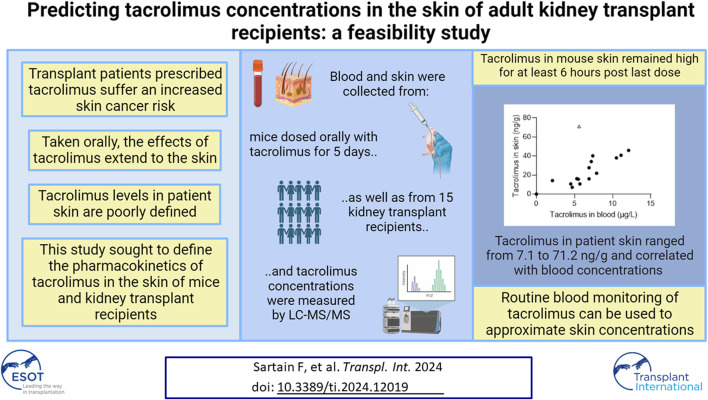 Figure 1
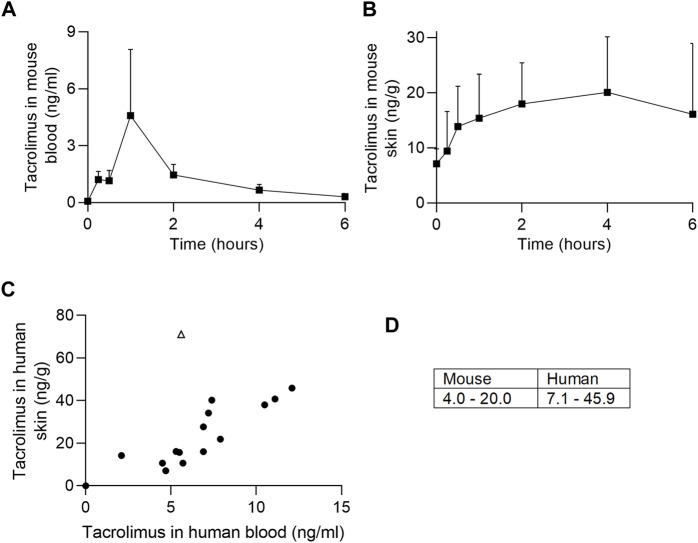 Figure 2
Peer Reviews
No public reviews on file for this paper yet. If you reviewed it on a platform where reviews are public (OpenReview, ICLR, NeurIPS, ICML), you can paste yours below so the community can read it here.
Videos
No videos yet. Explain this paper in a talk, walkthrough, or lecture? Add one.
Taxonomy
TopicsPolyomavirus and related diseases · Nonmelanoma Skin Cancer Studies · Herpesvirus Infections and Treatments