Orbital septum attachment site on the levator aponeurosis sling for mild congenital blepharoptosis
Jianwei Yang, Lihua Song, Yan Tan, Lulu Zhang, Juan Wang, Limin Liu

TL;DR
A new surgical technique called OSASLA sling is shown to effectively correct mild congenital drooping eyelids with minimal invasiveness.
Contribution
The study introduces the OSASLA sling as a novel, less invasive surgical method for mild congenital blepharoptosis.
Findings
Postoperative MRD1 increased significantly from 2.1 mm to 3.7 mm on average.
The distance from the superior tarsal border to OSASLA correlated strongly with eyelid elevation (r = 0.7328).
Eyelid margin positions remained stable during 6–18 months of follow-up.
Abstract
This study aimed to investigate the value of the orbital septum attachment site on the levator aponeurosis (OSASLA) sling in correcting mild congenital blepharoptosis. A total of 60 patients (92 eyes) with mild congenital blepharoptosis (levator function ≥ 8 mm) were treated in our hospital from January to October 2021, and relevant data of these patients were collected. All patients underwent OSASLA sling for ptosis correction. The distances from the superior tarsal border to the OSASLA were measured. The primary outcome was the number of postoperative changes in the marginal reflex distance 1 (MRD1). Pearson’s correlation coefficient between the distance from the superior tarsal border to the OSASLA and the height of the upper eyelid elevated was analyzed. Fifty-eight patients (89 eyes) successfully underwent OSASLA sling surgery. The preoperative MRD1 was 1.4–3.6 mm (mean 2.1 ± 0.5…
Genes, proteins, chemicals, diseases, species, mutations and cell lines named across the full text — each resolved to its canonical identifier and authoritative record.
Click any figure to enlarge with its caption.
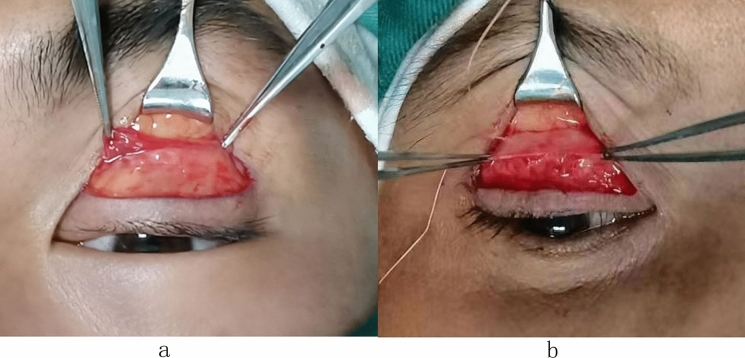 Figure 1
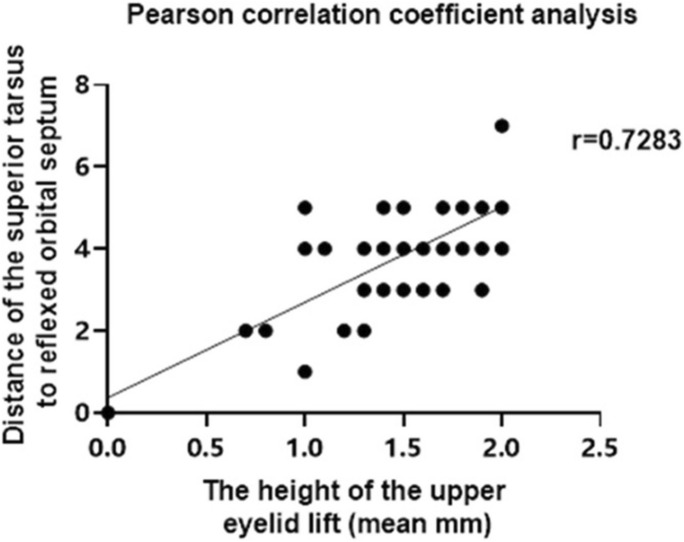 Figure 2
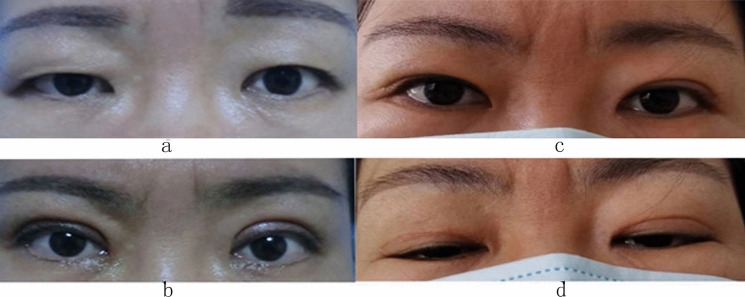 Figure 3
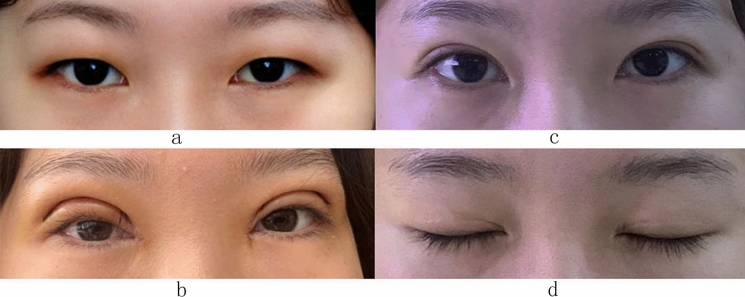 Figure 4
Peer Reviews
No public reviews on file for this paper yet. If you reviewed it on a platform where reviews are public (OpenReview, ICLR, NeurIPS, ICML), you can paste yours below so the community can read it here.
Videos
No videos yet. Explain this paper in a talk, walkthrough, or lecture? Add one.
Taxonomy
TopicsFacial Rejuvenation and Surgery Techniques · Facial Nerve Paralysis Treatment and Research · Botulinum Toxin and Related Neurological Disorders