Non-tip and rotatable sphincterotome for biliary cannulation in patients with Roux-en-Y gastrectomy
Haruo Miwa, Kazuya Sugimori, Kazuki Endo, Ritsuko Oishi, Hiromi Tsuchiya, Takashi Kaneko, Shin Maeda

Abstract
Genes, proteins, chemicals, diseases, species, mutations and cell lines named across the full text — each resolved to its canonical identifier and authoritative record.
Click any figure to enlarge with its caption.
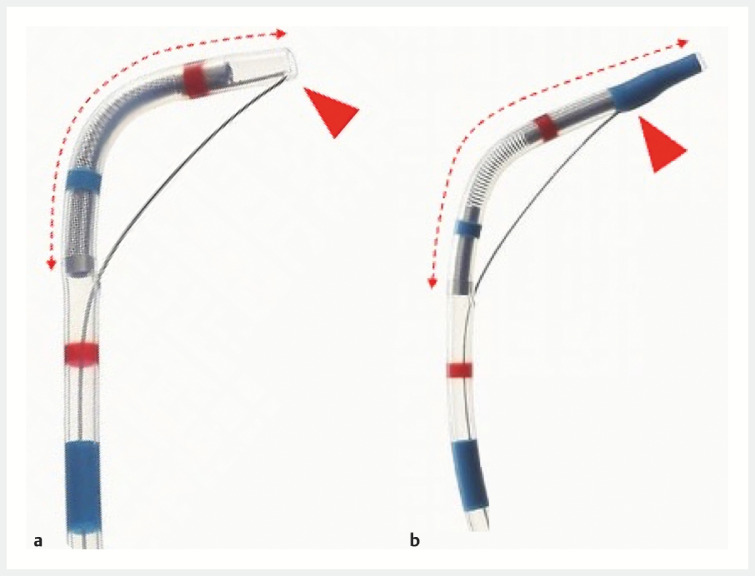 Fig. 1
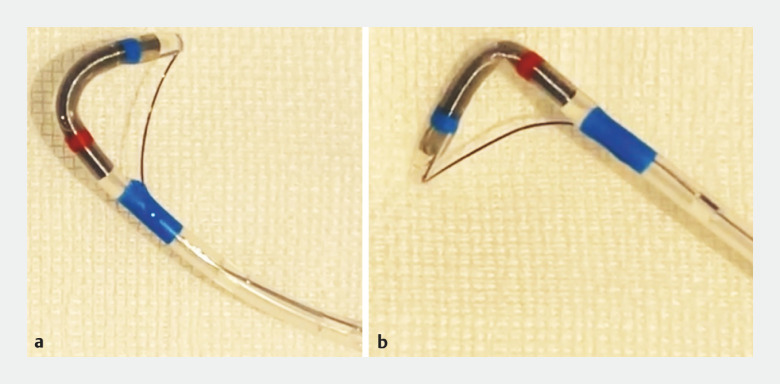 Fig. 2
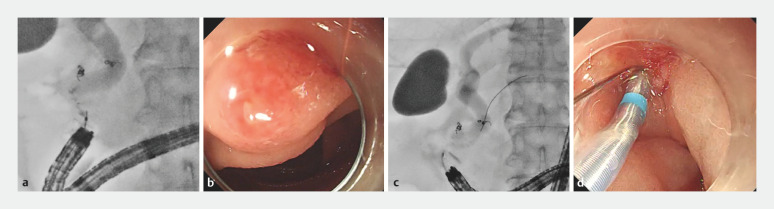 Fig. 3
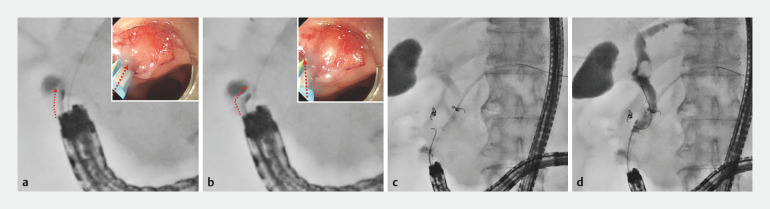 Fig. 4
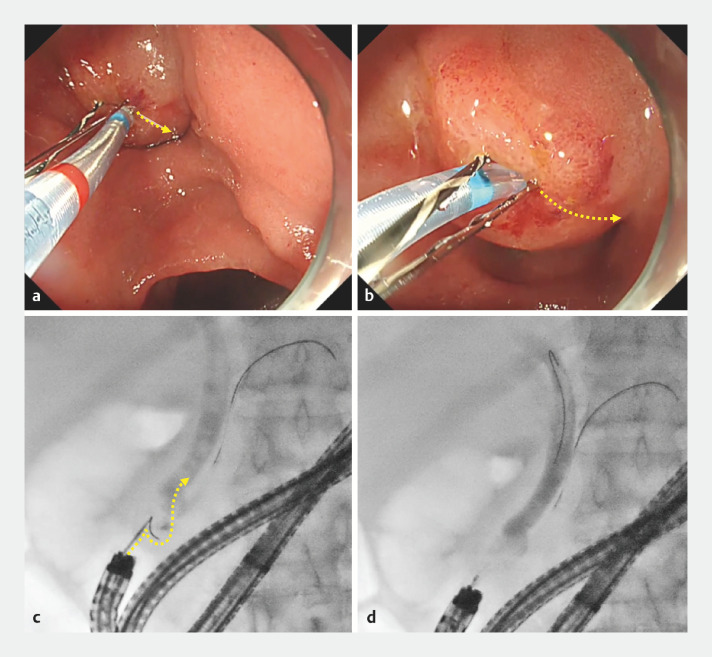 Fig. 5
Peer Reviews
No public reviews on file for this paper yet. If you reviewed it on a platform where reviews are public (OpenReview, ICLR, NeurIPS, ICML), you can paste yours below so the community can read it here.
Videos
No videos yet. Explain this paper in a talk, walkthrough, or lecture? Add one.
Taxonomy
TopicsGallbladder and Bile Duct Disorders · Esophageal and GI Pathology · Pediatric Hepatobiliary Diseases and Treatments
Balloon enteroscopy-assisted endoscopic retrograde cholangiopancreatography (BE-ERCP) has become widely used for patients with Roux-en-Y gastrectomy; however, selective biliary cannulation is still challenging 1 2 . A non-tip or rotatable sphincterotome has been reported to be beneficial in difficult cases 3 4 5 . A novel sphincterotome, Seeking Tome Zero (MTW Endoskopie Manufaktur, Wesel, Germany) ( Fig. 1 , Fig. 2 ), combines these features. Herein, we describe two successful cases with Roux-en-Y gastrectomy ( Video 1 ).
Seeking Tome Zero (MTW Endoskopie Manufaktur, Wesel, Germany) has no tip and a short angled part ( a ) compared with a normal endoscopic retrograde cholangiopancreatography catheter ( b ). Source: Abis Inc, Hyogo, Japan.
Seeking Tome Zero is easily rotated from one side ( a ) to the opposite side ( b ).
A non-tip sphincterotome facilitated changing the angle along a short distance and its rotatability allowed adjustment to the direction of the bile duct.Video 1
Case 1. An 87-year-old woman who had undergone Roux-en-Y gastrectomy was admitted to our hospital because of symptomatic choledocholithiasis. We attempted BE-ERCP using short-type single-balloon enteroscopy (SIF-H290S; Olympus Medical Systems, Tokyo, Japan). As biliary cannulation using a standard ERCP catheter was difficult due to a long and bent narrow distal segment, the catheter was substituted with Seeking Tome Zero ( Fig. 3 ). Following guidewire insertion into the pancreatic duct, a double guidewire technique was adopted. The sphincterotome was bendable at a short distance from the papilla, and a guidewire was successfully advanced into the bile duct ( Fig. 4 ).
Case 1. a Cholangiography showed a long and bent narrow distal segment. b Biliary cannulation was started close to the papilla. c,d A guidewire was inserted into the main pancreatic duct.
Case 1. a,b Seeking Tome Zero (MTW Endoskopie Manufaktur, Wesel, Germany) was bendable at a short distance from the papilla. c,d Biliary cannulation was achieved by gentle guidewire manipulation.
Case 2. A 64-year-old man who had undergone Roux-en-Y gastrectomy was admitted to our hospital because of asymptomatic choledocholithiasis. Despite the guidewire being advanced into the main pancreatic duct utilizing Seeking Tome Zero in BE-ERCP, the bile duct was oriented in the opposite direction. By rotating the handle, the sphincterotome was smoothly reversed in the direction of the bile duct. Following slight upward manipulation, the bile duct was aligned with the direction of the sphincterotome. Finally, biliary cannulation was achieved with gentle guidewire manipulation ( Fig. 5 ).
Case 2. The double-guidewire technique was performed with Seeking Tome Zero (MTW Endoskopie Manufaktur, Wesel, Germany). a The bile duct was oriented in the opposite direction to the sphincterotome. b Seeking Tome Zero was smoothly rotated in the direction of the bile duct. c Cholangiography showed a long and tortuous narrow distal segment. d Biliary cannulation was achieved.
To the best of our knowledge, this is the first report of biliary cannulation using Seeking Tome Zero for patients with altered anatomy. A non-tip sphincterotome facilitated changing the angle along a short distance and its smooth rotatability allowed adjustment to the axis of the bile duct.
Endoscopy_UCTN_Code_TTT_1AR_2AB
The reference list from the paper itself. Each links out to its DOI / PubMed record.
- 1Testoni PA Mariani A Aabakken L Papillary cannulation and sphincterotomy techniques at ERCP: European Society of Gastrointestinal Endoscopy (ESGE) Clinical Guideline Endoscopy 20164865768310.1055/s-0042-10864127299638 · doi ↗ · pubmed ↗
- 2Tanisaka Y Ryozawa S Mizuide M Biliary cannulation in patients with Roux-en-Y gastrectomy: an analysis of the factors associated with successful cannulation Intern Med 2020591687169332296000 10.2169/internalmedicine.4245-19PMC 7434537 · doi ↗ · pubmed ↗
- 3Suguro M Yamamoto K Itoi T Novel technique using a non-tip and short-wire papillotome for biliary cannulation of intradiverticular papilla in patients with Roux-en-Y anastomosis Dig Endosc 20183027027210.1111/den.1298529152792 · doi ↗ · pubmed ↗
- 4Okamoto T Sasaki T Takeda T Rotatable sphincterotome as a rescue device for endoscopic retrograde cholangiopancreatography cannulation: a single-center experience Clin Endosc 202310.5946/ce.2022.248PMC 1083429437157962 · doi ↗ · pubmed ↗
- 5Maluf-Filho F Kumar A Ferreria de Souza T Rotatable sphincterotome facilitates bile duct cannulation in patients with altered ampullary anatomy Gastroenterol Hepatol (N Y)20084596222798737 PMC 3394477 · pubmed ↗